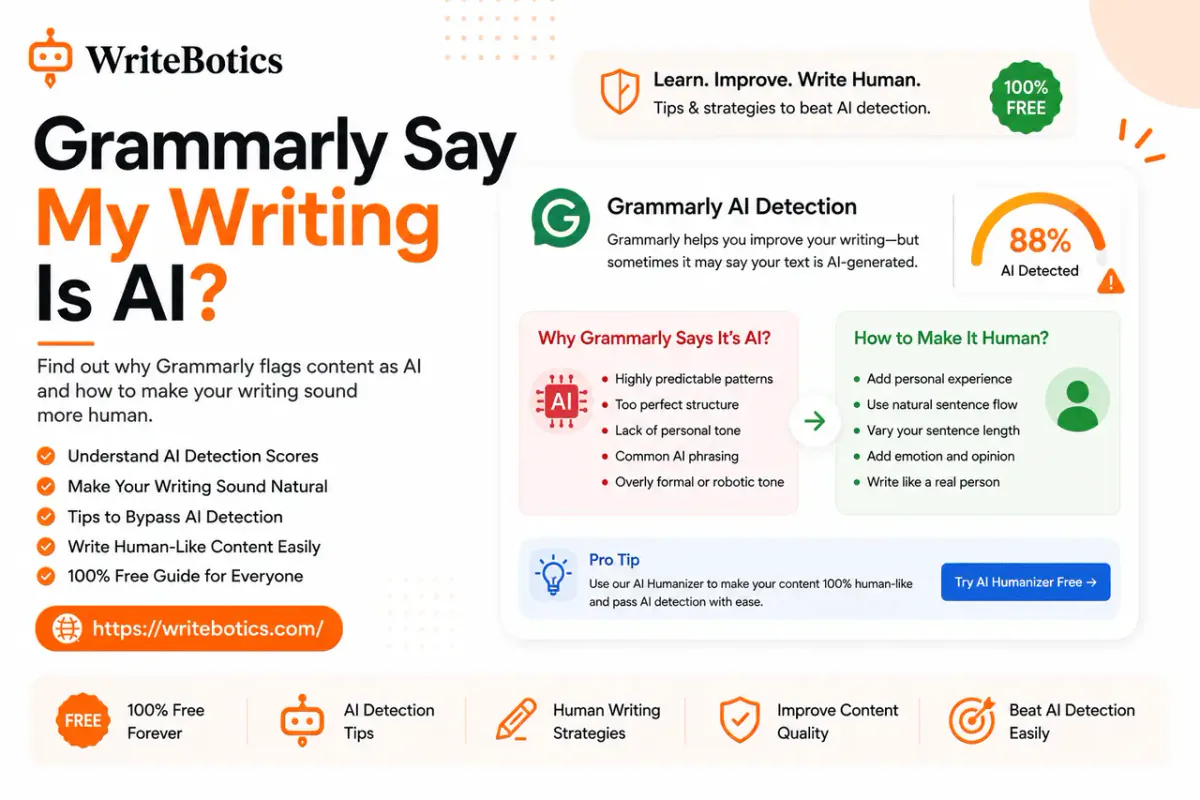
If you are wondering, why does Grammarly say my writing is AI, even though you wrote it yourself, the short answer is that an AI detector evaluates patterns in finished text. It does not have direct evidence of who wrote the document.
Human writing can sometimes resemble text associated with AI-generated language. Formal wording, consistent structure, careful editing, and predictable phrasing can all contribute to that resemblance.
A detector result should therefore be treated as a review signal, not automatic proof of authorship.
Quick answer: why does Grammarly say my writing is AI?
A Grammarly AI result does not automatically mean that you used AI.
The result is an estimate of how much submitted text appears AI-generated. Grammarly also notes that AI detection can produce errors, so the result should not be treated as definitive proof of how a document was created.
Human writing can share the same surface characteristics that detection systems examine.
What to do first
- Review the flagged passage in context.
- Compare it with your earlier drafts.
- Keep your notes, sources, and revision history.
- Check the text for genuine grammar, clarity, or citation problems.
- Follow the AI-use rules that apply to your school, workplace, publisher, or client.
A simple example
Imagine you write this sentence yourself:
"The main reason for the delay was a change in the project's approval process."
It is concise, grammatical, and predictable. A detector sees the finished sentence, but it does not see your notebook, keyboard, research process, or editing history.
That is why a human-written sentence can receive an AI-related result.
Why human writing gets flagged
Several characteristics of normal human writing can resemble patterns associated with generated text.
1. Your writing is highly structured
Clear writing often follows a recognizable sequence: introduce a point, explain it, provide evidence, and move to the next idea.
That is good writing practice. It can also make prose look predictable.
For example:
Less structured:
"There were a few issues with the project. We noticed them later than we should have. The schedule changed, and that caused some other problems too."
More structured:
"The project fell behind after a change in requirements affected both the schedule and the testing process."
Both versions could be written entirely by a person. The second is simply more concise and formal.
2. Formal writing can resemble generated writing
Academic papers, reports, technical documentation, business emails, and explanatory content often use standard language.
They tend to avoid slang, maintain a consistent tone, and use complete sentences. Those are normal characteristics of professional writing, not evidence of AI use.
A writer who spends significant time proofreading may produce especially consistent prose.
3. Heavy editing can change the surface of a draft
Suppose you write a rough paragraph and make several editing passes.
You remove repetition, correct grammar, shorten sentences, replace informal wording, and make the paragraphs consistent.
The final version may look very different from the first draft.
That does not change who originally wrote the ideas. It simply means the text has been edited.
4. Some subjects naturally have a standard voice
Certain subjects have conventions that many writers follow.
A medical explanation may use precise terminology. A software tutorial may follow a predictable sequence. A legal document may use established wording. A research paper may use formal transitions.
When writers follow the normal language of a subject, their sentences can naturally resemble one another.
5. Short passages provide less context
A single paragraph contains less information than a full document.
That can make any automated classification harder to interpret. If a short passage receives an unexpected result, consider the result alongside the full document and your writing history rather than viewing it in isolation.
Common false-positive patterns to understand
There is no single sentence pattern that proves a detector will flag human writing. However, several broad characteristics may make writing appear more similar to generated text.
| Writing characteristic | Why it may resemble AI text | What it actually means |
|---|---|---|
| Very consistent sentence structure | The prose may look predictable | You may have edited carefully |
| Formal vocabulary | Common in generated and professional writing | The writer may prefer formal language |
| Clear paragraph organization | Generated text often follows orderly structures | Good organization is not evidence of AI use |
| Repeated transitions | Similar transitions occur across many texts | The writer may follow a standard format |
| Highly polished grammar | Clean language can resemble edited generated text | The draft may have been proofread |
| Short sample | There is less context to assess | The result may be harder to interpret |
The important point is that none of these characteristics proves authorship.
A detector evaluates the text it receives. It cannot reconstruct the complete history of how that text was created.
What Grammarly's result can and cannot prove
An AI-detection score is easier to understand when you separate what it can indicate from what it cannot establish.
What the result can tell you
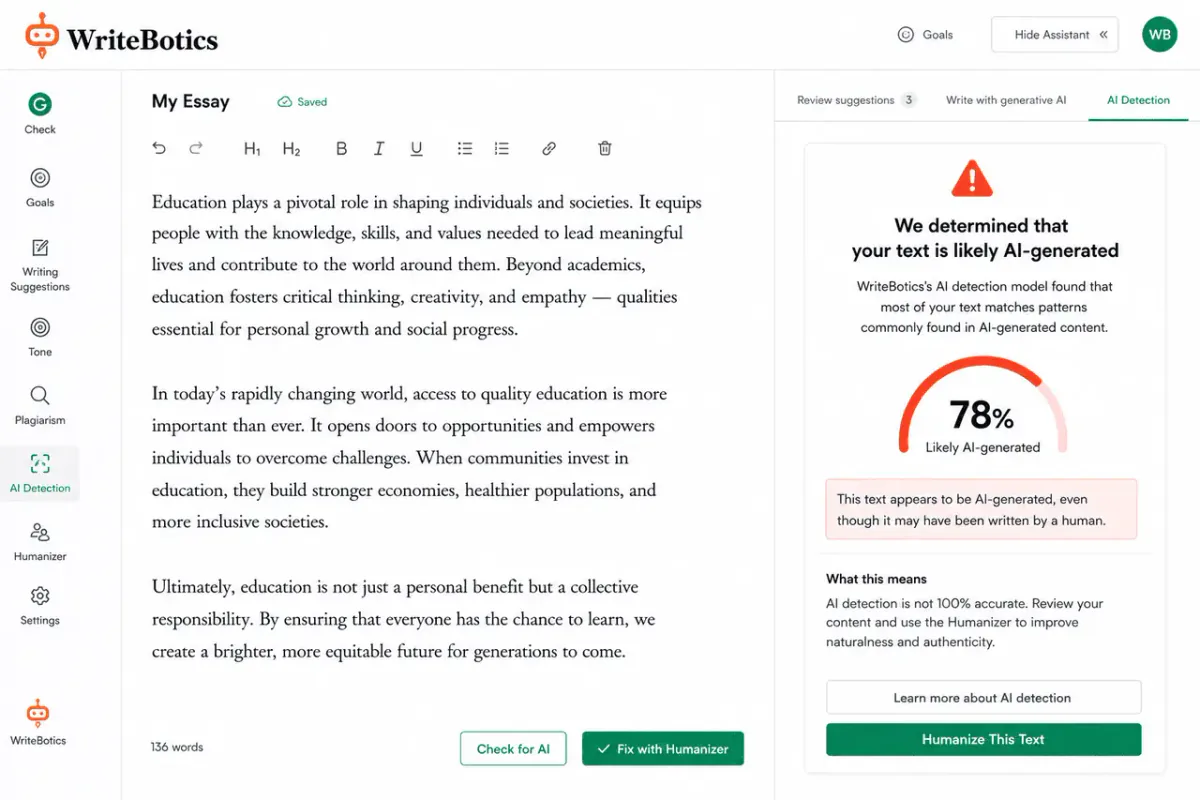
A detector can provide an estimate about whether submitted text resembles language associated with AI-generated writing.
That can be useful as a reason to review a passage more closely.
For example, if one paragraph receives an unexpected result, ask:
- Does the wording accurately express what I mean?
- Is the paragraph unusually generic?
- Did I revise this section heavily?
- Do I have an earlier draft?
- Can I show how the passage developed?
Those questions provide context that a percentage alone cannot provide.
What the result cannot prove
A Grammarly score cannot independently establish that a particular person used AI.
The result is based on the finished text rather than direct evidence of the author's writing process. Different detection systems can also produce different assessments of the same passage.
That is why an AI detector should not be confused with a plagiarism checker.
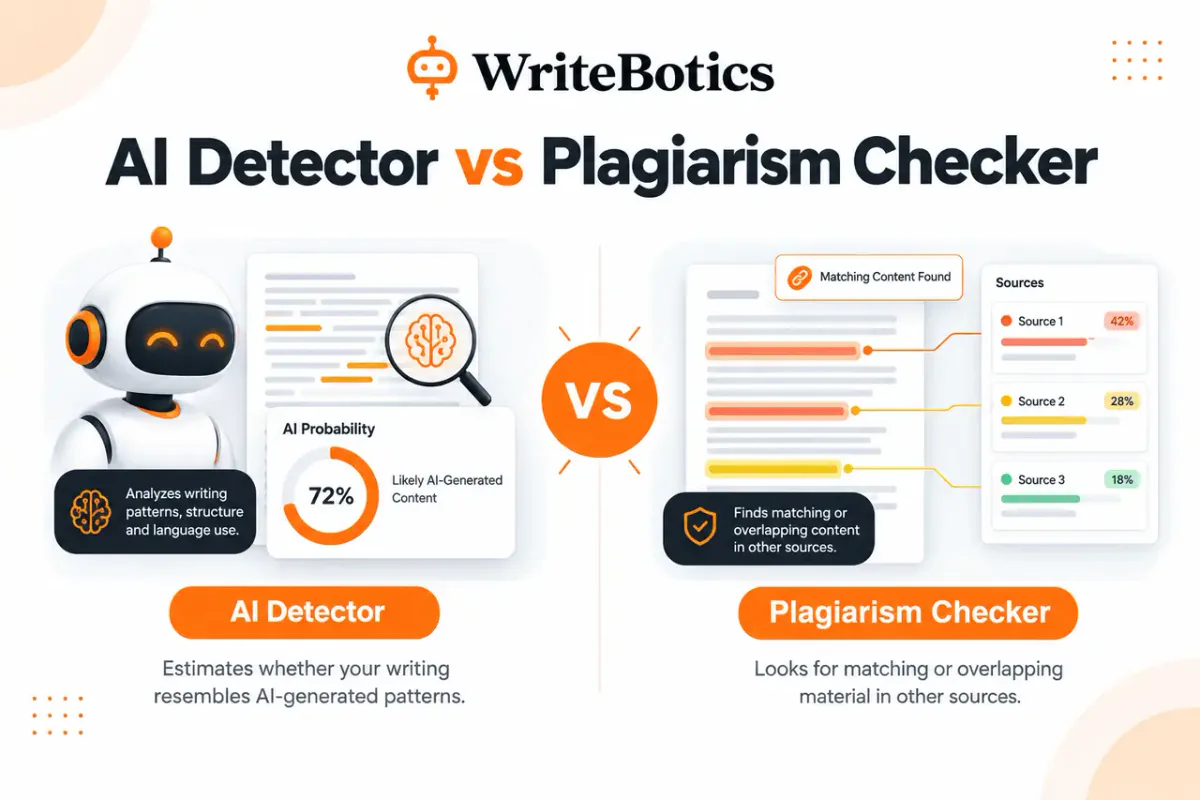
An AI detector estimates whether text resembles AI-generated writing. A plagiarism checker looks for matching or similar material in other sources.
For a clearer explanation of the difference, read AI detector vs Plagiarism checker.
Preserve drafts and version history
If authorship matters, documentation can provide valuable context.
Keep:
- Early drafts
- Outlines
- Research notes
- Source lists
- Saved revisions
- Comments and feedback
- Document version history
- Relevant timestamps
Suppose your final essay receives an unexpected AI-related result. You may be able to show an outline, a rough draft, later revisions, and the final version.
That evidence demonstrates how the document developed over time in a way that a detector score cannot.
If you use Google Docs or Microsoft Word, keep relevant version history when appropriate. For academic or professional work, also follow the documentation rules of the organization involved.
Keep the original beside the edited version
Before making substantial changes, preserve the original draft.
Then compare:
Original → edited version → final version
This makes it easier to understand what changed and why.
It can also help when someone questions a particular passage after several rounds of editing.
A safe revision checklist
If Grammarly flags writing that you believe is your own, do not rewrite the document simply to chase a lower detector result.
Instead, review the work for accuracy, clarity, authorship evidence, and compliance with the rules that apply to you.
- Read the flagged passage in its full context.
- Check whether the wording accurately reflects your intended meaning.
- Compare the passage with earlier drafts.
- Review your notes and source material.
- Check whether you used any generative writing features during revision.
- Correct factual, grammar, or citation problems normally.
- Preserve the original version before major changes.
- Follow your school's, workplace's, publisher's, or client's AI-use rules.
- Do not treat a detector percentage as proof of authorship.
- If authorship is disputed, provide your writing history and supporting material.
If you want another review of writing patterns, visit the WriteBotics AI Content Detector.
For grammar, punctuation, spelling, and sentence clarity, use the WriteBotics Grammar Checker.
What to do if a human-written document is flagged
Start with the basic question: Is the work yours, and can you show how you created it?
If the answer is yes, gather your evidence.
For a student, that might include an outline, notes, source research, saved drafts, and document history.
For a professional writer, it might include research notes, editorial comments, client revisions, and previous versions.
For a website owner, it may include the original draft, content brief, research documents, and editorial history.
Do not assume that changing a few words will resolve the issue. The more useful response is to make sure the work is accurate, properly sourced, and consistent with the rules that apply to you.
FAQs
Why does Grammarly say my writing is AI if I wrote it myself?
Because an AI detector evaluates patterns in the finished writing rather than your complete writing history. Human writing can share characteristics associated with generated text, especially when it is formal, highly structured, or heavily edited.
Can Grammarly prove that I used AI?
No. An AI-detection result is not independent proof of authorship. It is an estimate based on characteristics of the submitted text.
Can good grammar make writing look like AI?
Good grammar does not prove that writing is AI-generated. However, polished and consistent language can share characteristics that an AI detector examines.
Should I change my writing because Grammarly flags it?
Not solely because of the score. First check the passage for accuracy, clarity, citations, and compliance with the rules that apply to your work. If you wrote it yourself, preserve your drafts and revision history.
Can different AI detectors give different results?
Yes. Different detection systems can assess the same passage differently because they use different approaches. A difference between tools does not, by itself, establish who wrote the text.
Conclusion
So, why does Grammarly say my writing is AI when you know you wrote it yourself? Because the detector evaluates whether your finished text resembles patterns associated with AI-generated writing. It does not independently verify your authorship.
Formal language, consistent structure, polished editing, subject-specific wording, and short passages can all affect how writing is classified. None of those characteristics proves that a human writer used AI.
If the result matters, preserve your drafts, notes, sources, and version history. Review the flagged passage for genuine writing problems, but do not treat an automated score as the final word on authorship.
For another writing-pattern review, try the WriteBotics AI Content Detector. If your concern is grammar and clarity, use the WriteBotics Grammar Checker.