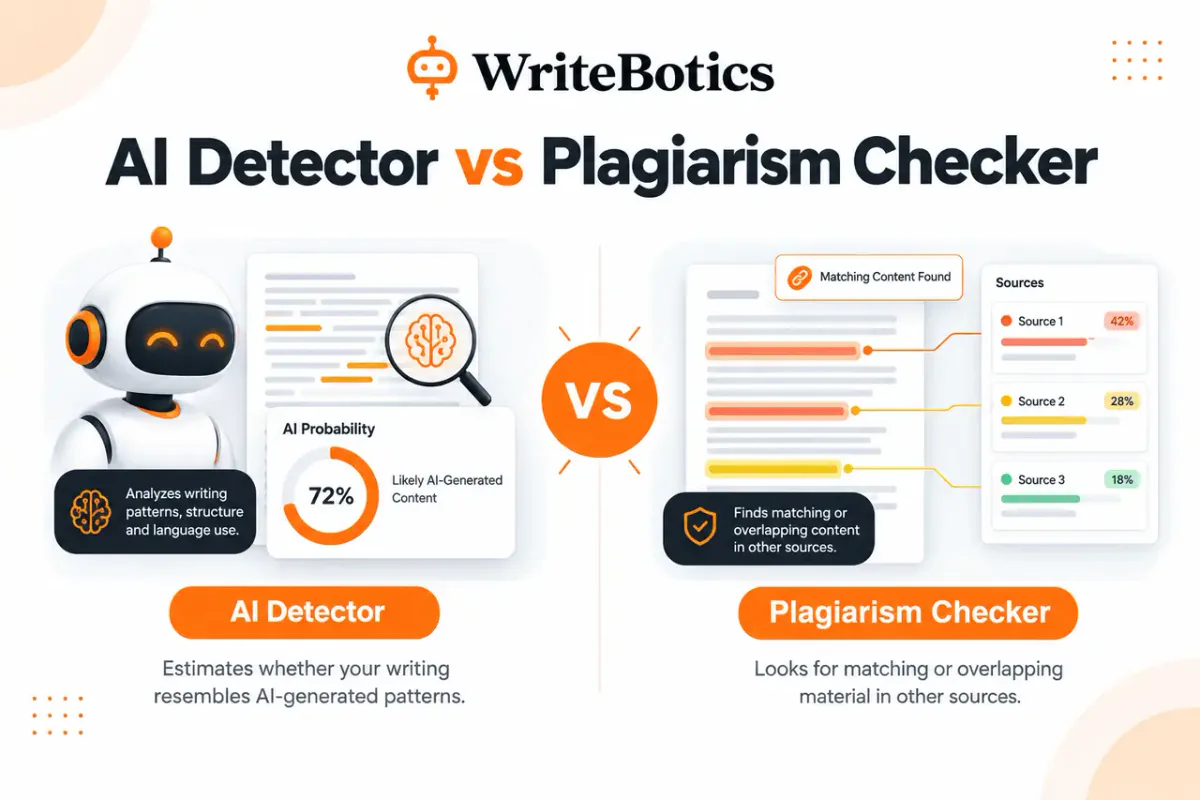
If you are comparing an AI detector vs plagiarism checker, the key difference is simple: an AI detector estimates whether writing shows patterns associated with AI-generated text, while a plagiarism checker looks for matching or closely similar wording that already exists elsewhere.
That means a draft can be flagged by an [AI Detector] (https://writebotics.com/tools/ai-content-detector) and still have no meaningful text matches. It can also pass an AI detector while containing copied material. The two checks answer different questions, so one cannot replace the other.
AI Detector vs Plagiarism Checker: Quick Comparison
| What you want to know | AI detector | Plagiarism checker |
|---|---|---|
| Main question | Does the writing show AI-typical patterns? | Does the wording match existing material? |
| What it analyzes | Patterns in the submitted text | Matching or similar passages |
| Typical result | An AI-likelihood or pattern estimate | Highlighted matches or similarity findings |
| What it can help you review | Writing style and possible AI-like patterns | Originality, duplication, quotation, and attribution issues |
| What it cannot prove | Who wrote the text | Whether copying was intentional |
| Main blind spot | Human writing can sometimes look AI-like | Original AI-written text may have no source match |
What Does an AI Detector Actually Check?
An AI detector looks at characteristics of the text itself. Depending on the system, that can include word predictability, sentence patterns, repetition, structure, and variation in how ideas are expressed.
The detector does not watch someone write. It does not see the writer's keyboard, research notes, document history, or intentions. It evaluates the finished text and estimates whether parts of it resemble patterns commonly associated with machine-generated writing.
For example, consider this short passage:
A project deadline can change when the approval process takes longer than expected. Teams may need to revise schedules, communicate new milestones, and adjust responsibilities.
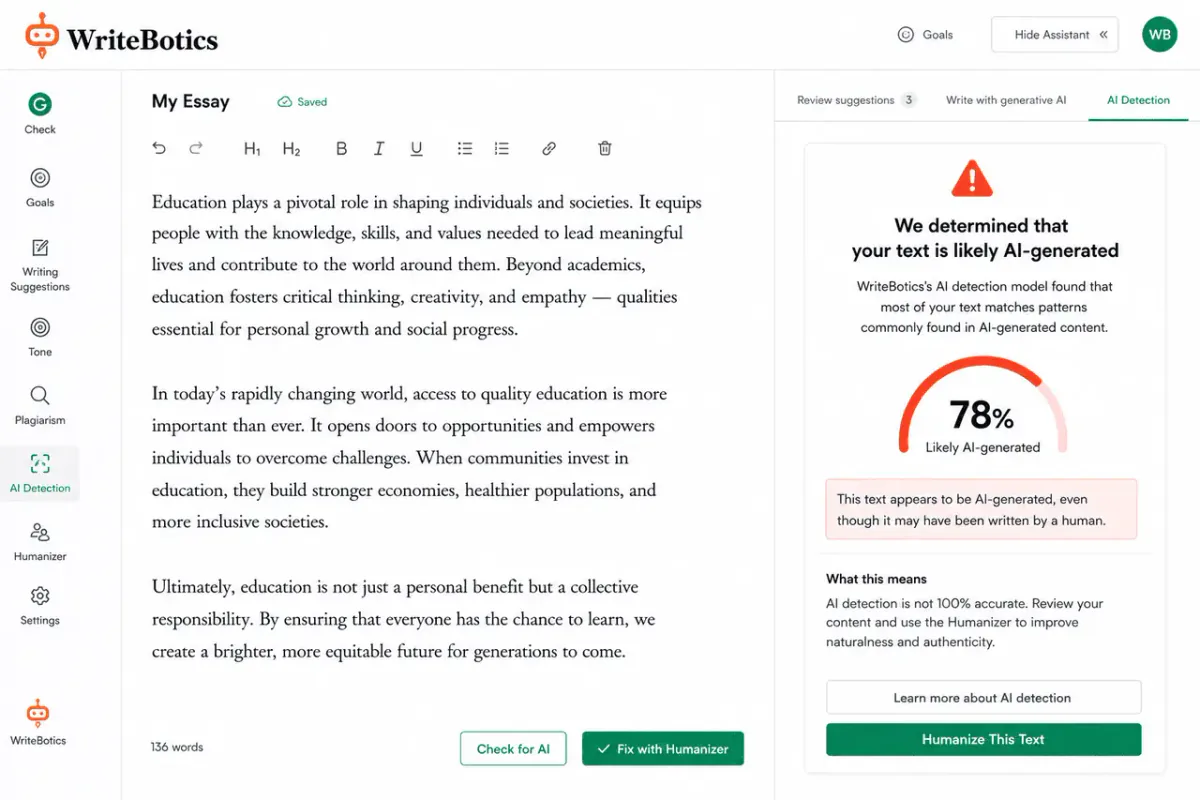
A detector may still assign a result because the passage has measurable characteristics. That is why AI detection should be treated as a review signal rather than proof.
Why AI detection can produce false positives
Human writing is not automatically the opposite of AI-like writing. Formal, concise, highly structured prose can share characteristics a detector examines. Results can also differ between detection systems because their methods and thresholds vary.
If a human-written draft receives an unexpected AI-related result, review the passage in context and preserve useful drafts or version history rather than treating the score as proof.
For more on unexpected AI flags, see the WriteBotics guide on why Grammarly may flag human writing as AI-generated.
What Does a Plagiarism Checker Actually Check?
A plagiarism checker addresses a different problem: whether your wording resembles material that already exists.
Instead of estimating how the writing was produced, it looks for matching or similar phrases. Depending on the checker and its comparison sources, those matches may come from web pages, documents, or other indexed material.
Imagine you write:
The company introduced a new approval process to reduce delays.
If that exact sentence, or a closely similar sentence, already appears in another source, a plagiarism checker may identify it as a possible match. That does not automatically mean plagiarism occurred. Common phrases, properly quoted material, technical terminology, and correctly attributed information can all create legitimate matches.
The result needs human review. A plagiarism checker can help you decide where to rewrite, quote, cite, or investigate a source; it does not determine whether a passage was produced by AI.
Pattern Estimation vs. Text Matching
The easiest way to remember the difference is to think about patterns versus matches.
An AI detector asks:
“Does this text contain characteristics commonly associated with AI-generated writing?”
A plagiarism checker asks:
“Where else does this wording, or wording very similar to it, appear?”
Those questions can produce very different outcomes.
Example 1: AI flag, no plagiarism match
Suppose a writer creates an original 500-word explanation from scratch. The language is formal, the sentences are consistently structured, and the writer uses common transitions.
An AI detector might identify AI-typical patterns. A plagiarism checker could find no meaningful matches.
That does not mean the writer plagiarized anything. It means the two tools are measuring different properties.
Example 2: No AI flag, plagiarism match
Now suppose a writer copies several sentences from a published article and changes nothing.
The copied wording may look completely natural to an AI detector. The detector could return a low AI-related estimate. A plagiarism checker, however, may identify the matching passages.
Again, the results are not contradictory. They answer different questions.
What a “Clean” Result Does Not Mean
A clean result from either tool has limits. A clean AI-detection result does not prove human authorship, and a clean plagiarism result does not prove that the writing is human-generated or that every claim is original.
You still need to check facts, citations, audience fit, quality, and any AI-use rules that apply to the work.
When Should You Use an AI Detector?
An AI detector can be useful when you want another signal about how a finished draft reads.
You might use one when:
- You are reviewing AI-assisted content before publication.
- A draft sounds unusually repetitive or formulaic.
- You want another signal when investigating an unexpected AI-related classification.
- You want to review how an automated system may interpret a draft.
Use the result carefully. If the score surprises you, inspect the actual writing rather than trying to reach a particular percentage.
You can run a draft through the WriteBotics AI Content Detector as one part of that review process.
When Should You Use a Plagiarism Checker?
Use a plagiarism checker when your main concern is originality and source overlap.
It is especially useful when:
- You researched heavily and want to check for accidental phrase reuse.
- You are preparing academic work or publishing from multiple sources.
- You have paraphrased material and want to review source-dependent wording.
- You are editing content that passed through several writers or tools.
Do not automatically treat every match as plagiarism. Open the result, identify the source, and decide whether the wording is common, properly quoted, appropriately cited, or too close to the source.
You can review possible overlaps with the WriteBotics Plagiarism Checker.
The Best Workflow: Use Both, Then Review the Draft Yourself
For many writing tasks, the most useful approach is not choosing between the two tools. It is using them for their separate jobs.
1. Check for source overlap
Start with a plagiarism check. Review meaningful matches and decide whether to rewrite, quote, cite, or remove the wording.
2. Review AI-related patterns
Next, use an AI detector as an additional signal. Read the result in context rather than treating a percentage as a final judgment.
3. Fix real writing problems
If the draft is repetitive, unclear, inaccurate, or poorly structured, improve those problems because they affect readers—not simply because a detector produced a particular score.
4. Verify facts and citations
Check claims, quotations, links, and source attribution. Neither tool replaces fact-checking.
5. Keep evidence when authorship matters
For important academic or professional work, keep drafts, notes, sources, and version history when appropriate.
6. Do a final human review
Read the complete piece as a reader. Check that it is accurate, useful, clear, properly sourced, and compliant with the rules that apply to you.
This is more reliable than asking one checker to answer a question it was never designed to answer.
Which One Should You Use?
The answer depends on the risk you are trying to review.
| Situation | Better first check |
|---|---|
| “Does this draft show AI-like patterns?” | AI detector |
| “Did I accidentally copy wording from a source?” | Plagiarism checker |
| “Is this academic submission original and compliant?” | Both, plus your institution's policy |
| “Is this blog ready to publish?” | Plagiarism check, AI-pattern review if useful, then human editing |
| “Why was my human writing flagged as AI?” | Review the AI result in context and preserve drafts/version history |
FAQs
Is an AI detector the same as a plagiarism checker?
No. An AI detector estimates whether text resembles patterns associated with AI-generated writing. A plagiarism checker looks for matching or closely similar wording in existing material.
Can something be flagged by an AI detector but pass a plagiarism check?
Yes. A piece can be original yet contain writing patterns that an AI detector considers AI-like. A plagiarism checker may find no meaningful source match because the wording is not copied.
Can something pass an AI detector but still be plagiarized?
Yes. A copied passage can read like ordinary human writing. An AI detector may not flag it, while a plagiarism checker can identify the source overlap.
Can an AI detector prove who wrote a document?
No. AI detection is an estimate based on characteristics of the submitted text. It does not independently verify authorship or provide proof that a particular person or AI system wrote the document.
Why do AI detectors sometimes disagree?
Different detection systems can use different methods and thresholds. The same passage can therefore receive different results. A disagreement does not establish which system is “telling the truth” about authorship.
Should I change my writing just to get a lower AI score?
No. Do not optimize for a particular detector score. Instead, improve clarity, accuracy, specificity, structure, and your genuine voice. If AI use is restricted in your context, follow those rules rather than trying to bypass a detector.
Is a plagiarism match automatically proof of plagiarism?
No. A match is a reason to investigate. It may be a quotation, a cited passage, a common phrase, or wording that needs revision. Context matters.
Check Your Draft With the Right Tool
AI detection and plagiarism checking solve different problems. An AI detector provides an estimate about AI-associated writing patterns; a plagiarism checker helps identify possible textual overlap. Neither one is a substitute for human judgment, source review, or the rules that apply to your work.
If you want to review a draft for both kinds of risk, start with the WriteBotics Plagiarism Checker, then use the WriteBotics AI Content Detector as an additional pattern-based signal. If you are dealing with an unexpected AI flag on writing you believe is your own, the guide on why Grammarly may flag your writing as AI-generated can help you understand what to review next.
The goal is not to “pass” a detector. The goal is accurate, properly sourced, useful writing that follows the rules that apply to it.