If you've ever poured effort into writing something yourself, only to have Grammarly label it as "AI-generated," you're not alone. This is one of the most common frustrations writers report with AI Detection Tools — and it says more about how these tools work than it does about your writing. Here's what's actually going on, and what you can do about it.
What Does Grammarly's AI Detection Actually Do?
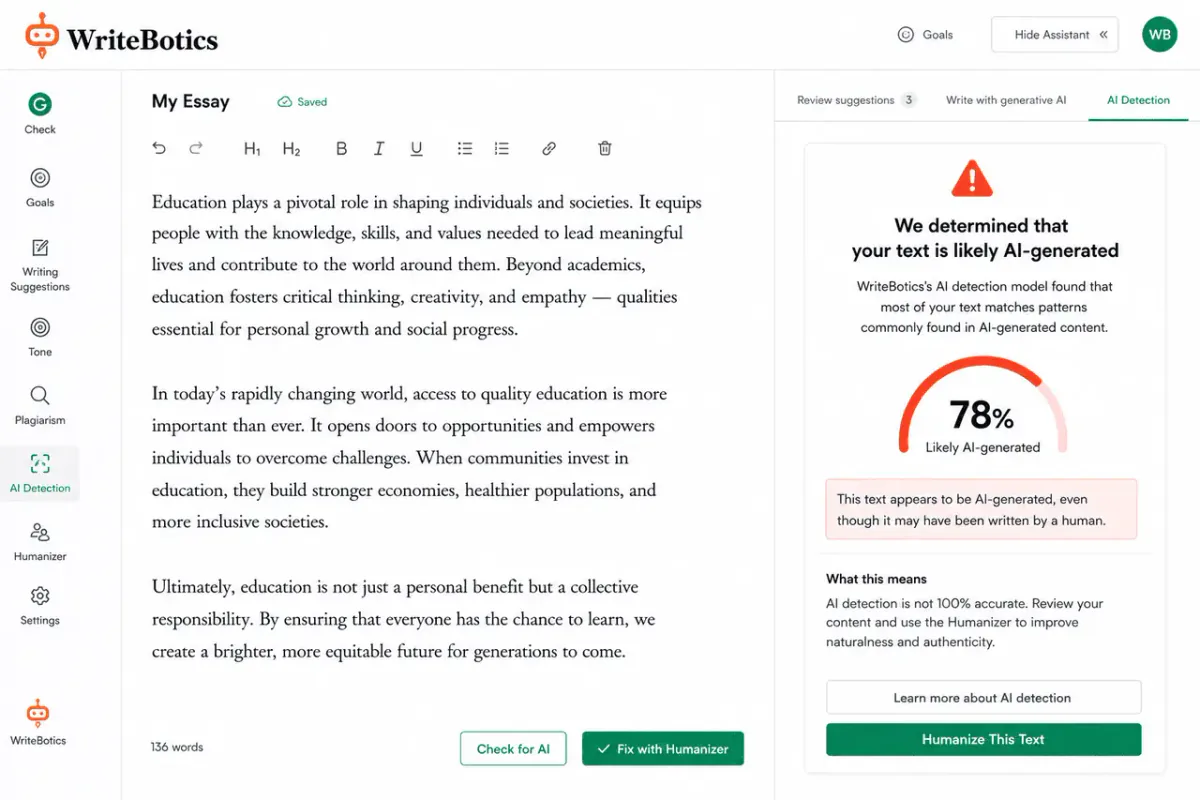
Grammarly's AI detection feature scans your text and estimates the probability that it was written by a generative AI tool like ChatGPT, Claude, or similar. It does this by analyzing patterns in your writing — things like sentence structure, word predictability, consistency of tone, and how "expected" each word choice feels given what came before it.
The tool doesn't know who wrote something. It can only measure whether the writing looks like what AI tends to produce. And that's where false positives come in.
Why Is My Human Writing Being Flagged?
1. You Write in a Clear, Structured Way
AI models are trained to produce clear, well-organized, grammatically clean text. So are good writers. If you naturally write in a logical, structured style — with strong topic sentences, smooth transitions, and consistent formatting — your writing may look statistically similar to AI output.
This is especially common with:
- Technical writers
- Academics and researchers
- Journalists and content professionals
- Anyone who has spent years practicing clear, precise writing
The better your writing, the more likely it is to resemble polished AI output — at least by the metrics these tools use.
2. You Used Writing Assistance Without Fully Rewriting
Even if you used AI only lightly — to brainstorm, fix a sentence, or rephrase a paragraph — those sections may carry AI-like patterns into your final draft. Grammarly doesn't always distinguish between a fully AI-generated piece and one that was 90% human-written with minor AI assistance.
3. Your Topic Has a "Standard" Voice
Some subject areas have well-established conventions: legal writing, medical explanations, how-to guides, business communications. AI models have absorbed these conventions thoroughly. If you're writing in one of these genres and following the norms correctly, your text may naturally match AI patterns in that domain.
4. Formal or Academic Register Looks "AI-Like"
Formal writing tends to avoid slang, favor complete sentences, use transitions deliberately, and maintain consistent tone — all things AI does well. If you're writing in a formal register, especially without the hedging, digressions, or idiosyncratic phrasing of casual prose, AI detectors may flag it.
5. The Detection Technology Has Inherent Limitations
It's important to understand that AI detection is a probabilistic tool, not a definitive test. No AI detector — including Grammarly's — can determine with certainty who wrote a piece of text. Studies have repeatedly shown that these tools produce false positives at significant rates, particularly for non-native English speakers, writers from certain academic fields, and people who write in clear, formal styles.
Grammarly itself acknowledges that its AI detection feature is not foolproof and should not be used as sole proof of AI authorship.
Frequently Asked Questions
Does Grammarly flag all formal writing as AI?
Not all formal writing, but formal writing is more susceptible to flagging because it shares stylistic features with AI output — consistency, clarity, correct grammar, and neutral tone. The less your writing deviates from "correct" standard English, the harder it is for detectors to distinguish it from AI.
Can non-native English speakers get flagged more often?
Yes. Research has shown that non-native English speakers are disproportionately flagged by AI detectors. One reason is that non-native writers often prioritize grammatical correctness and formal phrasing over idiomatic, colloquial expression — which can make their writing look more "AI-like" to detectors trained on native-speaker corpora.
Does Grammarly use the same AI detection as Turnitin or GPTZero?
No. Each platform uses its own model. Results from Grammarly, Turnitin, GPTZero, and other tools can differ significantly for the same piece of text. This inconsistency is itself a sign of how unreliable these tools are when used in isolation.
Will using a grammar checker make my writing look more AI-generated?
Potentially, yes. If you heavily correct your writing with any Grammar Tool (including Grammarly itself), you may remove the natural "errors," hesitations, and idiomatic quirks that make writing seem human. A heavily polished draft may paradoxically score higher for AI probability.
Can I "humanize" my writing to avoid false positives?
There are some strategies that can help (more on that below), but it's worth noting that trying to game AI detectors is an arms race with diminishing returns. The better long-term approach is documentation — keeping drafts, notes, and timestamps that demonstrate your writing process.
What Can You Do If You're Falsely Flagged?
Keep Your Drafts and Notes
The strongest evidence that you wrote something yourself is a paper trail. Save early drafts, outlines, research notes, and revision history. If you use Google Docs or Word, version history is automatically preserved.
Add Your Own Voice Deliberately
If you're concerned about detection, try incorporating elements that AI rarely produces naturally:
- Personal anecdotes or specific examples from your own experience
- Opinions or takes that go against the consensus
- Casual asides, parenthetical thoughts, or deliberate repetition for emphasis
- Regional expressions, industry jargon, or humor specific to your context
These "human markers" aren't just detection countermeasures — they also tend to make writing more engaging.
Vary Your Sentence Rhythm
AI-generated text often has consistent sentence length and structure. Humans naturally vary: some sentences run long with embedded clauses, some are very short. Mixing these up makes your writing feel more natural and reduces AI detection flags.
Push Back When Flagged Unfairly
If Grammarly (or any tool) flags your writing in a context where it matters — a workplace, school, or publication — you have every right to explain that AI detectors are probabilistic and prone to false positives. Ask for the decision to be made on the quality and originality of the ideas, not on an automated score.
The Bottom Line
Being flagged by Grammarly's AI detection does not mean you used AI. It means your writing shares surface-level patterns with AI output — something that's increasingly common as AI models have been trained on enormous amounts of high-quality human writing. The line between "writes like a professional" and "writes like AI" is genuinely blurry.
These tools are useful for catching cases where AI was clearly used without disclosure, but they are not reliable enough to be used as evidence against a specific writer. If you know you wrote something yourself, trust that — and keep the receipts.