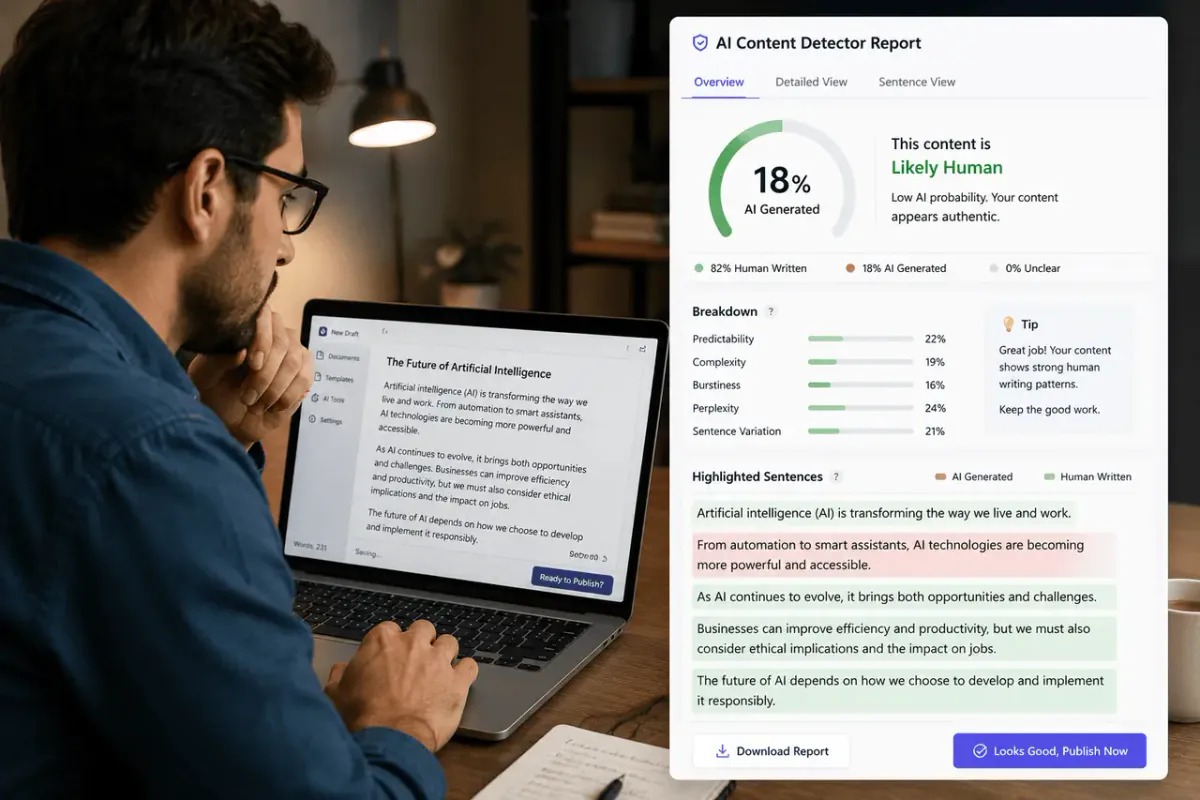
An AI content detector doesn't tell you who wrote something. It tells you how much a piece of text resembles the statistical patterns common in AI-generated writing — repetition, sentence rhythm, certain word choices — and gives you a probability, not a verdict. That distinction matters more than most people treat it, because a detector result is often read as a fact when it's really an estimate. Here's what these tools actually measure, why they get things wrong in both directions, and how a writer can use one as one part of a review process rather than the final word.
What an AI content detector is actually measuring
- Sentence-length uniformity — AI-generated text often has less variation in sentence length than natural human writing.
- Predictability of word choice — some models flag text where each word is unusually likely to follow the last, based on common language patterns.
- Repetition of phrasing or structure — recurring sentence openers or transition phrases across a passage.
- Lack of small imperfections — natural writing tends to have minor inconsistencies that heavily edited or AI-generated text sometimes lacks.
None of these are proof of authorship. They're statistical fingerprints, and plenty of human writing — especially formal, technical, or heavily edited prose — can share those same fingerprints without any AI involvement at all.
Why detectors get it wrong in both directions
False positives happen often with careful, formal writers. Someone who writes in short, consistent sentences, avoids filler words, and edits heavily for clarity can produce text that reads as "AI-like" to a detector, even if every word came from them. Non-native English speakers and writers who learned English through formal instruction are disproportionately flagged for the same reason — their sentence patterns can look more uniform than casual native writing.
False negatives happen just as often in the other direction. A lightly edited AI draft — reworded here, a sentence reordered there — can slip past a detector that's tuned to catch unedited output, because a human pass is often enough to break the statistical pattern the detector is looking for.
Both failure modes matter for the same reason: a detector score alone isn't strong enough evidence to act on by itself, whether the goal is confirming originality or catching misuse.
What this means if you're an editor or teacher
If you're using a detector to evaluate someone else's writing, treat the score as a prompt to look closer, not as a conclusion. A high AI-likelihood score is a reason to review the piece for other signs — does the writer's usual voice match this piece, do the specific claims check out, is there a version history or draft process to look at — not a reason to accuse someone outright. Detector scores have real consequences when they're wrong, and a single number rarely holds up as the sole basis for a decision.
What this means if you're a writer checking your own work
For writers, a detector is more useful as a self-check before publishing than as a judgment tool. A few practical uses:
Catching over-polished passages. If a section of your own writing flags as AI-like, it's often a sign the sentences have become too uniform — worth varying sentence length and structure, which usually helps readability regardless of what a detector says.
Reviewing AI-assisted drafts before publishing. If you used an AI tool to help draft something, running it through a detector — alongside your own edit — is a reasonable step in making sure the final piece reads as your own voice, not because a detector score is the goal, but because it's a proxy for "does this sound like unedited AI output."
Not treating a low score as a guarantee. A low AI-likelihood score doesn't confirm originality any more than a high score confirms AI authorship. It's one signal among several.
Using the WriteBotics AI Content Detector
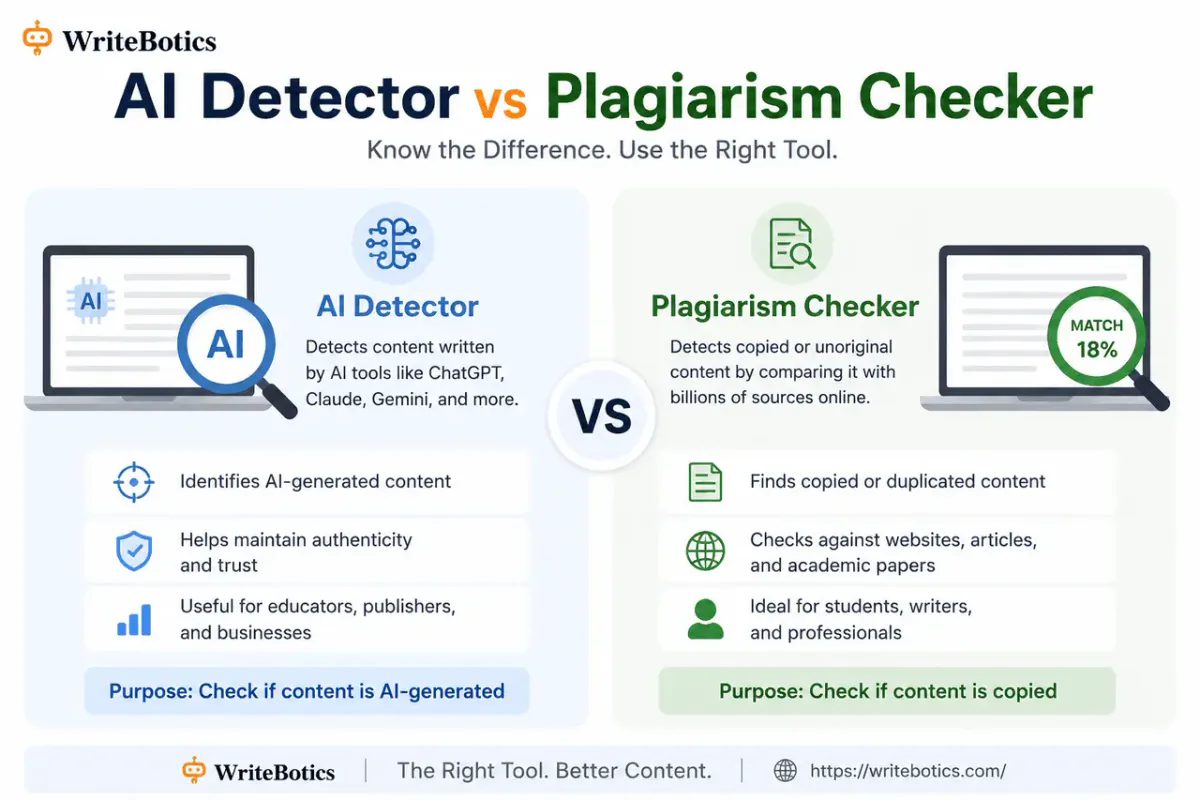
The AI Content Detector estimates whether a piece of text shows common AI-writing patterns, giving you a quick read before you rely on your own judgment for the rest. Paste in a draft, review the estimate, and treat it as a starting point for a closer look rather than a final answer — particularly for any passage the tool flags, since that's the part worth rereading with fresh eyes.
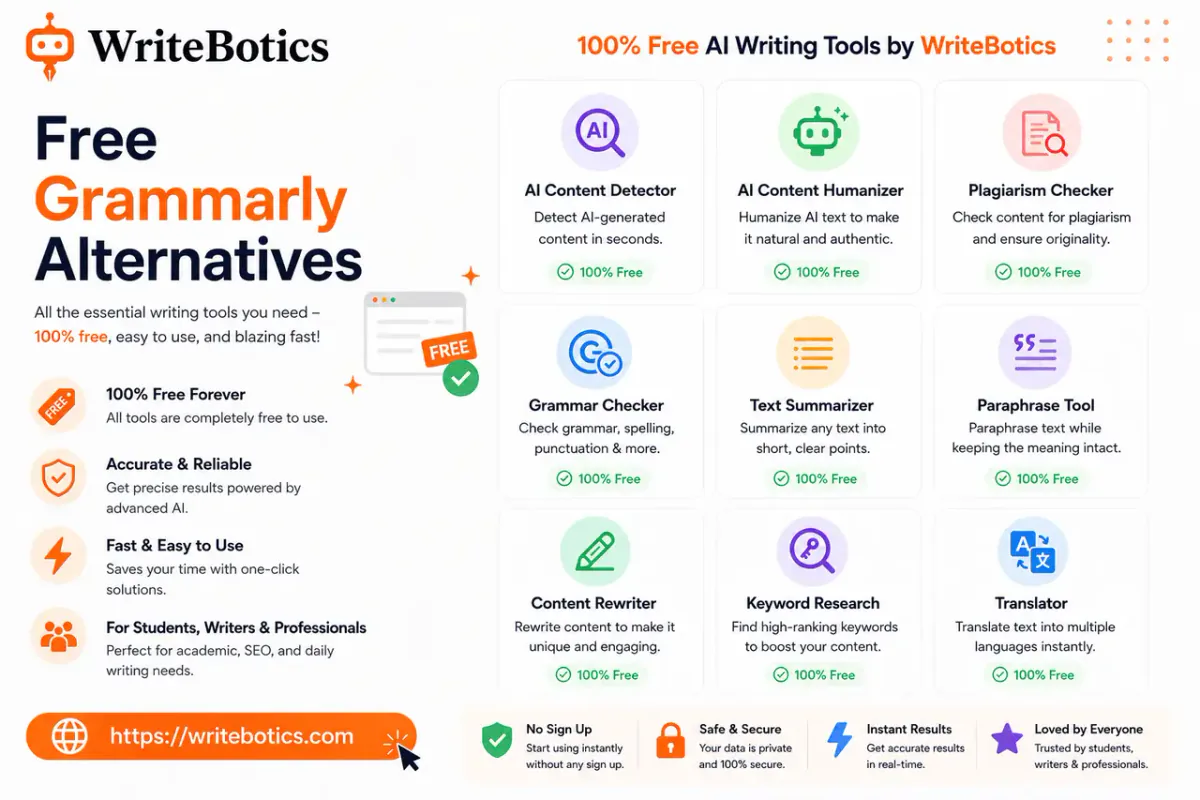
If a flagged passage does read as stiff or overly uniform, the AI Humanizer can rework the sentence structure and wording to read more naturally, which is often the more useful fix than simply hoping the detector score changes: a passage that reads better to a human is usually a passage that also scores differently on pattern-based checks.
Where this fits into a bigger review process
Checking for AI patterns is one part of preparing a draft for publication, alongside making sure the writing itself is clear and correct. For a broader look at improving a draft's clarity and grammar, see AI Writing Assistant: Write Faster and Smarter Today, and for a wider set of tools worth having on hand, Best Writing Tools Online to Boost Your Creativity covers the rest of the workspace.
You can find the AI Content Detector and every other tool mentioned here on the WriteBotics homepage.
FAQs
Can an AI content detector prove who wrote a piece of text?
No. Detectors provide an estimate based on writing patterns, not proof of authorship. Treat the result as one signal, and review the text, context, and any supporting evidence yourself.
Why did my own human-written text get flagged as AI-generated?
Formal, heavily edited, or very consistent writing can share statistical patterns with AI text, even when a human wrote every word. This is a known limitation, not a sign the tool is checking for something else.
Can editing an AI draft help it pass a detector?
Often, yes — a human editing pass tends to break up the uniform patterns detectors look for. This is exactly why detector scores shouldn't be treated as reliable proof either way.
Should I take action against someone based only on a detector score?
No. A detector score alone isn't strong enough evidence for a serious decision like an accusation or penalty. Use it as a starting point for a closer, more complete review.
Is the WriteBotics AI Content Detector free to use?
Yes — it's a free, browser-based tool with no signup required, though usage limits can vary by tool.