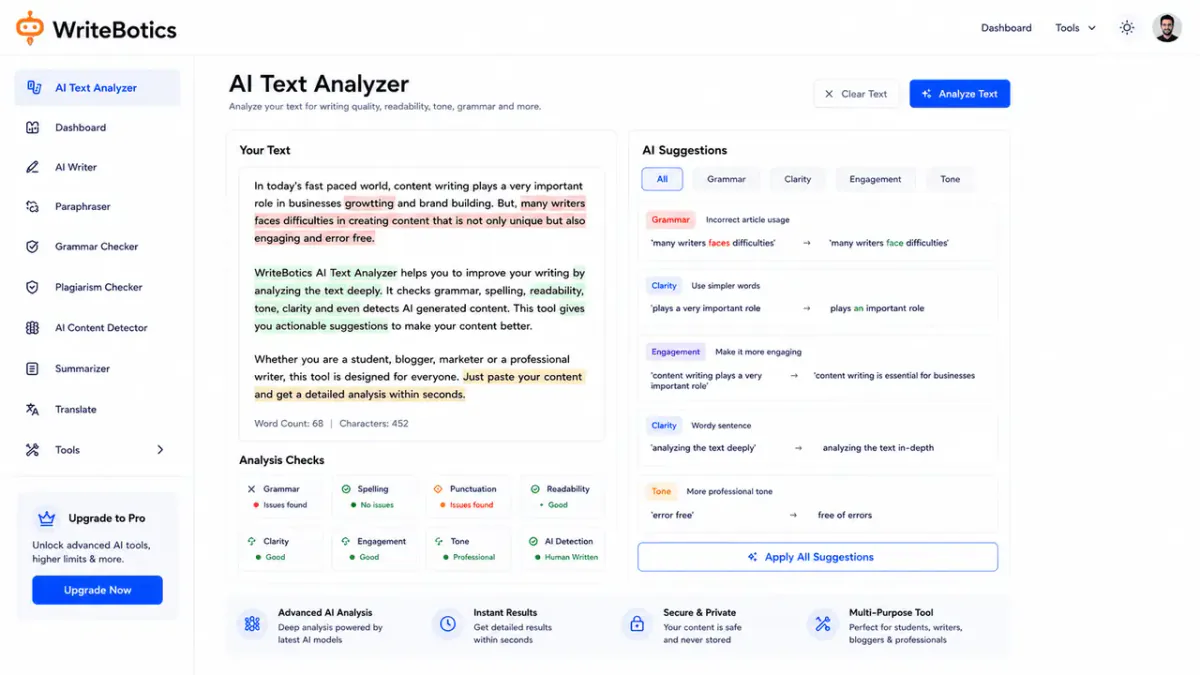
Before a piece of writing goes out — an email, an article, an assignment, a product description — it helps to know more than "does this sound okay to me." An AI text analyzer looks at a draft the way an editor would: checking grammar and clarity, flagging patterns that read as AI-generated, and catching phrasing that's too close to something already published. Used well, it's a second set of eyes on a draft before anyone else sees it.
What an AI text analyzer actually checks
"Text analyzer" isn't one single feature — it's really a handful of different checks, each answering a different question about a draft:
- Is it grammatically clean? Spelling, punctuation, subject-verb agreement, and sentence structure.
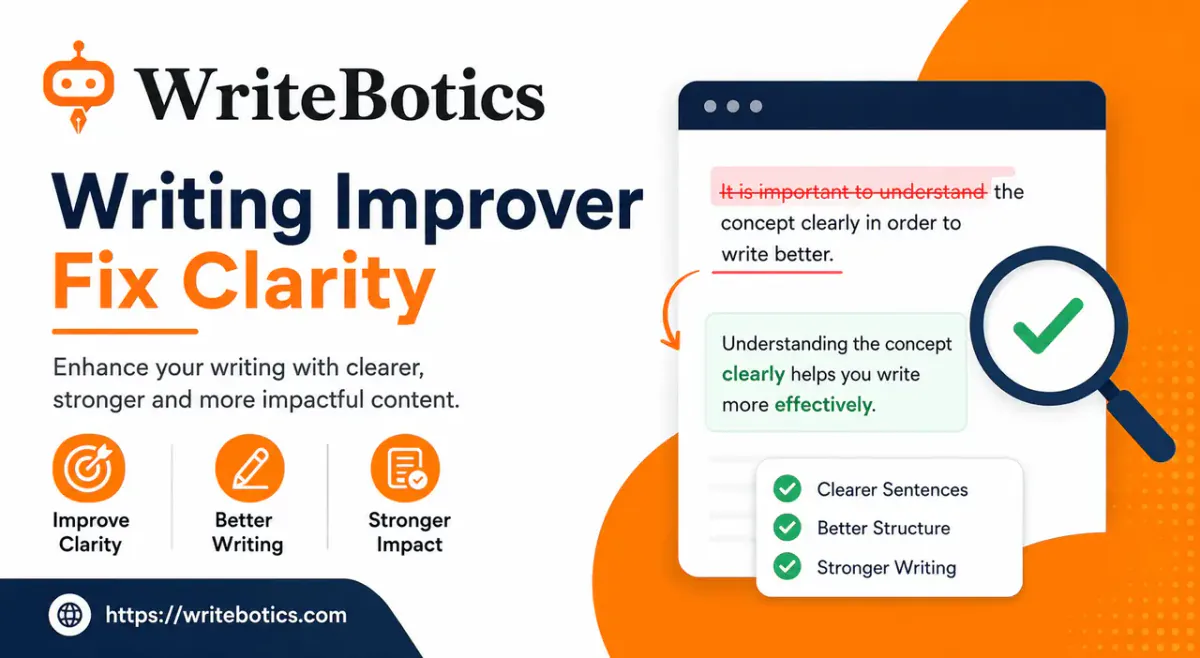
- Is it clear? Sentences that are too long, too dense, or ambiguous get flagged even if they're technically correct.
- Does it read as AI-written? Repetitive sentence structure, overly uniform pacing, and certain phrasing patterns are common signals.
- Is it original? Matching or near-matching phrases from existing published content.
No single check answers all four questions well. That's why "analyzing" a piece of writing usually means running it through more than one focused tool rather than expecting one score to cover everything.
Grammar and clarity come first
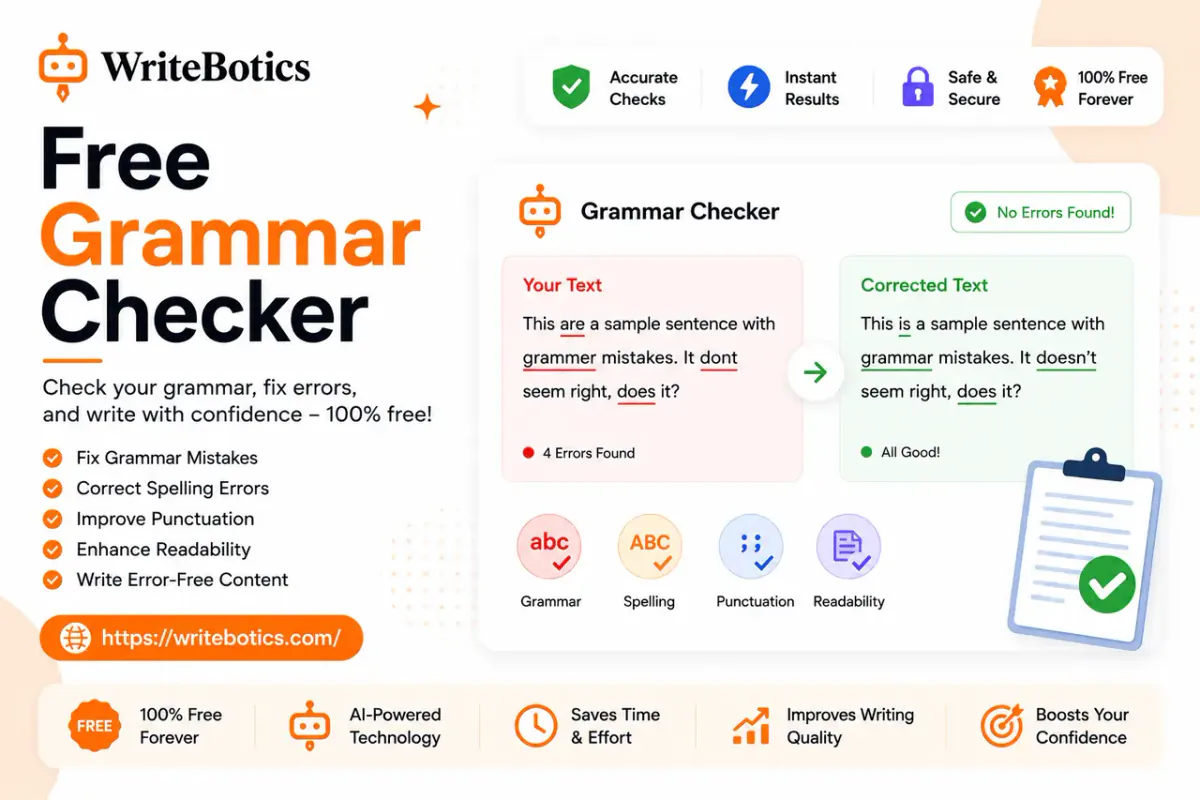
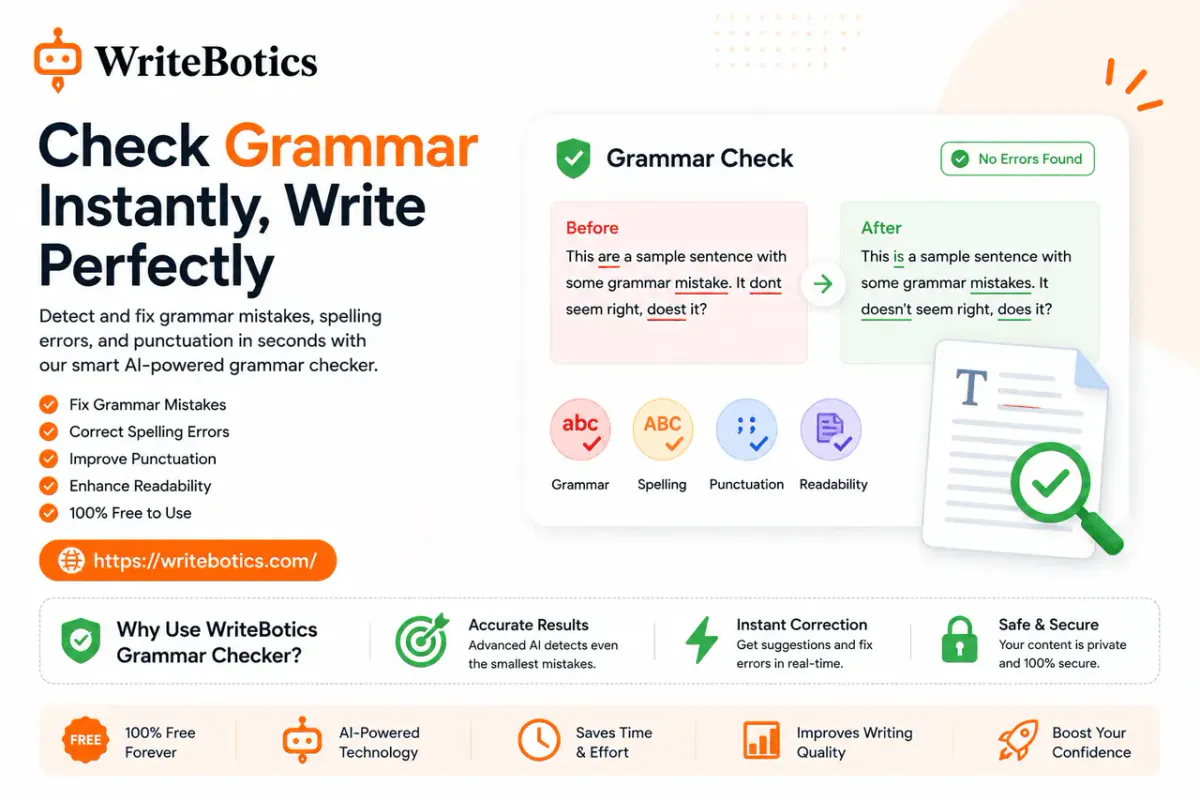
Before anything else, a draft needs to be readable. The Grammar Checker reviews spelling, punctuation, and sentence clarity, and is the fastest way to catch the small errors that undercut an otherwise solid piece of writing. This is worth running even on writing you're confident about — most grammar issues aren't things you'd catch rereading your own work, because you already know what you meant to say.
Clarity is a slightly different problem from correctness. A sentence can be grammatically perfect and still be hard to follow. Watch for:
- Sentences running past 25–30 words without a clear break
- More than one idea packed into a single sentence
- Passive constructions that hide who's doing what
- Jargon that isn't defined for the intended reader
A grammar-and-clarity pass is the baseline every piece of writing should get before it's evaluated for anything else.
Estimating AI-writing patterns
If originality or authenticity of voice matters for where your writing is going — a school assignment, a client deliverable, published editorial content — the next useful check is an AI-pattern estimate. The AI Content Detector reviews a draft for the phrasing and structural patterns commonly associated with AI-generated text and returns an estimate, not a verdict.
That distinction matters. No detector — from any provider — can prove definitively who wrote a piece of text. Detectors work off statistical patterns: unusually uniform sentence length, certain transition-word habits, low variation in vocabulary. Human writing can occasionally trigger these patterns too, and AI-generated writing that's been edited by a person can avoid them. Treat a detector result as one input among several, not the final word. If a result surprises you, the more useful next step is usually a close read of the specific passages flagged, not just the summary score.
Checking for unintentional overlap
Even original writing can end up close to existing published material, especially in technical or well-covered topics where there are only so many ways to phrase something. A plagiarism check reviews a draft for matching or near-matching phrases against existing content, which is useful both for academic integrity and for making sure marketing or blog content isn't accidentally echoing a competitor's copy too closely.
This step is easy to skip because it feels like it's "for other people" — students, agencies handling multiple clients. But it's a fast check, and catching an unintentional overlap before publishing is a lot less costly than catching it after.
Putting the checks together
A reasonably thorough writing-quality pass looks like this:
- Draft the piece the normal way — write, revise, read it back once yourself.
- Run a grammar and clarity check. Fix what's flagged; use judgment on suggestions that don't fit your intended tone.
- Run an AI-pattern check if authenticity or originality is a requirement for where this is going. Read the flagged passages, not just the score.
- Run a plagiarism check for anything that will be published, submitted, or sent externally.
- Do one final read-through with fresh eyes, focused on whether the piece still says what you meant it to say.
None of these steps replace human judgment — they narrow down where to spend your attention. A grammar checker won't tell you if an argument is persuasive. A detector won't tell you if a claim is accurate. That's still on you.
Why "one score" tools fall short
It's tempting to want a single number — a "writing quality score" — that tells you everything at once. In practice, this tends to hide more than it reveals. A draft can score well on grammar and poorly on originality, or read as clearly human-written while still containing factual errors. Separating the checks (grammar, clarity, AI-pattern estimate, originality) gives you a more useful picture than a single blended score, because you can see exactly where a draft needs work instead of just knowing that it needs some work.
Free tools, no setup required
The tools above are free, browser-based, and don't require an account. Open the one that matches the check you need, paste in your draft, and review the result — no signup wall in between.
If you're building out a broader writing workflow rather than just running a one-off check, AI Writing Assistant: Write Faster and Smarter Today covers how to combine tools for rewriting and drafting, and Best Writing Tools Online to Boost Your Creativity looks at tools more focused on generating and shaping ideas.
FAQs
What does an AI text analyzer actually measure?
It depends on the tool. Most "text analyzer" checks fall into one of four categories: grammar and spelling, clarity and readability, AI-writing pattern estimates, and originality/plagiarism checks. Few tools do all four well, so it's often more reliable to run separate focused checks.
Can an AI text analyzer tell me for certain if something was written by AI?
No. AI content detectors provide an estimate based on common writing patterns, not proof. Treat the result as one signal and review the flagged content yourself before drawing conclusions.
Is a grammar checker the same as a text analyzer?
Not quite. A grammar checker focuses on correctness — spelling, punctuation, sentence structure. A fuller text-quality review usually also includes clarity, originality, and sometimes an AI-pattern estimate.
Do I need to sign up to analyze my writing online?
No. WriteBotics' grammar checker and AI content detector are free, browser-based tools with no signup required.
Is it safe to paste unpublished or sensitive writing into an online analyzer?
Avoid pasting private, confidential, or sensitive text into any online tool. Check the tool's privacy policy first if you're unsure how submitted text is handled.
The bottom line
Checking writing quality isn't really one task — it's grammar, clarity, originality, and (increasingly) an honest look at whether a draft reads as AI-generated. Running a draft through a couple of focused tools, then reading the results yourself, gets you a clearer picture than any single "quality score" ever could.