A 20-page report. A dense research paper. A meeting transcript nobody has time to reread. An AI summary generator takes any of these and gives you the main points in a fraction of the time it would take to read the original — without you having to skim and guess what matters.
Here's how it works, when it's actually useful, and what a real summary looks like next to the source text.
What an AI summary generator does
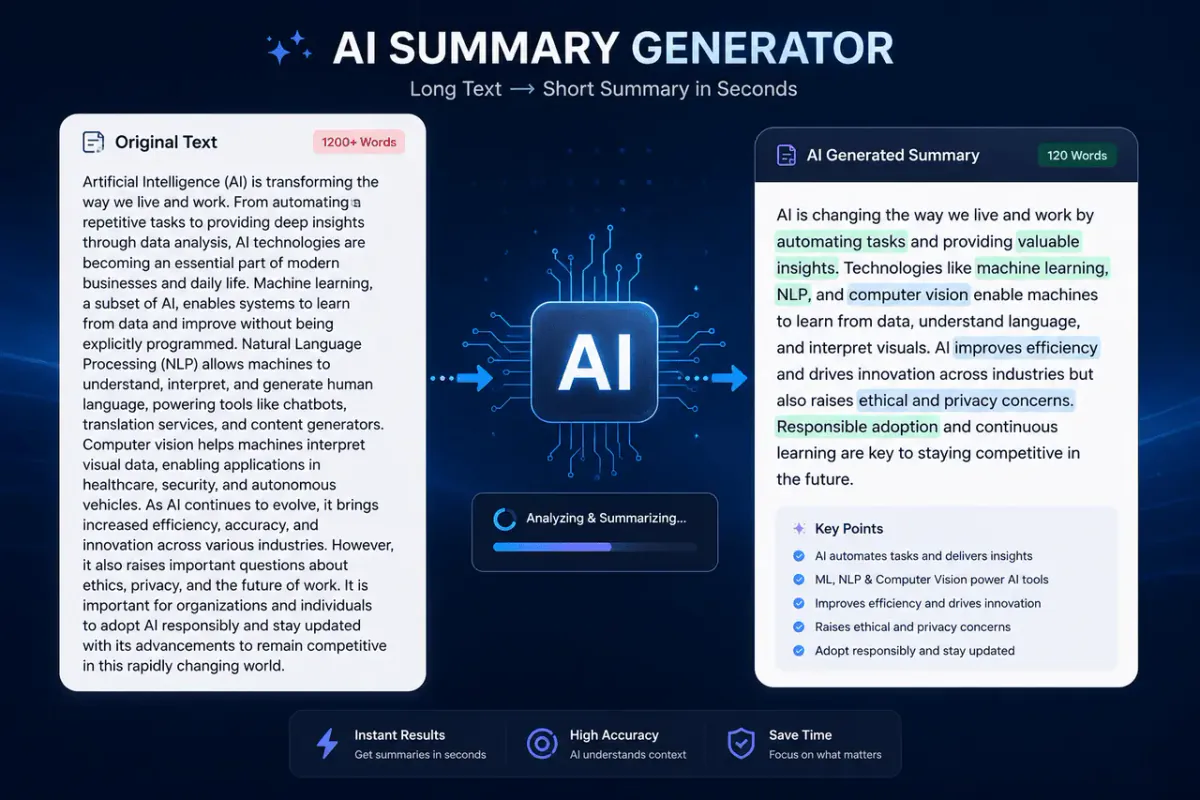
You paste in text — an article, a document, notes, a transcript — and the tool identifies the key ideas and condenses them into a short version. Most tools let you choose the format:
- Paragraph summary — a short, flowing overview, good for getting context fast
- Bullet points — individual takeaways, easier to scan or drop into notes
- Adjustable length — a tighter summary for a quick skim, or a longer one that keeps more detail
The tool isn't rewriting your content or adding new information. It's identifying which sentences and ideas carry the most weight and cutting the rest.
A real example
Original (142 words):
Remote work adoption has changed significantly since 2023. While many companies initially pushed for a full return to office, recent survey data shows that hybrid arrangements have become the dominant model across most industries. Employees report higher satisfaction with hybrid schedules compared to fully remote or fully in-office setups, citing a better balance between focused work and in-person collaboration. Employers, meanwhile, have shifted their concerns from productivity monitoring toward space planning, since fewer companies need daily full-capacity office space. This has led to a wave of smaller, more flexible office leases in major cities. At the same time, some sectors — particularly finance and law — have continued to push harder for in-office presence, citing culture and mentorship as reasons junior employees benefit from more in-person time. The overall picture is one of divergence rather than a single industry-wide standard.
Summary (38 words):
Hybrid work has become the dominant model post-2023, with employees favoring it over fully remote or in-office setups. Companies are downsizing office space accordingly, though finance and law continue pushing in-office presence for junior staff mentorship.
That's roughly a 70% reduction, with the core facts — the trend, the reason, the exception — all still intact.
When it's genuinely useful
Research and reading. Skimming a dozen articles or papers to find the ones worth reading in full is exactly what a summarizer speeds up.
Meeting notes and transcripts. Long transcripts are hard to scan for decisions and action items. A summary pulls those out fast.
Pre-reading before a meeting. Getting the gist of a report before a discussion, without blocking out an hour to read it cover to cover.
Content repurposing. Turning a long report into a short internal update, or an article into a social caption, starts with a tight summary of the core point.
Where it falls short: anything where nuance, exact wording, or full context matters — legal documents, contracts, or academic work you're citing. Always read the source before relying on a summary for something high-stakes.
Getting a better summary
- Paste clean text. Stripping out navigation menus, ads, or formatting junk before pasting gives the tool cleaner material to work with.
- Pick the right length. A one-line summary is good for a quick gut check; a longer bullet list is better before a meeting where details matter.
- Check it against the source. For anything you'll rely on or share, skim the original to confirm the summary didn't drop something important.
FAQs
Does an AI summary generator change the meaning of the text?
It shouldn't. A good summarizer condenses by removing repetition and lower-priority detail, not by rewording the core claims. Still, always compare the summary to the source for anything important.
How long can the text be?
This varies by tool, but most handle anything from a short paragraph up to several thousand words in one pass. For very long documents, summarizing in sections often gives a more accurate result than one giant pass.
Can it summarize a PDF or a webpage, not just pasted text?
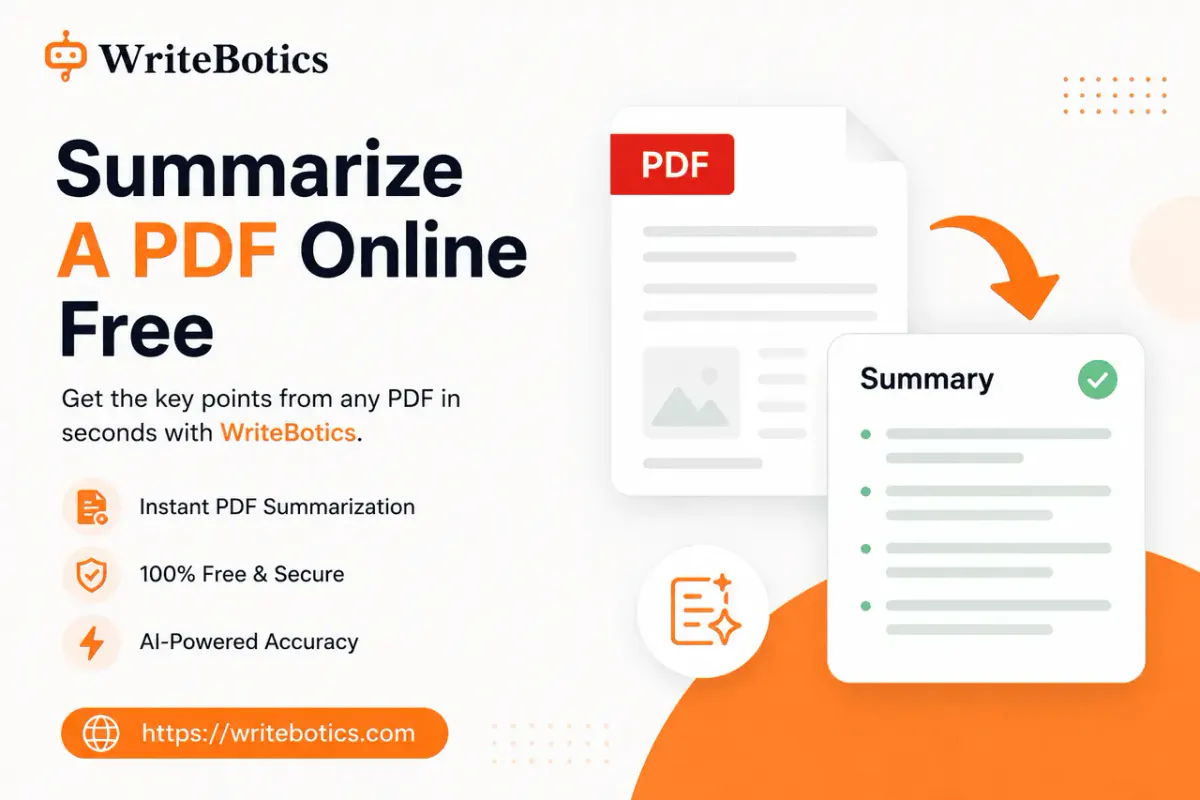
Many summarizers accept file uploads or URLs in addition to pasted text — check the specific tool's input options.
Is a summary a substitute for reading the original?
For a quick overview, yes. For anything you're citing, signing, or making a decision based on, no — treat the summary as a starting point, not a replacement for the source.
Is an AI summary generator free to use?
WriteBotics' text summarizer is free to try, so you can test it on your own document before deciding it fits your workflow.
Try it yourself
If you're regularly working through long documents, pairing a summarizer with a paraphrase tool covers most of the editing work: summarize to find what matters, then paraphrase anything you want to fold into your own writing. For more on building a faster reading and writing workflow, see how an AI summary generator saves you time and the writing tools worth trying online. Ready to try it? Explore WriteBotics' free writing tools and paste in your first document.