
AI Content Detector for Blogs: Free Tools & Accuracy Guide

Looking for the best AI content detector for blogs? Compare free AI detection tools, accuracy, false positives, and tips to publish original content.

Hassan SEO

WriteBotics editor

June 28, 20269 min read
A writer checking digital content for originality on a laptop screen
Table of Contents

Using an ai content detector for blogs has become essential as the academic landscape of 2026 looks vastly different than it did just a few years ago. In the early 2020s, the emergence of Large Language Models (LLMs) like ChatGPT sent shockwaves through universities worldwide. Today, in 2026, generative AI has become a standard tool in professional environments, yet the "arms race" between AI content generation and AI detection has reached a fever pitch.

For students, the central question remains:Does Turnitin Detect AI writing The short answer is yes—but the technology behind that detection has evolved far beyond simple pattern matching.

This guide explores the current state of Turnitin’s AI detection accuracy, the risks of attempting to "beat" the system, and how students can navigate this era of academic integrity.

1. AI Content Detector for Blogs: The State of Turnitin in 2026

By 2026, Turnitin has moved past its initial "experimental" AI detection phase. The software is now integrated with more sophisticated neural networks designed to identify the specific linguistic signatures of advanced models like GPT-5, Claude 4, and specialized academic LLMs.

Beyond Perplexity and Burstiness

In the early days, AI detectors relied on two primary metrics:

  • Perplexity: How "random" the word choice is.
  • Burstiness: The variation in sentence length and structure.

However, as AI models learned to mimic human "burstiness," Turnitin updated its algorithms. In 2026, Turnitin utilizes Linguistic DNA Analysis. This looks at the underlying logic and semantic consistency of a paper. Human writers tend to drift in focus, use idiosyncratic metaphors, or make subtle logical leaps that AI—which operates on statistical probability—struggles to replicate authentically.

Deep Integration with Writing History

One of the biggest shifts in 2026 is Turnitin’s ability to compare a student’s current submission against their Historical Writing Style. If a student has submitted five essays written in a certain "voice" and suddenly produces a paper with the perfect, sterile syntax of a high-end AI, Turnitin flags the discrepancy. This "Authorship Verification" is much harder to bypass than a simple probability check.

2. Turnitin AI Detection Accuracy: How Reliable Is It?

One of the most contentious topics in 2026 is the accuracy of these detectors. Turnitin officially maintains that its AI detection tool is highly accurate, often citing a false positive rate of less than 1% for whole documents.

The False Positive Dilemma

Despite technological leaps, the "False Positive" remains the Achilles' heel of AI detection. A false positive occurs when the software flags human-written content as AI-generated.

  • ESL/ELL Students: Research has shown that students who speak English as a Second Language are at a higher risk of being falsely flagged. This is because non-native speakers often use more formulaic sentence structures which AI detectors mistake for machine-generated patterns.
  • Technical Writing: Scientific reports and legal briefs, which require standardized language and lack "creative" flair, are also more susceptible to high AI probability scores.

Understanding the "AI Score"

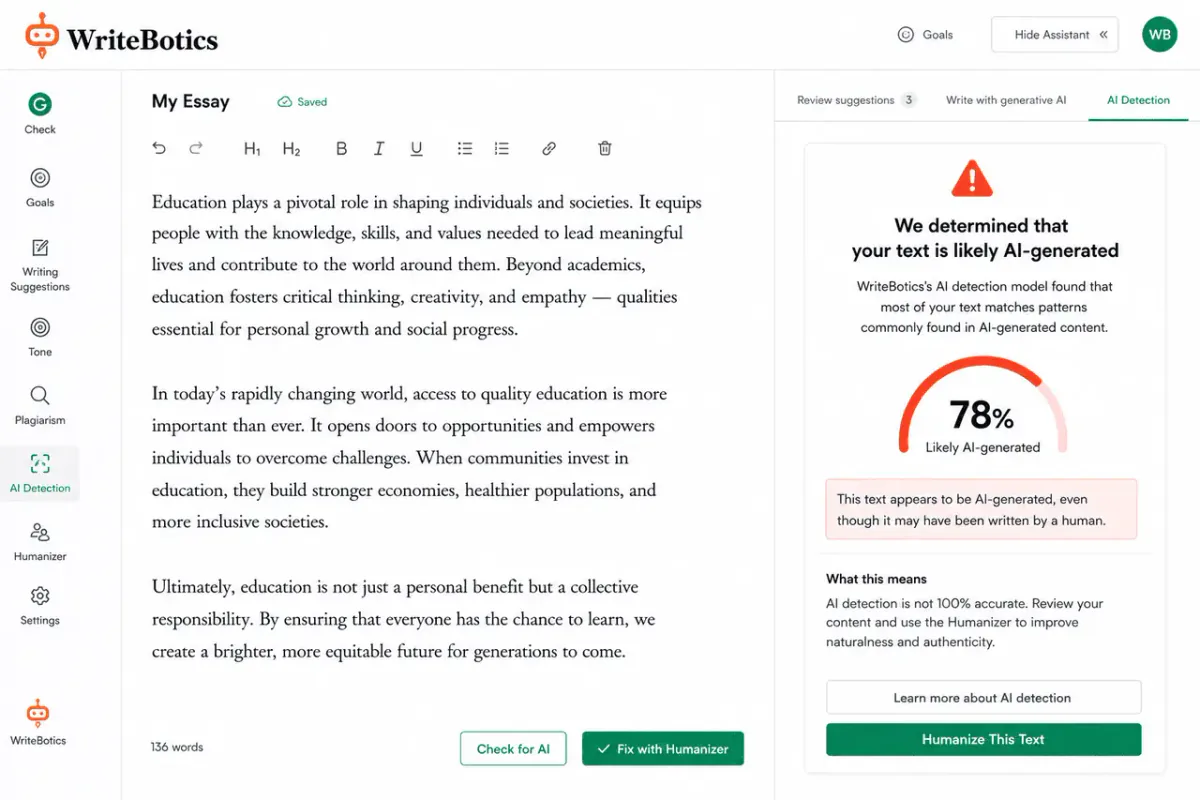
It is vital for students to understand that Turnitin does not provide a "Yes/No" answer. It provides a percentage score. In 2026, most universities do not treat a 20% or 30% AI score as an automatic "fail." Instead, it serves as a red flag for professors to investigate further.

3. Can You "Beat" the Turnitin AI Checker?

As soon as Turnitin launched its AI detector, a secondary market of "AI Humanizers" and "Bypass Tools" exploded. Students often search for ways to beat the Turnitin AI checker, but in 2026, these methods are increasingly risky.

The Myth of Paraphrasing Tools

In the past, tools like Quillbot were the go-to for "spinning" AI text. By 2026, Turnitin’s AI detection is specifically trained to recognize the output of these paraphrasing tools. When you use a "humanizer," you often create "word salad"—text that is grammatically correct but lacks coherent human nuance. This often results in a "Mixed Signal" flag, which tells the professor that the text has been mechanically altered.

The "Invisible Character" and "White Text" Tricks

Old hacks—such as replacing spaces with invisible characters or inserting hidden white text—have been completely neutralized. Turnitin’s 2026 processing engine strips all formatting and invisible layers, analyzing only the raw text string. Using these tricks is now often viewed by Honor Councils as "intent to deceive," which carries harsher penalties than simply using AI.

4. The "AI-on-AI" Detection Loop

In 2026, a new phenomenon has emerged: using AI to check if your AI-written essay will be caught by Turnitin. While there are "Stealth AI" services that claim to be undetectable, they are in a constant losing battle.

Turnitin has more data than any private "bypass" company. Because Turnitin has access to millions of student submissions, its "training set" for what human writing looks like is superior to any commercial AI humanizer. Relying on a "bypass" tool in 2026 is essentially gambling with your degree.

5. How to Use AI Responsibly (The "Safe" Path)

The reality of 2026 is that many professors expect students to use AI for research. The key is distinguishing between AI-assisted writing and AI-generated writing.

  1. The Brainstorming Method: Use AI to generate outlines or suggest research topics. When you do the actual writing yourself, Turnitin will see your unique "Linguistic DNA," and your AI score will remain low.
  2. The Citations Strategy: If you use a specific phrase or idea generated by an AI, cite it. In 2026, many academic styles (APA, MLA) have standardized formats for AI citations.
  3. Keep Your Version History: Always write in a cloud-based editor (like Google Docs) that tracks version history. If accused, you can show the time-stamped evolution of your essay.

6. Frequently Asked Questions (FAQs)

Q1: Does Turnitin detect ChatGPT-4 and ChatGPT-5?

Yes. Using an ai content detector for blogs can help you understand how these tools evaluate your writing. Turnitin’s 2026 algorithms are specifically updated to handle the most recent iterations of LLMs. They detect the statistical patterns and "predictive" nature of the text generated by these models, even when the models attempt to be more "human-like."

Q2: Can Turnitin detect AI writing if I rewrite it by hand?

It depends If you use AI to generate the ideas and then rewrite every sentence in your own voice, the "AI score" will likely be low. However, if you simply change a few words here and there (synonym swapping), Turnitin’s Linguistic DNA Analysis will likely still flag the structure as machine-generated.

Q3: What is a "Safe" AI score on Turnitin?

There is no universal "safe" percentage. Some institutions ignore anything under 15%, while others investigate any score above 0%. In 2026, most professors look for clusters of AI writing (e.g., three paragraphs in a row flagged as 100% AI) rather than the overall document percentage.

Q4: Does Turnitin detect Grammarly?

Grammarly’s basic spelling and grammar checks are generally not flagged as AI writing. However, Grammarly’s "Gen-AI" features (like "Rewrite this paragraph") can trigger AI detectors. If the software is doing the actual writing or restructuring for you, it may be flagged.

Q5: Can I be expelled for a high AI score?

A high AI score is typically a starting point for an investigation, not an immediate grounds for expulsion. In 2026, most universities require a "Holistic Review," where a professor examines the score alongside your previous work and your ability to explain your paper’s concepts in an interview.

Q6: Do "AI Humanizers" like StealthWriter or Netus AI work against Turnitin?

By 2026, these tools are largely ineffective and highly risky. Turnitin’s engine is trained on the outputs of these very tools. Furthermore, many universities now use "Tamper Detection" which flags text that has been processed by "humanizers" due to the specific statistical anomalies they leave behind.

Q7: Does Turnitin check for AI in languages other than English?

Yes. In 2026, Turnitin has expanded its AI detection capabilities to include Spanish, French, German, Chinese, and several other major languages. Its multi-lingual neural networks are designed to catch AI translations and AI-generated content in various global languages.

Q8: If I use AI for an outline but write the essay myself, will I be caught?

No Using AI for outlining or research is generally considered "AI-assisted" rather than "AI-generated." Since the actual words and sentence structures are yours, the detector will recognize the human fingerprints in the prose.

Q9: How can I prove I didn't use AI if I am falsely accused?

The best defense is Version History. If you can show a Google Doc or Word history with hours of active typing, deletions, and edits, it is nearly impossible for a university to claim you used AI. Additionally, being able to discuss your sources and the "why" behind your arguments is strong proof of authorship.

7. Conclusion: Authenticity is the Only "Bypass"

In 2026, Turnitin is more powerful than ever. Its AI detection accuracy has reached a point where "tricks" and "humanizers" are easily spotted. For students, the risks of being flagged—including academic probation, suspension, or the permanent tarnishing of their digital record—far outweigh the time saved by using AI to ghostwrite an essay.

The best way to "beat" Turnitin in 2026 is not to find a better scrambler or a more advanced prompt. It is to use AI as a collaborator, not a replacement. By focusing on developing your own voice, maintaining a clear paper trail of your writing process, and being transparent about your tool usage, you can navigate your academic career without fear of the "AI Flag."

Share this article

Continue with WriteBotics

Improve your own writing

Check grammar, humanize AI text, rewrite content, or scan for plagiarism with our free tools.

Explore tools

Keep reading