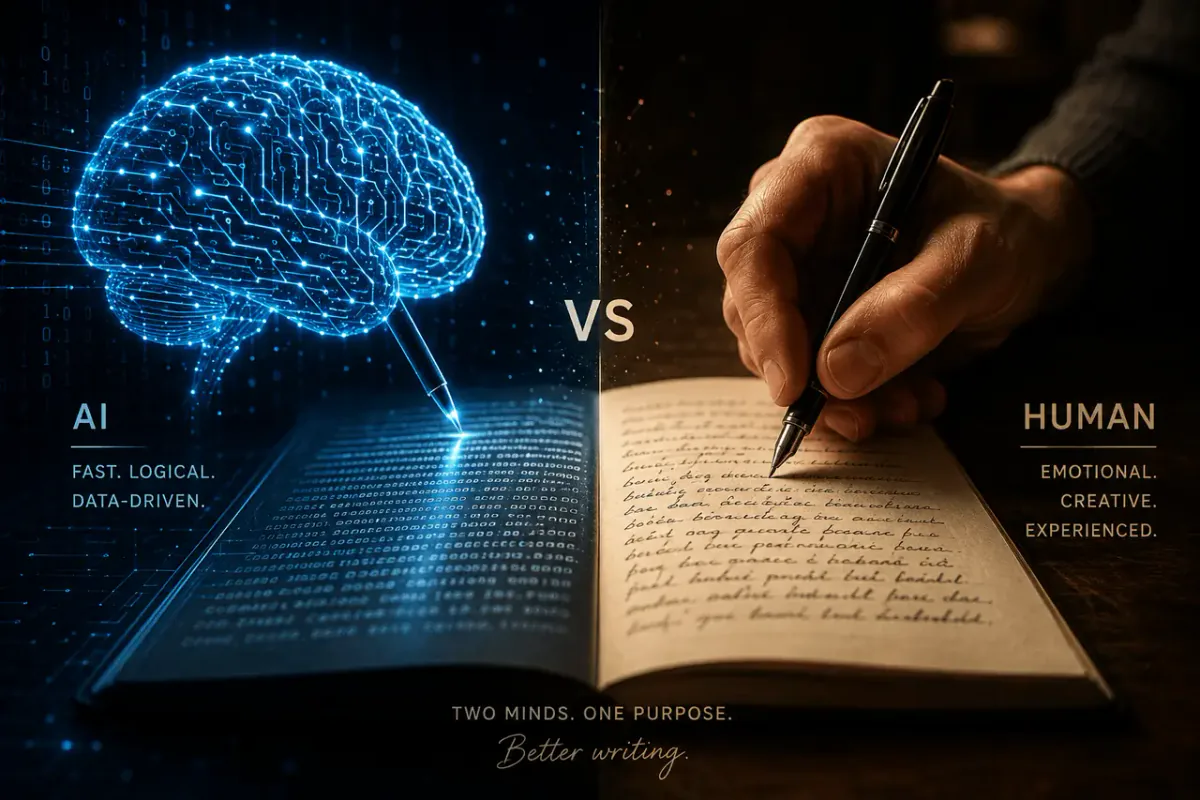
Using a chatgpt ai detector free online has become increasingly common as Large Language Models (LLMs) like ChatGPT have transformed from niche curiosities into ubiquitous tools. Today, AI generates everything from legal briefs and high school essays to marketing copy and creative fiction. As these models become more sophisticated, the line between silicon and soul begins to blur.
However, despite the rapid advancement of generative AI, there remains a fundamental difference between how a machine "predicts" language and how a human "expresses" it. Learning how to spot AI writing is no longer just a skill for teachers or editors—it is an essential form of digital literacy in the 21st century.
This guide explores the structural, linguistic, and emotional signs of AI Generated Text , helping you distinguish the calculated output of an algorithm from the messy, brilliant nuances of human thought.
1. The Concepts of Perplexity and Burstiness
To understand the difference between AI and human writing, we must first understand how AI "thinks." AI models work on probability; they predict the most likely next word (or token) based on a massive dataset. This leads to two measurable metrics: perplexity and burstiness.
Perplexity (Randomness)
Perplexity refers to the complexity of the text. Because AI aims for the "most likely" next word to ensure clarity and correctness, its writing often has low perplexity. It is predictable. Humans, on the other hand, are unpredictable. We use rare words, odd metaphors, and unconventional sentence structures. If a piece of writing feels like the most "average" possible version of that topic, it’s likely AI.
Burstiness (Sentence Variation)
"Burstiness" refers to the variation in sentence length and structure. Humans write in "bursts." We might follow a long, winding, lyrical sentence with a punchy, three-word sentence for emphasis. AI tends to be incredibly consistent. Its sentences are often of a similar rhythmic length, creating a "drone" effect that lacks the natural cadence of human speech.
2. Linguistic Hallmarks: The "AI Accent"
Just as people from different regions have accents, AI has its own distinct linguistic fingerprint. These signs of AI-generated text are often subtle, but once you see them, they become hard to ignore.
The "Over-Polite" and Neutral Tone
AI is programmed to be helpful, harmless, and objective. As a result, it rarely takes a hard stance unless prompted. It often uses hedging language like "It is important to consider..." or "While there are many perspectives..." Human writers are generally more opinionated, biased, and willing to use sharp, evocative language to make a point.
The Repetitive Vocabulary
ChatGPT has a "favorite" list of words that it relies on to sound sophisticated. If you see the following words appearing frequently in a short text, your AI alarms should go off:
- Delve: AI loves to "delve into" topics.
- Tapestry/Landscape: It views everything as a "complex tapestry" or a "changing landscape."
- Pivotal/Crucial: It overuses these to signify importance.
- In conclusion/Furthermore: AI is obsessed with formal transition words that many modern human writers have discarded.
3. The Logic Gap and "Hallucinations"
One of the most reliable ways to tell the difference in ChatGPT vs. human writing is to look at the relationship between the words and the truth.
Circular Reasoning
Because AI doesn't actually "know" anything—it only knows which words look good together—it often falls into circular reasoning. It might spend three sentences saying the same thing in slightly different ways. A human writer typically moves the argument forward with each sentence.
Factual Errors (Hallucinations)
AI can be confidently wrong. It might invent a historical date, cite a non-existent study, or attribute a quote to the wrong person. This is because it is prioritizing the flow of the sentence over the accuracy of the data. If you find a piece of writing that is beautifully composed but contains a glaring, weird factual error, it is almost certainly AI.
4. Emotional Intelligence and Lived Experience
The greatest divide between AI and humans is "The Lived Experience Gap." Writing is not just a collection of facts; it is a transfer of consciousness.
Anecdotes and Personal Voice
Humans tell stories. We reference our childhoods, our specific mistakes, and our unique cultural backgrounds. AI can simulate an anecdote (e.g., "Imagine a young girl in a small town..."), but it cannot provide a genuine, idiosyncratic personal history.
Humor and Sarcasm
Sarcasm is notoriously difficult for AI to master. Sarcasm relies on saying the opposite of what you mean while maintaining a specific tone. AI, being literal and helpful by nature, often misses the mark on dry humor, satire, or subtle wit. Its jokes are usually "dad jokes"—predictable, pun-based, and safe.
5. Using AI Detection Tools (and Their Limitations)
If you suspect a piece of writing is AI-generated, you might turn to detection software like GPTZero, Originality.ai, or Copyleaks. These tools analyze the perplexity and burstiness mentioned earlier.
However, it is vital to remember that AI detectors are not 100% accurate.
- False Positives: Non-native English speakers are often flagged as "AI" because their writing tends to be more formal and uses more common word choices.
- The "Humanizer" Loophole: There are tools specifically designed to add "noise" to AI text to bypass detectors.
- Academic Risks: Using these tools as the sole basis for accusations is dangerous, as they can misidentify high-quality, structured human writing as machine-generated.
6. Frequently Asked Questions (FAQs)
Q1: Is there a single "smoking gun" that proves a text is AI-written?
No. There is no single characteristic that definitively proves a text is AI-generated. Instead, detection is about identifying a "constellation of symptoms." If you see a combination of low burstiness, a generic "summary" conclusion, the word "delve," and a lack of personal anecdotes, the probability of it being AI increases significantly.
Q2: Why does AI writing often feel "boring" or "bland"?
AI is trained to predict the most statistically probable next word. In statistical terms, it aims for the "center of the bell curve." Human creativity, however, often lives at the edges of that curve—using unexpected adjectives or jarring metaphors. Because AI avoids "risky" or "unlikely" word choices, the resulting text often feels safe, repetitive, and ultimately bland.
Q3: Can AI detectors distinguish between AI-written and AI-edited text?
This is a major challenge. If a human writes a draft and uses AI to fix the grammar, detectors may still flag it as AI because the "rhythm" (burstiness) has been smoothed out by the algorithm. Currently, most detectors struggle to tell the difference between a text generated entirely by AI and a human text that has been heavily polished by an AI grammar tool.
Q4: How can I "humanize" my own writing so it doesn't look like AI?
The best way to ensure your writing sounds human is to embrace imperfection and personality.
- Use personal stories: AI can't replicate your actual memories.
- Vary your sentence length: Intentionally use very short sentences alongside long ones.
- Use specific data: Instead of saying "Many people believe," say "In my 10 years as a carpenter, I’ve noticed..."
- Avoid clichés: Instead of calling a situation a "complex tapestry," describe the specific "mess of tangled threads."
Q5: Is it ethical to use AI for writing as long as I check it?
This depends on the context. In journalism or academia, using AI to generate content is often considered a violation of integrity. However, in marketing or technical writing, AI is increasingly seen as a legitimate productivity tool—provided a human "fact-checks" the output and ensures it meets quality standards. The key is transparency.
Q6: Will we eventually be unable to tell the difference?
As models like GPT-5 and beyond are released, they will get better at simulating burstiness and irony. However, there is a concept called "Model Collapse," where AI trained on AI-generated data begins to degrade in quality. Human-generated data (original thoughts and experiences) will always be the "gold standard" that keeps language evolving, which suggests that humans will likely always have a slight edge in stylistic depth.
Conclusion: The Enduring Value of the Human Touch
While AI can synthesize the entire history of human knowledge in seconds, it cannot experience the world. It cannot feel the weight of a secret, the sting of a loss, or the specific joy of a niche hobby.
The best way to differentiate between ChatGPT and a human is to look for the "scars" of human experience—the weird metaphors, the passionate biases, the rhythmic inconsistencies, and the deep emotional resonance that only comes from a living being. As AI continues to flood the internet with "perfectly average" content, the value of authentic, imperfect human voices will only continue to rise.