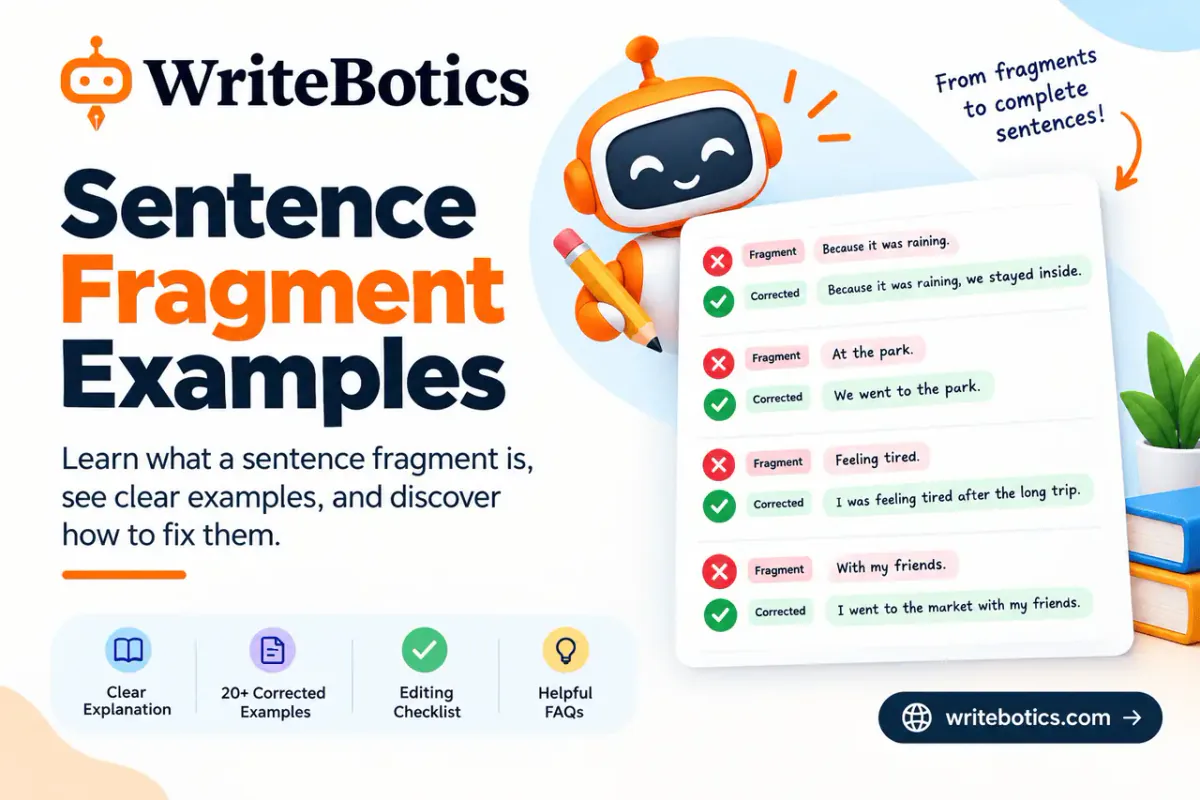
A sentence fragment is a group of words that looks like a sentence but does not express a complete thought. Most fragments are missing a subject, a verb, or an independent clause. To fix one, identify what is missing and connect the fragment to a complete sentence or rewrite it as a complete sentence.
Sentence fragments are common in school assignments, emails, reports, blog posts, and everyday writing. They can be easy to overlook because a fragment may sound natural when you read it quickly.
The good news is that most sentence fragments are simple to fix. Once you know what a complete sentence needs, you can spot fragments and correct them without changing the meaning of your writing.
What Is a Sentence Fragment?
A complete sentence normally expresses a complete thought and contains an independent clause. An independent clause has a subject and a verb and can stand on its own.
For example:
Maya finished the assignment.
“Maya” is the subject, and “finished” is the verb. The sentence communicates a complete thought.
Now consider:
After Maya finished the assignment.
This has a subject and a verb, but it begins with after, which makes it dependent on another clause. It does not tell the reader what happened after Maya finished the assignment.
It is therefore a sentence fragment when used by itself.
Fragment: After Maya finished the assignment.
Correct: After Maya finished the assignment, she submitted it.
Common types of sentence fragments
Most sentence fragments fall into a few common categories:
| Type | What is missing? | Example |
|---|---|---|
| Missing subject | Who or what performs the action | Ran to the bus. |
| Missing verb | What the subject does or is | The students in the library. |
| Dependent clause | A complete independent thought | Because the meeting ended. |
| Incomplete phrase | A phrase presented as a sentence | Before the final deadline. |
Understanding the type of fragment makes the correction much easier.
Sentence Fragment Examples With a Missing Subject
A sentence needs a subject unless the context or grammatical structure clearly supplies one.
Consider:
Went to the store after work.
Who went to the store? The reader cannot tell from the sentence itself.
You can fix it by adding the missing subject:
I went to the store after work.
Or:
Jordan went to the store after work.
The same problem appears in this example:
Finished the report before lunch.
A corrected version could be:
She finished the report before lunch.
Why missing-subject fragments happen
Missing-subject fragments often appear when writers begin with a verb and accidentally leave out who performed the action.
They can also happen when a writer separates a phrase from the sentence it belongs to:
The team reviewed the proposal carefully. And approved the final version.
“And approved the final version” does not work well as a standalone sentence because the subject is missing.
A clearer version is:
The team reviewed the proposal carefully and approved the final version.
Or:
The team reviewed the proposal carefully. Then the team approved the final version.
Sentence Fragment Examples With a Missing Verb
Some fragments contain a subject but lack a main verb.
For example:
The new employees in the training room.
The reader knows who or what the sentence is about, but there is no main verb telling us what the employees are doing.
You could write:
The new employees are in the training room.
Another example:
The final version of the report.
This is a noun phrase, not a complete sentence.
Depending on the intended meaning, you could revise it as:
The final version of the report is ready.
Or:
We submitted the final version of the report.
Check for the main verb
When proofreading, look for sentences that begin with a noun or noun phrase and ask:
What is the subject doing, being, or becoming?
If there is no main verb, you may have a fragment.
For example:
The manager with years of experience in the industry.
The phrase describes the manager but does not tell us anything about what the manager does or is.
A complete version could be:
The manager with years of experience in the industry approved the proposal.
Dependent-Clause Sentence Fragments
One of the most common types of sentence fragments begins with a word that makes the clause dependent.
Common examples include:
- because
- although
- when
- while
- if
- unless
- since
- after
- before
- which
- that
These words can introduce dependent clauses. A dependent clause may contain a subject and verb but still cannot stand alone as a complete sentence.
For example:
Because the deadline changed.
This tells us there is a reason, but it does not tell us what happened because of the changed deadline.
Fix it by adding an independent clause:
Because the deadline changed, we moved the meeting.
Or remove the dependent-clause marker:
The deadline changed.
More dependent-clause fragments
Although the report was finished.
Correct:
Although the report was finished, the editor requested several changes.
Another example:
When the customers arrived.
Correct:
When the customers arrived, the staff opened the doors.
And:
If the weather improves.
Correct:
If the weather improves, we will continue the event outside.
The important question is not simply whether the clause contains a subject and verb. Ask whether it can stand alone as a complete thought.
Intentional Sentence Fragments
Not every fragment is automatically a mistake.
Writers sometimes use intentional fragments for style, emphasis, rhythm, dialogue, advertising, headings, or informal communication.
For example:
No problem.
In many contexts, “No problem” works naturally as a conversational response even though it is not structured like a traditional full sentence.
Another example:
Absolutely.
Or:
Never again.
Fragments can also be effective in creative writing:
The door opened.
Silence.
The fragment creates a deliberate pause or emphasis.
When should you fix an intentional fragment?
Context matters.
In a formal essay, academic assignment, business report, or professional document, sentence fragments may distract readers and should generally be corrected unless there is a clear stylistic reason to keep one.
In headlines, advertising copy, dialogue, notes, and creative writing, fragments can be completely intentional.
The goal is not to eliminate every fragment mechanically. The goal is to recognize whether the fragment is intentional and appropriate for the context.
20 Sentence Fragment Examples and Corrections
Here are 20 common sentence fragment examples with simple corrections.
1. Missing subject
Fragment: Went to the library after class.
Correct: I went to the library after class.
2. Missing subject
Fragment: Finished the presentation before the meeting.
Correct: Priya finished the presentation before the meeting.
3. Missing verb
Fragment: The new employees in the conference room.
Correct: The new employees are in the conference room.
4. Missing verb
Fragment: The final report for the client.
Correct: The final report for the client is ready.
5. Dependent clause beginning with “because”
Fragment: Because the server was unavailable.
Correct: Because the server was unavailable, we postponed the update.
6. Dependent clause beginning with “although”
Fragment: Although the task was difficult.
Correct: Although the task was difficult, the team completed it.
7. Dependent clause beginning with “when”
Fragment: When the meeting ended.
Correct: When the meeting ended, everyone returned to work.
8. Dependent clause beginning with “if”
Fragment: If the customer needs more information.
Correct: If the customer needs more information, we can send another explanation.
9. Dependent clause beginning with “while”
Fragment: While the editor reviewed the article.
Correct: While the editor reviewed the article, the writer checked the references.
10. Phrase beginning with “before”
Fragment: Before the final deadline.
Correct: We submitted the application before the final deadline.
11. Missing subject after a coordinating word
Fragment: And sent the revised document.
Correct: She reviewed the document and sent the revised version.
12. Incomplete noun phrase
Fragment: A useful solution to the problem.
Correct: We found a useful solution to the problem.
13. Incomplete prepositional phrase
Fragment: On the desk beside the window.
Correct: The files are on the desk beside the window.
14. Dependent clause beginning with “since”
Fragment: Since the company changed its policy.
Correct: Since the company changed its policy, employees have followed a different process.
15. Dependent clause beginning with “unless”
Fragment: Unless the weather improves.
Correct: Unless the weather improves, the event will remain indoors.
16. Relative-clause fragment
Fragment: Which caused several delays.
Correct: The system failed, which caused several delays.
17. Incomplete phrase after a sentence
Fragment: Especially during busy periods.
Correct: Errors are more likely during busy periods, especially when the team is understaffed.
18. Missing verb in a description
Fragment: The customer support team available all weekend.
Correct: The customer support team is available all weekend.
19. Dependent clause beginning with “after”
Fragment: After we reviewed the proposal.
Correct: After we reviewed the proposal, we approved the changes.
20. Fragment that needs a subject and verb
Fragment: Working late to finish the project.
Correct: The developers were working late to finish the project.
Notice that the corrections do not all use the same method. Some require a subject, some need a verb, and others need an independent clause to complete the thought.
How to Fix a Sentence Fragment
When you find a fragment, first identify what is missing.
Step 1: Find the subject
Ask:
Who or what is this sentence about?
If you cannot identify a subject, check whether one needs to be added.
Fragment: Completed the application.
Correct: Maria completed the application.
Step 2: Find the verb
Ask:
What is the subject doing or being?
If there is no main verb, add one.
Fragment: The new policy for remote employees.
Correct: The new policy for remote employees is effective today.
Step 3: Check for dependent words
Look at the beginning of the sentence.
Words such as because, although, when, if, while, after, and unless may signal that you have a dependent clause.
Fragment: Although the project was complete.
Add the independent clause:
Although the project was complete, the client requested another revision.
Step 4: Connect the fragment to the sentence before it
Sometimes the easiest fix is to attach the fragment to the previous sentence.
Fragment: The team changed the schedule. Because the original date was unavailable.
Correct:
The team changed the schedule because the original date was unavailable.
This prevents a dependent clause from being incorrectly presented as its own sentence.
Sentence Fragment Editing Checklist
Use this checklist when proofreading an essay, article, email, or report.
- Does every formal sentence express a complete thought?
- Can each sentence stand alone?
- Does each independent clause have a subject and verb?
- Did I accidentally leave out the subject?
- Did I accidentally leave out the main verb?
- Does the sentence begin with because, although, when, if, while, after, before, unless, or a similar word?
- If it begins with a dependent word, does it have an independent clause attached?
- Did I accidentally turn a phrase into a standalone sentence?
- Is a fragment being used intentionally for style or emphasis?
- Is that intentional fragment appropriate for the audience and type of writing?
- Have I preserved the original meaning after making corrections?
If you want an additional grammar and punctuation review, you can run your draft through the WriteBotics Grammar Checker. Review its suggestions yourself before accepting changes, particularly when the sentence depends on context.
Sentence Fragments vs. Run-On Sentences
Sentence fragments and run-on sentences are opposite types of sentence-boundary problems.
A fragment is incomplete:
Because the meeting ended.
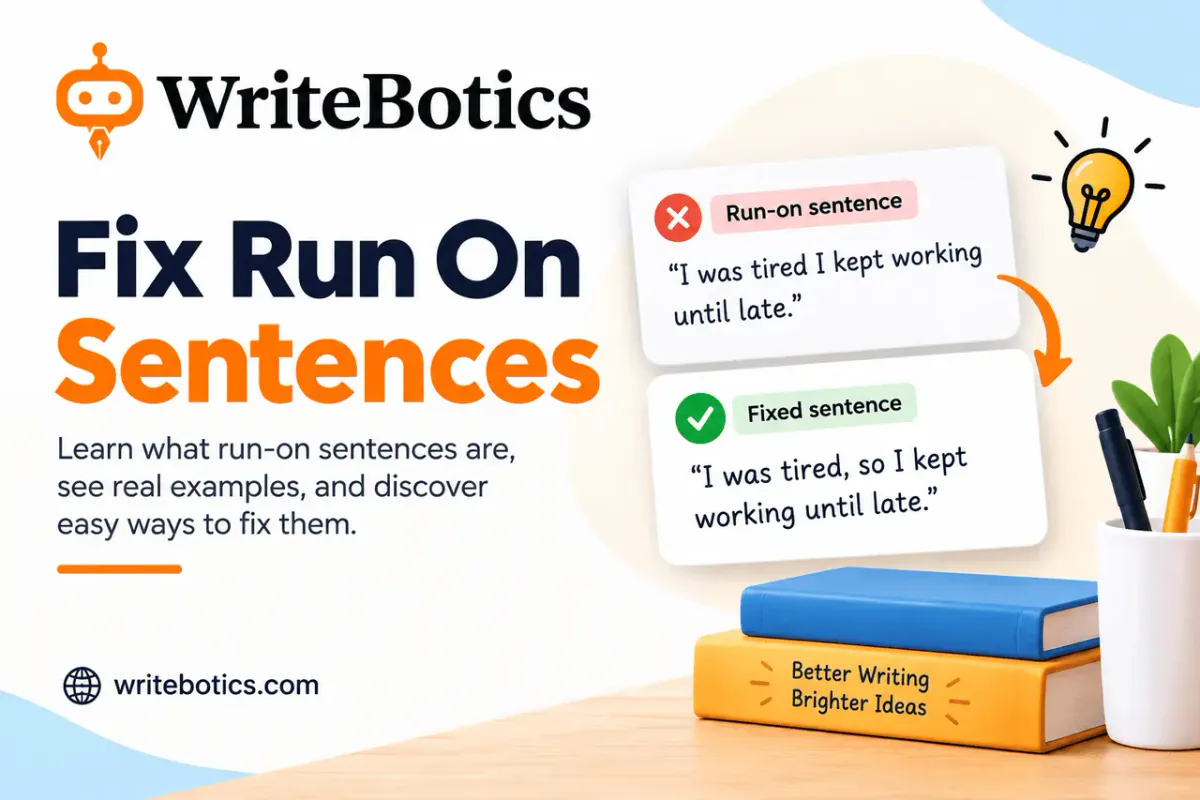
A run-on sentence incorrectly joins complete thoughts:
The meeting ended everyone left.
The fixes are different. A fragment usually needs additional information or a connection to an independent clause. A run-on needs a proper boundary or connector.
For more examples of sentence-boundary problems, see How to Fix Run-On Sentences.
Understanding both problems can make proofreading much easier because you learn to ask the same basic question:
Is this a complete sentence, and are its ideas connected correctly?
When a Fragment Is Better Left Alone
A fragment does not always need correction.
Consider:
Never again.
In a novel, speech, advertisement, or informal message, this may be exactly what the writer wants.
Likewise:
The final answer?
A writer might intentionally use this fragment in dialogue to show surprise or uncertainty.
The important distinction is between an intentional stylistic fragment and an accidental fragment.
If you are writing an academic essay or formal report, complete sentences are usually the safer choice. If you are writing creatively or conversationally, fragments can sometimes improve rhythm and emphasis.
For broader clarity and sentence-level editing, see the WriteBotics Writing Improver.
FAQs About Sentence Fragments
What is a sentence fragment?
A sentence fragment is a group of words that does not form a complete sentence. It may be missing a subject, a main verb, or an independent clause.
What is an example of a sentence fragment?
“Because the meeting was canceled” is a sentence fragment when it appears by itself. A complete version is: “Because the meeting was canceled, we returned to the office.”
How do you fix a sentence fragment?
First identify what is missing. You may need to add a subject, add a verb, attach the fragment to another sentence, or rewrite a dependent clause as a complete sentence.
Can a sentence fragment have a subject and verb?
Yes. A dependent clause can have both a subject and a verb while still being a fragment when it cannot stand alone.
For example:
Although the weather improved.
“Although the weather improved” contains a subject and verb, but “although” makes it dependent on another clause.
Is a phrase the same as a sentence fragment?
A phrase is a group of words that does not contain the structure needed for an independent clause. When a phrase is incorrectly used as a standalone sentence, it becomes a sentence fragment in that context.
Are sentence fragments always grammatically wrong?
No. Intentional fragments can be effective in creative writing, dialogue, headlines, advertising, and informal communication. In formal writing, accidental fragments should generally be corrected.
How can I tell if a sentence is complete?
Ask whether it expresses a complete thought and can stand alone. Then check whether it has the necessary subject and verb. If the sentence begins with a dependent word such as “because” or “although,” check whether it is connected to an independent clause.
What is the difference between a fragment and a run-on sentence?
A fragment is incomplete because it lacks what is needed to form an independent sentence. A run-on sentence contains multiple independent clauses that are joined incorrectly.
Can starting a sentence with “and” create a fragment?
Not automatically. A sentence can correctly begin with “and” if what follows is a complete independent clause.
For example:
And the team approved the final version.
This can be grammatically complete depending on context. The problem is not the word “and” itself. Check whether the resulting sentence expresses a complete thought.
Should I use a grammar checker to find sentence fragments?
A grammar checker can be useful for identifying possible sentence fragments, but context matters. Review the suggested correction yourself, especially when you intentionally use fragments for style or emphasis.
Final Takeaway
The easiest way to recognize sentence fragments is to ask whether the words form a complete thought that can stand on their own.
Look for three common problems: a missing subject, a missing main verb, or a dependent clause that has been separated from the independent clause it needs.
Then decide whether the fragment is accidental or intentional. Fix accidental fragments by adding what is missing or connecting the fragment to a complete sentence. Keep intentional fragments when they serve a clear stylistic purpose and fit the context.
For a final grammar review, try the WriteBotics Grammar Checker. If the bigger issue is sentence clarity rather than one specific grammar error, the WriteBotics Writing Improver can be a useful next editing step.