Writing a good essay involves more than presenting interesting ideas. Each sentence and paragraph should connect naturally so readers can follow your thoughts without confusion. This is where transitions for essays become important. They help connect ideas, introduce new points, show relationships between arguments, and guide readers from one section to another. Without Effective Transitions an essay can feel disconnected, even when its individual paragraphs contain strong information. With the right transition words and phrases, your writing becomes clearer, more organized, and easier to understand.
Whether you are writing an argumentative essay, a research paper, or a personal narrative, learning how to use transitions can significantly improve your writing.
What Are Transitions in an Essay?
Transitions are words, phrases, or sentences that connect ideas within an essay. They help readers understand how one thought relates to another.
For example:
Without a transition:
Social media helps people communicate with friends and family. It can also negatively affect mental health.
With a transition:
Social media helps people communicate with friends and family. However, excessive use can also negatively affect mental health.
The word "however" signals a contrast between the two ideas. It makes the relationship easier to understand.
Transitions can connect:
- Individual sentences.
- Supporting details.
- Paragraphs.
- Main arguments.
- Different sections of an essay.
- The introduction and conclusion.
The purpose is not simply to add more words. Effective transitions make the relationship between ideas clear.
Why Are Transitions Important in Essay Writing?
Transitions improve the overall structure and readability of an essay. They help readers move through your arguments without having to guess how different points are connected.
Here are five important benefits.
1. They Improve the Flow of Ideas
A well-written essay should feel like a continuous discussion rather than a collection of unrelated statements.
Transitions guide readers from one idea to the next. For example, words such as "first," "next," and "finally" help organize information in a logical order.
2. They Strengthen Your Arguments
In argumentative essays, transitions help explain relationships between claims and supporting evidence.
Words such as "therefore," "consequently," and "as a result" show how one point supports or leads to another.
3. They Improve Paragraph Connections
Each paragraph should contribute something meaningful to the overall discussion.
Paragraph transitions connect the main idea of one paragraph with the next, helping readers understand why the discussion is moving in a particular direction.
4. They Make Writing Easier to Understand
Readers should not have to work hard to understand how your ideas relate to each other.
Transitions clarify whether you are introducing an example, explaining a cause, presenting an opposing viewpoint, or reaching a conclusion.
5. They Create a More Professional Writing Style
Appropriate transitions make academic and professional writing more polished.
However, using too many transition words can make writing sound unnatural. The goal is to create smooth connections, not to insert a transition into every sentence.
Types of Transition Words for Essays
Different transitions communicate different relationships between ideas. Choosing the right category helps you express your meaning accurately.
1. Addition Transitions
Addition transitions introduce another supporting idea or provide extra information.
Use these when you want to expand an argument or strengthen an explanation.
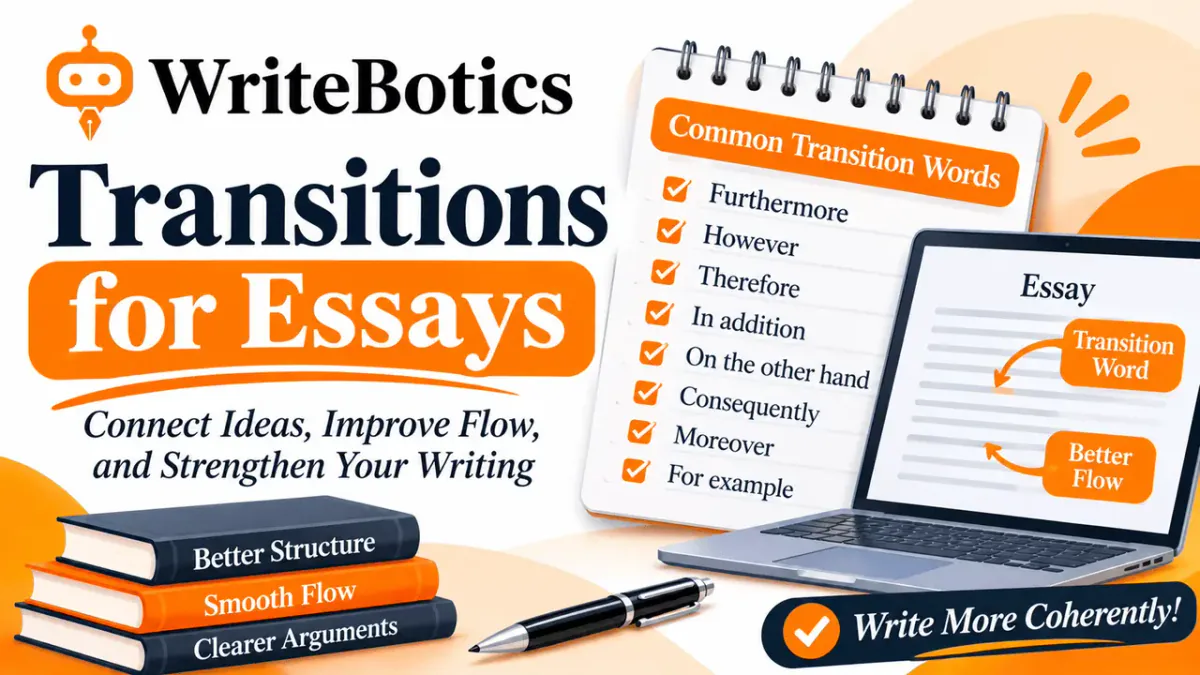
Common addition transition words:
- Additionally
- Furthermore
- Moreover
- Also
- In addition
- Besides
- Equally important
- Not only that
Example:
Reading regularly improves vocabulary and language skills. Furthermore, it helps students develop stronger critical-thinking abilities.
The transition "furthermore" introduces another benefit that supports the original point.
2. Contrast Transitions
Contrast transitions show differences between two ideas, arguments, or situations.
They are especially useful in argumentative and comparative essays.
Common contrast transition words:
- However
- Nevertheless
- On the other hand
- In contrast
- Conversely
- Although
- Whereas
- Despite this
- Even so
Example:
Online learning provides flexibility for students. However, it may offer fewer opportunities for face-to-face interaction.
The transition introduces an opposing consideration without disconnecting the discussion.
3. Cause-and-Effect Transitions
Cause-and-effect transitions explain why something happens or describe the result of an action.
These are particularly useful in analytical, explanatory, and research essays.
Common cause-and-effect transitions:
- Therefore
- Consequently
- As a result
- Thus
- Because of this
- For this reason
- Accordingly
- Hence
Example:
Many students do not get enough sleep during examination periods. As a result, they may experience difficulty concentrating in class.
The phrase "as a result" clearly connects the cause with its consequence.
4. Example Transitions
Example transitions introduce evidence, illustrations, or specific situations that support a general statement.
They help readers understand abstract ideas through practical examples.
Common example transitions:
- For example
- For instance
- To illustrate
- Specifically
- In particular
- Such as
- As an illustration
Example:
Technology has transformed many aspects of education. For instance, students can now attend virtual classes and access digital learning materials from almost anywhere.
The transition introduces a specific example that supports the broader statement.
5. Sequence and Order Transitions
Sequence transitions organize information according to time, order, or importance.
They are useful for explaining processes, describing events, and presenting step-by-step arguments.
Common sequence transitions:
- First
- Second
- Next
- Then
- Afterward
- Subsequently
- Meanwhile
- Finally
- Before
- Eventually
Example:
First, students should identify the main topic of their essay. Next, they should organize their supporting arguments. Finally, they can begin writing their first draft.
These transitions make the writing process easier to follow.
6. Conclusion Transitions
Conclusion transitions signal that an argument or discussion is approaching its end.
They help summarize important points and reinforce the main message.
Common conclusion transitions:
- In conclusion
- To summarize
- Overall
- Ultimately
- In summary
- To conclude
- All things considered
- In short
Example:
Overall, effective time management helps students balance academic responsibilities, personal activities, and relaxation.
Use conclusion transitions when they genuinely introduce a summary or final thought.
7. Emphasis Transitions
Emphasis transitions highlight important information or draw attention to a significant point.
They are useful when you want readers to focus on a particular argument.
Common emphasis transitions:
- Indeed
- Certainly
- Above all
- Most importantly
- In fact
- Particularly
- Without a doubt
Example:
Regular practice is essential for improving writing skills. Most importantly, it helps students recognize their weaknesses and develop better writing habits.
Paragraph Transitions: How to Connect One Paragraph to Another
Paragraph transitions are especially important because they help maintain a logical connection between different sections of an essay.
A common mistake is starting every paragraph with an unrelated statement. Even when each paragraph is well-written, the essay may feel disorganized if the ideas do not connect.
Consider this example:
Paragraph 1:
Regular exercise improves physical health by strengthening muscles and supporting heart function.
Paragraph 2 without a transition:
Exercise also improves mental health by reducing stress and supporting emotional well-being.
Paragraph 2 with a transition:
In addition to its physical benefits, regular exercise also improves mental health by reducing stress and supporting emotional well-being.
The improved version connects the new paragraph with the previous discussion.
Here are some useful paragraph transition phrases:
| Purpose | Paragraph transition |
|---|---|
| Add information | Building on this idea |
| Introduce contrast | Despite these benefits |
| Explain a result | As a consequence |
| Introduce evidence | A clear example of this |
| Change direction | Another important consideration |
| Summarize | Taken together |
| Introduce a new argument | Beyond this point |
Writing tip: A good paragraph transition should connect the previous paragraph's main idea with the new paragraph's purpose. Avoid using a transition simply because it sounds academic.
How to Use Transitions Naturally in Different Types of Essays
Not every essay requires the same transition words. Your choices should depend on the type of writing and the relationship between your ideas.
Argumentative Essays
Argumentative essays present claims, evidence, and opposing viewpoints.
Useful transitions include:
- To begin with
- Furthermore
- However
- On the contrary
- For this reason
- Therefore
- In conclusion
Example:
Public transportation can reduce traffic congestion in major cities. Furthermore, it can make daily commuting more affordable. However, transportation systems must be reliable to encourage people to use them.
Compare-and-Contrast Essays
These essays examine similarities and differences between two or more subjects.
Useful transitions include:
- Similarly
- Likewise
- In contrast
- Conversely
- Whereas
- On the other hand
- Both
Example:
Traditional classrooms encourage direct interaction between teachers and students. Similarly, online classrooms can support communication through virtual discussions. However, the two learning environments differ in their level of face-to-face interaction.
Narrative Essays
Narrative essays describe personal experiences or events. Transitions help readers understand the order in which events occur.
Useful transitions include:
- At first
- Shortly afterward
- Meanwhile
- Later
- Eventually
- Suddenly
- In the end
Example:
At first, I was nervous about speaking in front of the audience. Shortly afterward, I became more comfortable as I started presenting my ideas.
Expository Essays
Expository essays explain topics using facts, examples, and logical explanations.
Useful transitions include:
- For example
- Specifically
- In addition
- As a result
- Consequently
- To explain further
Example:
Water pollution affects aquatic ecosystems in several ways. For example, harmful chemicals can reduce oxygen levels and damage marine habitats.
Common Mistakes to Avoid When Using Essay Transitions
Even experienced writers sometimes use transitions incorrectly. Avoiding these mistakes can make your essays more effective.
1. Overusing Transition Words
Using "furthermore," "moreover," or "however" in every paragraph makes writing repetitive.
Instead: Use transitions only when they help clarify the relationship between ideas.
2. Choosing the Wrong Transition
A transition should accurately represent the connection between two statements.
For example, using "therefore" when introducing an unrelated example creates confusion.
Instead: Understand whether you are showing contrast, addition, cause and effect, or another relationship.
3. Using Formal Words Unnecessarily
Long or complicated transition phrases do not automatically make an essay better.
For example, "in light of the aforementioned circumstances" may be unnecessarily complicated when "because of this" communicates the same idea.
Instead: Choose clear and natural language.
4. Ignoring the Connection Between Paragraphs
Adding a transition word at the beginning of a paragraph does not automatically create a logical connection.
Instead: Make sure the new paragraph develops, explains, or contrasts with the previous discussion.
5. Repeating the Same Transitions
Repeating the same few words throughout an essay can make your writing sound predictable.
Instead: Build a varied vocabulary of transitions and choose expressions that fit the context.
How to Improve Your Essay Transitions Step by Step
You do not need to rewrite your entire essay to improve its flow. A few focused editing steps can make a significant difference.
Step 1: Identify the Main Idea of Each Paragraph
Write down the central point of every paragraph. This helps you understand the logical order of your discussion.
Step 2: Identify the Relationship Between Ideas
Ask yourself whether the next paragraph adds information, introduces a contrast, explains a result, or provides an example.
Step 3: Choose an Appropriate Transition
Select a transition that communicates the intended relationship clearly.
Step 4: Check the Sentence Structure
Make sure the transition fits grammatically and does not create awkward or unnecessarily long sentences.
Step 5: Read Your Essay Aloud
Reading aloud can help you identify sudden changes in direction, repetitive phrases, and disconnected paragraphs.
Step 6: Edit for Clarity
Remove unnecessary transitions and replace repeated expressions with more natural alternatives.
A useful additional step is to review your overall paragraph structure and essay outline. Strong organization makes it easier to create meaningful transitions.
Improve Your Writing with the Right Tools
Learning transition words is only one part of becoming a better writer. You also need to organize your ideas, maintain a consistent tone, and make sure each paragraph supports your main argument.
A writing improvement tool can help you review your sentences, identify awkward phrasing, and improve readability.
With Writebotics Writing Improver, you can work on making your writing clearer and more polished. Instead of relying on complicated vocabulary, focus on expressing ideas naturally and connecting them logically.
Remember that writing tools should support your editing process rather than replace your own judgment. Always review suggested changes to ensure that your intended meaning remains accurate.
Frequently Asked Questions About Transitions for Essays
What are the best transitions for essays?
Some commonly useful transitions include "furthermore," "however," "therefore," "for example," "similarly," and "in conclusion." The best choice depends on the relationship between the ideas you want to connect.
How do you start a new paragraph in an essay?
Start a new paragraph with a clear topic sentence that introduces its main idea. When necessary, use a transition phrase such as "building on this idea," "in contrast," or "another important consideration" to connect it with the previous paragraph.
What are good transition words for academic writing?
Useful academic transitions include "moreover," "nevertheless," "consequently," "specifically," "in addition," "similarly," and "therefore." Choose words that fit your argument and maintain a professional tone.
How many transitions should an essay have?
There is no fixed number of transitions required for an essay. Their frequency depends on the length, structure, and complexity of your writing. Use them wherever they improve clarity and flow.
Can you start a sentence with a transition word?
Yes. Starting a sentence with words such as "however," "therefore," "additionally," and "for example" is grammatically acceptable when used correctly. Make sure the punctuation and sentence structure are appropriate.
What is the difference between transition words and transition sentences?
Transition words are individual words or short phrases that connect ideas, such as "however" or "furthermore." Transition sentences are complete sentences that explain the relationship between two paragraphs or introduce a new direction in the discussion.
Final Thoughts
Transitions for essays help transform separate sentences and paragraphs into a connected, meaningful discussion. They guide readers through your arguments, explain relationships between ideas, and make your writing easier to understand.
The key is to choose transitions according to their purpose. Use addition transitions to expand ideas, contrast transitions to introduce differences, and cause-and-effect transitions to explain relationships between events or arguments.
Most importantly, prioritize logical organization over complicated vocabulary. When your ideas are clearly structured and connected naturally, your essay becomes more effective, engaging, and professional.