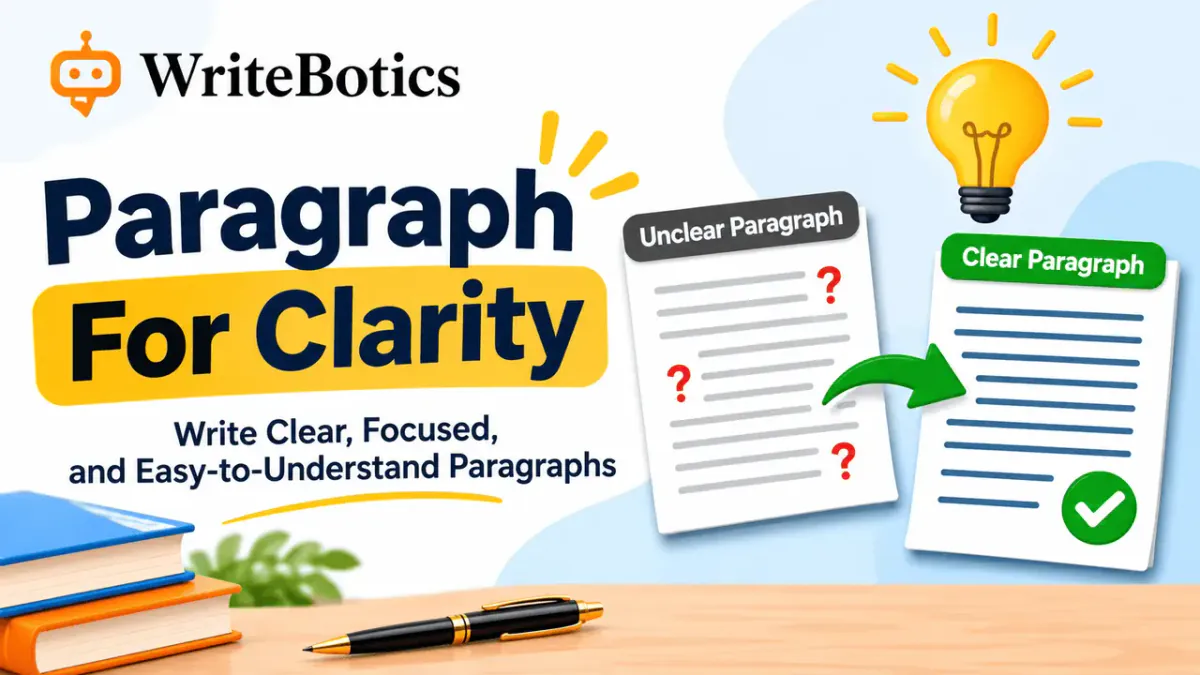
Writing a good paragraph is only the first step toward effective communication. Even when your ideas are meaningful and supported by relevant information, poor sentence structure, unnecessary words, and weak connections can make your writing difficult to understand.
Learning how to edit a paragraph for clarity helps you communicate your ideas more effectively. It allows you to remove confusing expressions, improve sentence order, strengthen supporting details, and create smoother transitions between ideas.
Whether you are writing an academic essay, a research paper, a blog post, or professional content, paragraph editing can make a significant difference in the quality of your writing.
The good news is that you do not need to Rewrite Every Paragraph Completely. A systematic editing process can help you identify weaknesses and improve your writing one step at a time.
In this guide, you will learn a practical five-pass editing method to improve paragraph focus, organization, evidence, transitions, and wording.
Why Is Paragraph Editing Important?
A paragraph should communicate one central idea through logically connected sentences. If the sentences are unclear, repetitive, or poorly organized, readers may struggle to understand your message.
Paragraph editing helps solve these problems before you finalize your writing.
Here are five important benefits:
- Improves readability: Clear sentences make your content easier to understand.
- Strengthens your message: Removing unnecessary information helps readers focus on your main point.
- Creates better flow: Logical sentence order helps ideas connect naturally.
- Improves credibility: Accurate evidence and precise wording make your arguments more convincing.
- Maintains consistency: Editing helps establish a consistent tone and writing style.
For students, paragraph editing is especially useful when preparing essays, assignments, research papers, and dissertations. For content writers, it helps create engaging articles that readers can follow easily.
What Makes a Paragraph Clear and Well-Organized?
Before editing, it helps to understand the elements of an effective paragraph.
A well-structured paragraph generally contains four important components.
| Component | Purpose |
|---|---|
| Topic sentence | Introduces the paragraph's central idea. |
| Supporting evidence | Provides examples, facts, explanations, or research findings. |
| Analysis | Explains how the supporting information relates to the main idea. |
| Concluding or linking sentence | Reinforces the idea or connects it to the next paragraph. |
Consider this example:
Weak paragraph:
"Reading is important for students. It helps them learn new things. Students also need good vocabulary. Reading books is useful. It can improve writing."
Improved paragraph:
"Regular reading plays an important role in students' academic development. It exposes them to new ideas, strengthens vocabulary, and improves their understanding of language. Furthermore, reading different types of texts helps students recognize effective writing techniques that they can apply in their own assignments. As a result, developing a consistent reading habit can support both communication and academic writing skills."
The improved version has a clear central idea, supporting explanations, and better connections between sentences.
The Five-Pass Method for Editing a Paragraph
One of the easiest ways to edit a paragraph is to review it in five separate passes. Each pass focuses on a different aspect of writing.
Your five-pass paragraph editing framework
Focus
Check whether the paragraph communicates one clear main idea.
Order
Arrange sentences in a logical sequence.
Evidence
Check whether supporting information is relevant and sufficient.
Transitions
Improve connections between sentences and ideas.
Wording
Remove unnecessary words and improve sentence clarity.
Let's explore each editing pass in detail.
Pass 1: Focus – Check the Main Idea
The first step is to identify what your paragraph is actually trying to communicate.
Every paragraph should have a central purpose. If you include several unrelated ideas, readers may lose track of your main message.
Start by asking:
- What is the main point of this paragraph?
- Does the topic sentence clearly introduce that point?
- Does every sentence support the same idea?
- Are there any unrelated details?
- Does the paragraph repeat information unnecessarily?
Example:
Original paragraph:
"Exercise improves physical health. Students should also eat healthy food. Many people enjoy watching movies. Regular exercise can strengthen muscles and improve cardiovascular health."
The paragraph discusses exercise, nutrition, and entertainment. These ideas do not all support the same central point.
Edited paragraph:
"Regular exercise supports physical health by strengthening muscles and improving cardiovascular fitness. It can also help individuals maintain an active lifestyle and develop better physical endurance."
The edited version focuses entirely on the benefits of exercise.
Editing tip: If a sentence does not support your paragraph's main idea, remove it or move it to a more appropriate paragraph.
Pass 2: Order – Arrange Sentences Logically
Once your paragraph has a clear focus, examine the order of its sentences.
Even relevant sentences can create confusion when they appear in the wrong sequence.
A useful structure is:
- Introduce the main idea.
- Provide supporting information.
- Explain the evidence.
- Connect the discussion to the broader topic.
Consider this example.
Poorly organized paragraph:
"Students can improve their vocabulary through reading. Academic writing requires clear communication. Reading also exposes students to different sentence structures. Many students struggle with expressing complex ideas."
Better-organized paragraph:
"Academic writing requires clear communication and a strong vocabulary. However, many students struggle to express complex ideas effectively. Regular reading can help address this challenge by exposing students to new vocabulary and different sentence structures."
The revised version introduces the broader idea, identifies the challenge, and then presents a relevant solution.
Editing tip: Read your sentences individually and check whether each one naturally prepares the reader for the next.
Pass 3: Evidence – Strengthen Supporting Information
A clear paragraph needs more than a strong topic sentence. Its supporting details should explain, demonstrate, or strengthen the central idea.
Evidence can include:
- Research findings.
- Statistics.
- Real-world examples.
- Expert opinions.
- Relevant observations.
- Specific explanations.
For academic writing, evidence should come from credible and appropriate sources.
Example:
Weak paragraph:
"Online learning is useful for students because it is flexible and convenient. Many students like online education because it is good."
The paragraph makes general claims without explaining them.
Improved paragraph:
"Online learning provides students with greater flexibility by allowing them to access educational materials outside traditional classroom hours. For example, recorded lectures enable learners to revisit difficult topics at their own pace. This flexibility can be particularly valuable for students who balance academic responsibilities with employment or family commitments."
The improved version provides a specific example and explains why the benefit matters.
Editing tip: Ask yourself whether a reader would understand why your supporting information proves or explains your main point.
For research-based writing, verify every statistic, quotation, and factual claim against its original source.
Pass 4: Transitions – Improve Paragraph Flow
Transitions help readers understand how sentences and ideas relate to one another.
Without appropriate connections, writing can sound like a list of separate statements.
For example:
"Technology improves communication. Students can attend online classes. They can access digital resources. Some students experience technical difficulties."
These sentences are relevant, but their relationships are not clearly explained.
Improved version:
"Technology improves communication and creates new learning opportunities. For example, students can attend online classes and access digital educational resources. However, some learners may experience technical difficulties that affect their participation."
The transitions "for example" and "however" clarify the relationship between the ideas.
Here are useful transitions for different purposes:
| Purpose | Useful transitions |
|---|---|
| Adding information | Furthermore, additionally, moreover |
| Showing contrast | However, nevertheless, in contrast |
| Giving examples | For example, for instance, specifically |
| Explaining results | Therefore, consequently, as a result |
| Showing similarity | Similarly, likewise, in the same way |
| Concluding | Overall, ultimately, in summary |
Do not force a transition into every sentence. Sometimes a clear sentence structure creates a natural connection without additional linking words.
Editing tip: Read the paragraph aloud. If the discussion feels abrupt or disconnected, examine whether the relationship between the sentences needs clarification.
Pass 5: Wording – Make Sentences Clear and Concise
The final pass focuses on the actual words and expressions you use.
Even well-organized paragraphs can become difficult to read when sentences contain unnecessary words, vague expressions, or complicated language.
Look for:
- Repeated words and phrases.
- Unnecessarily long sentences.
- Vague expressions.
- Weak verbs.
- Complicated vocabulary.
- Redundant explanations.
- Incorrect grammar and punctuation.
Example:
Before editing:
"Due to the fact that students have a limited amount of time available to them, it is important for them to make use of effective time management strategies."
After editing:
"Because students have limited time, they should use effective time management strategies."
The revised version communicates the same message with fewer words.
Another example:
Wordy: "The reason why regular exercise is important is because it has several benefits."
Clear: "Regular exercise is important because it offers several benefits."
Editing tip: Choose simple, precise language. Academic writing should be professional and clear, not unnecessarily complicated.
A Practical Paragraph Editing Checklist
After completing the five editing passes, use this checklist to evaluate your paragraph.
Paragraph editing checklist
0/10 completed
The paragraph communicates one clear main idea.
The topic sentence introduces the central point.
Every sentence supports the main idea.
Sentences appear in a logical order.
Supporting evidence is relevant and accurate.
Explanations connect evidence to the main argument.
Transitions create natural connections.
Repeated or unnecessary information has been removed.
Sentences use clear and precise wording.
Grammar, spelling, and punctuation are correct.
Reset checklist
Use this checklist whenever you review an academic paragraph, blog post, essay, or professional document.
Common Paragraph Editing Mistakes to Avoid
Editing is not simply about making sentences shorter or replacing basic words with complicated alternatives. It is about improving how effectively your ideas are communicated.
Avoid these common mistakes.
1. Removing Too Much Information
Trying to make every paragraph shorter can remove important explanations and supporting evidence.
Better approach: Remove unnecessary words while keeping information that contributes to the main idea.
2. Using Too Many Transition Words
Adding "furthermore," "moreover," and "however" repeatedly can make writing sound unnatural.
Better approach: Use transitions only when they clarify relationships between ideas.
3. Changing Words Without Improving Meaning
Replacing simple vocabulary with sophisticated alternatives does not automatically improve writing.
Better approach: Choose words that communicate your intended meaning accurately.
4. Ignoring Sentence Structure
A paragraph may contain relevant ideas but still be difficult to understand because of awkward sentence construction.
Better approach: Review sentence length, punctuation, subject-verb agreement, and grammatical structure.
For additional guidance, explore our article on improving sentence structure.
5. Editing Without Considering the Reader
A paragraph might make sense to its writer but remain confusing to someone reading it for the first time.
Better approach: Review your writing from the reader's perspective. Ask whether the message is immediately understandable.
How Writebotics Can Help Improve Paragraph Clarity
Manually editing every sentence can take time, especially when working on long essays, research papers, or professional documents.
Writing tools can support your editing process by identifying problems that may be difficult to notice during self-review.
Writebotics Writing Improver
Use the Writing Improver to refine awkward sentences, improve readability, and make paragraphs more natural. It can help you identify expressions that need clarification while preserving your intended message.
Writebotics Grammar Checker
Use the Grammar Checker to review grammar, punctuation, spelling, and common language errors. Correcting these issues helps make your paragraphs more polished and professional.
For the best results, combine automated suggestions with the five-pass editing method. Always review suggested changes to ensure they preserve your original meaning and writing style.
Frequently Asked Questions
How do you edit a paragraph for clarity?
Start by identifying its main idea. Then review sentence order, check supporting evidence, improve transitions, and remove unnecessary wording. Finally, check grammar and punctuation to ensure the paragraph communicates its message clearly.
What are the five steps of paragraph editing?
A practical five-step method includes checking focus, arranging sentence order, evaluating evidence, improving transitions, and refining wording. These steps help improve paragraph organization, readability, and overall clarity.
How can I improve the flow of a paragraph?
Arrange sentences in a logical sequence, make sure each sentence connects to the central idea, and use appropriate transitions where needed. Reading the paragraph aloud can also help identify abrupt changes and awkward connections.
How long should a paragraph be?
There is no universal paragraph length. A paragraph should be long enough to develop one central idea with sufficient explanation and supporting information. Avoid adding sentences simply to reach a particular word count.
Should I edit grammar or structure first?
Start with structure and meaning. Check the paragraph's focus, sentence order, and supporting evidence before correcting grammar and punctuation. This prevents you from spending time polishing sentences that may later need to be removed or rewritten.
What is the difference between proofreading and editing?
Editing improves the content, organization, clarity, sentence structure, and flow of writing. Proofreading focuses on identifying final errors such as spelling mistakes, punctuation problems, and grammatical inconsistencies.
Final Thoughts
Learning how to edit a paragraph for clarity is an important step toward becoming a stronger writer. A well-written paragraph should communicate one central idea, support it with relevant information, and guide readers through a logical sequence of sentences.
The five-pass editing method makes this process manageable: check the focus, improve the order, strengthen the evidence, refine transitions, and simplify wording.
You do not need to make every sentence complicated or excessively formal. Instead, aim for writing that is accurate, natural, concise, and easy to understand.
With consistent practice and the right editing techniques, you can turn rough paragraphs into clear, organized, and effective writing.