Writing clearly is an essential skill, whether you are creating business documents, academic papers, website content, or everyday professional emails. However, complex sentences can make even good writing difficult to understand.
Long sentences, unnecessary words, technical expressions, and complicated grammatical structures often prevent readers from understanding the main message quickly.
Learning how to simplify complex sentences can make your writing more readable, professional, and effective without losing important information.
The challenge is that simplifying a sentence does not mean removing essential details or changing its original meaning. You need to preserve the writer's intention, important qualifications, technical terms, and relationships between ideas while making the language easier to understand.
In this guide, you will learn how to Simplify Complex Sentences, practical techniques for improving sentence clarity, and examples that show how to rewrite complicated sentences without changing their meaning.
What Does It Mean to Simplify Complex Sentences?
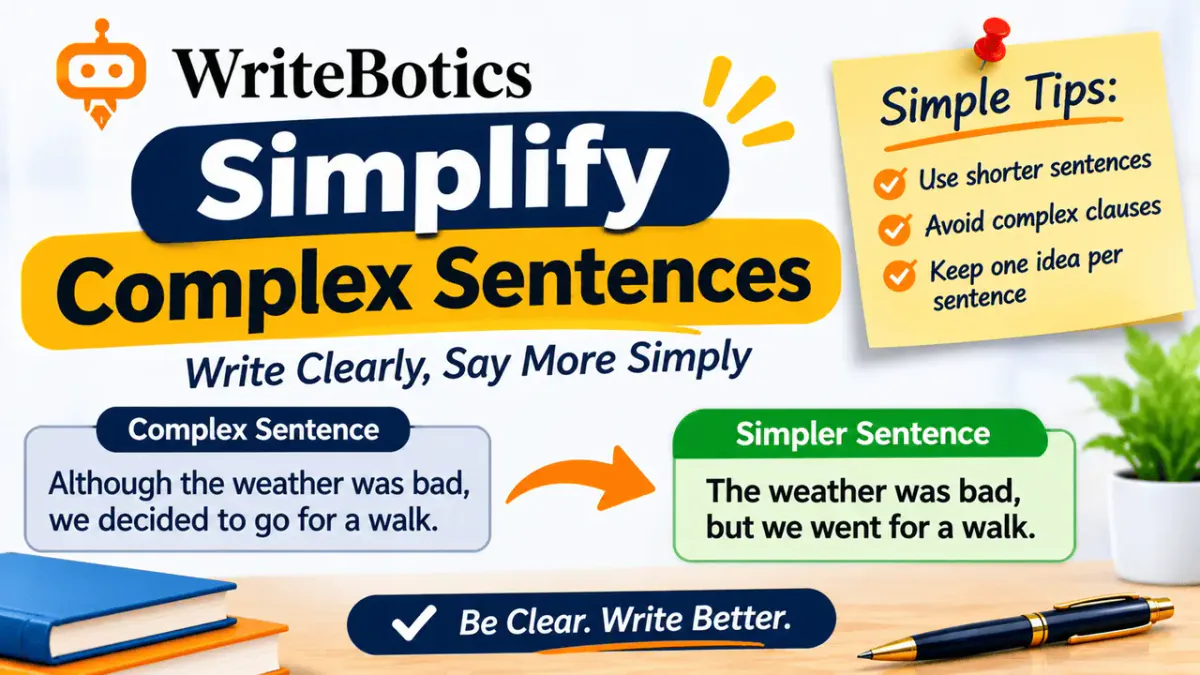
Sentence simplification is the process of rewriting complicated sentences using clearer words, shorter structures, and more direct language while preserving the original meaning.
A complex sentence may contain unnecessary phrases, multiple clauses, technical vocabulary, or complicated grammatical constructions.
For example:
Complex sentence:
"Due to the fact that the marketing campaign was unable to achieve its intended performance objectives, the management team decided to implement several modifications to the existing promotional strategy."
Simplified sentence:
"Because the marketing campaign failed to meet its goals, management decided to modify the promotional strategy."
Both sentences communicate the same essential information, but the simplified version is shorter and easier to understand.
The goal is not simply to reduce word count. It is to make the message more accessible without sacrificing accuracy.
Why Is Sentence Simplification Important?
Clear sentences help readers understand information faster and reduce the effort required to process complicated ideas.
Here are some important benefits of simplifying sentences.
- Improves readability: Readers can understand your message without repeatedly reading the same sentence.
- Strengthens communication: Clear writing reduces misunderstandings in professional and academic environments.
- Saves time: Shorter, more direct sentences help readers find important information quickly.
- Improves user experience: Website visitors can navigate content more easily when information is presented clearly.
- Makes technical information accessible: Complicated concepts become easier to understand when explained in straightforward language.
- Supports effective SEO content: Readable, useful content makes it easier for visitors to find answers and engage with your website.
For businesses, educators, writers, and content creators, sentence simplification can make communication more effective across different audiences.
How to Simplify Complex Sentences: 8 Effective Techniques
You do not need to change your entire writing style to improve sentence clarity. Small adjustments can make a significant difference.
1. Remove Unnecessary Words and Phrases
One of the easiest ways to simplify a sentence is to remove words that do not contribute meaningful information.
Many writers use unnecessarily long expressions when shorter alternatives communicate the same idea.
Consider these examples:
| Complex Expression | Simpler Alternative |
|---|---|
| Due to the fact that | Because |
| At this point in time | Now |
| In the event that | If |
| For the purpose of | To |
| Make a decision regarding | Decide about |
| In close proximity to | Near |
| Has the ability to | Can |
| With regard to | About |
Example:
Complex: "At this point in time, we are unable to provide a final decision regarding the proposed changes."
Simplified: "We cannot make a final decision about the proposed changes yet."
The revised sentence communicates the same essential message using fewer words.
2. Break Long Sentences Into Shorter Sentences
Sentences containing several independent ideas can overwhelm readers.
Instead of connecting multiple thoughts with commas and conjunctions, consider separating them into two or more sentences.
Example:
Complex: "The company introduced a new employee training program to improve workplace productivity, reduce operational errors, and ensure that all employees understand the updated procedures."
Simplified: "The company introduced a new employee training program to improve productivity and reduce operational errors. The program also helps employees understand the updated procedures."
The second version makes each idea easier to process.
However, do not break sentences unnecessarily. If two ideas are closely connected, keeping them together may produce better writing.
3. Replace Complicated Vocabulary With Familiar Words
Using advanced vocabulary does not automatically make writing more professional.
When a simpler word communicates the same meaning, it is usually the better choice.
Examples include:
- Utilize → Use
- Commence → Begin
- Terminate → End
- Facilitate → Help
- Demonstrate → Show
- Approximately → About
- Subsequent → Following
- Obtain → Get
Example:
Complex: "The organization will commence the implementation of its revised operational procedures next month."
Simplified: "The organization will begin using its revised operating procedures next month."
Choose familiar vocabulary without removing distinctions that matter. For example, a technical term should remain when replacing it would make the statement less accurate.
4. Use Active Voice When Appropriate
Active voice often makes sentences more direct by clearly identifying who performs an action.
Passive voice:
"The final report was reviewed by the project manager before it was submitted."
Active voice:
"The project manager reviewed the final report before submitting it."
The active version is more direct and identifies the person responsible for the action.
However, passive voice is not always incorrect. It can be useful when the person performing an action is unknown, unimportant, or less relevant than the action itself.
For example:
"The equipment was damaged during transportation."
If the responsible person is unknown, changing this to active voice would require inventing information.
5. Remove Repetition and Redundant Information
Sometimes writers repeat the same idea using different expressions.
Removing unnecessary repetition makes sentences more concise.
Examples:
| Redundant Expression | Simplified Expression |
|---|---|
| Final outcome | Outcome |
| Basic fundamentals | Fundamentals |
| Past history | History |
| Completely eliminate | Eliminate |
| Each and every | Each |
| Advance planning | Planning |
| Future plans | Plans |
Example:
Complex: "The main reason for the delay was primarily due to unexpected technical problems."
Simplified: "The delay was mainly caused by unexpected technical problems."
The revised sentence removes unnecessary repetition while preserving the original explanation.
6. Organize Ideas in a Logical Order
A sentence becomes easier to understand when information appears in a natural sequence.
Place the main subject and action near the beginning, then introduce supporting details.
Example:
Complex: "After completing the required security checks, which were introduced following the recent system update, employees can access the new platform."
Simplified: "Employees can access the new platform after completing the required security checks introduced in the recent system update."
The revised sentence presents the main action earlier while retaining the relevant context.
7. Replace Unclear Pronouns With Specific Nouns
Pronouns such as "it," "they," "this," and "that" can create confusion when multiple subjects appear in the same sentence.
Example:
Complex: "The marketing team discussed the new advertising strategy with the sales department, but they did not approve it."
Who did not approve the strategy? The marketing team or the sales department?
Clearer version:
"The marketing team discussed the new advertising strategy with the sales department, but the sales department did not approve the strategy."
The revised sentence makes the intended meaning clear.
8. Preserve Important Qualifications and Technical Details
This is one of the most important principles of sentence simplification.
A sentence may contain words that seem unnecessary but actually limit, qualify, or explain the original statement.
Words such as "may," "might," "usually," "only," "unless," "approximately," and "in certain circumstances" can significantly affect meaning.
Consider this example:
Original:
"Employees may work remotely on Fridays if their managers approve the arrangement and their responsibilities do not require an on-site presence."
Incorrect simplification:
"Employees can work remotely on Fridays."
The simplified version removes two important conditions: managerial approval and the requirement to be available on-site.
Correct simplification:
"Employees may work remotely on Fridays if their managers approve and their jobs do not require them to be on-site."
The revised sentence is easier to understand while preserving both conditions.
This principle is especially important when simplifying academic research, legal documents, medical information, financial reports, and technical instructions.
Before-and-After Examples of Complex Sentence Simplification
The following examples demonstrate how to improve sentence clarity without changing important information.
| Complex Sentence | Simplified Sentence |
|---|---|
| In order to improve customer satisfaction, the company implemented several changes. | The company made several changes to improve customer satisfaction. |
| The results indicate that there may be a significant improvement in performance. | The results suggest that performance may improve significantly. |
| Due to unexpected circumstances, the scheduled meeting has been postponed until further notice. | Unexpected circumstances have postponed the meeting. A new date has not yet been announced. |
| The research was conducted for the purpose of identifying potential causes of employee dissatisfaction. | The research aimed to identify possible causes of employee dissatisfaction. |
| Customers who have completed the registration process will be eligible to receive additional benefits. | Customers who have registered can receive additional benefits. |
Notice that effective simplification does not always mean producing the shortest possible sentence. Sometimes retaining a second sentence or an important qualification is necessary for accuracy.
How to Simplify Academic and Technical Sentences
Academic and technical writing often contains specialized vocabulary, detailed explanations, and carefully qualified statements.
Simplifying this type of content requires extra attention because changing a single word can alter the original claim.
Consider the following example:
Original academic sentence:
"The findings suggest that increased exposure to natural light may contribute to improved concentration among participants, although the relationship was not statistically significant across all age groups."
Oversimplified version:
"Natural light improves concentration."
This version changes the original research finding. It removes uncertainty and ignores the statistical qualification.
Better simplified version:
"The findings suggest that natural light may improve concentration. However, this relationship was not statistically significant in every age group."
The revised version maintains the original uncertainty and research limitation.
When simplifying academic or technical writing:
- Keep important technical terms when no accurate alternative exists.
- Preserve numerical values, measurements, and research findings.
- Maintain words that express uncertainty or limitations.
- Do not turn correlations into claims of causation.
- Keep conditions and exceptions intact.
- Avoid presenting possibilities as confirmed facts.
The objective is to make technical information easier to read without weakening its accuracy.
Common Mistakes to Avoid When Simplifying Sentences
Simplifying sentences requires more than shortening them. Avoid these common mistakes:
Removing essential information: Deleting conditions, exceptions, or supporting details can change the original message.
Replacing precise words with vague alternatives: A familiar word is not always an accurate substitute for a technical term.
Breaking every long sentence apart: Some complex sentences are logically connected and should remain together.
Changing the level of certainty: Replacing "may improve" with "improves" changes the strength of the original statement.
Overusing simple vocabulary: Repeating basic words can make writing sound unnatural. Focus on clarity rather than avoiding every advanced word.
Ignoring grammar: Short sentences still need correct punctuation, sentence structure, and subject-verb agreement.
How AI Writing Tools Can Help Simplify Complex Sentences
AI-powered writing tools can make sentence simplification faster and easier.
A Writing Improver can help identify unnecessarily complicated expressions, suggest clearer alternatives, improve sentence structure, and adjust writing for different audiences.
For example, you can use this prompt:
"Rewrite the following paragraph using simple, clear, and professional language. Preserve the original meaning, technical terminology, qualifications, conditions, and level of certainty. Do not remove important details or introduce new information."
AI tools can be particularly useful for:
- Simplifying academic paragraphs.
- Improving business communication.
- Rewriting technical explanations.
- Making website content easier to read.
- Improving grammar and sentence flow.
- Adapting content for different reading levels.
However, AI-generated rewrites should always be reviewed. Automated tools can sometimes remove important qualifications, misunderstand technical terminology, or change the intended meaning.
For sensitive or high-stakes documents, compare the revised version with the original before using it.
Frequently Asked Questions About Sentence Simplification
How can I simplify a sentence without changing its meaning?
Identify the main idea, remove unnecessary words, replace complicated expressions with accurate alternatives, and reorganize the sentence. Preserve important conditions, qualifications, technical terms, and relationships between ideas.
What is the easiest way to make complex sentences easier to read?
Start by identifying unnecessary phrases and redundant information. Then use familiar vocabulary, direct sentence structures, and shorter sentences where appropriate.
Should I always break long sentences into shorter ones?
No. Break long sentences when they contain multiple independent ideas that are difficult to follow. Keep closely connected ideas together when doing so improves clarity.
How do I simplify academic writing without losing accuracy?
Use straightforward language while preserving technical terms, research findings, limitations, numerical information, and expressions of uncertainty. Never change a qualified research statement into an absolute claim.
Can AI simplify complex sentences?
Yes. AI writing tools can suggest clearer sentence structures, replace unnecessarily complicated expressions, and improve readability. Always review the result to ensure that the original meaning remains unchanged.
What is the difference between sentence simplification and paraphrasing?
Sentence simplification focuses on making language easier to understand by reducing unnecessary complexity. Paraphrasing expresses the same information using different wording or sentence structures, sometimes without necessarily making it simpler.
Final Thoughts
Simplifying complex sentences is one of the most effective ways to improve writing clarity and communication.
By removing unnecessary words, using familiar vocabulary, organizing ideas logically, and choosing direct sentence structures, you can make your writing easier to understand without sacrificing important information.
The most important rule is to preserve the original meaning. Always pay attention to qualifications, technical details, conditions, and expressions of uncertainty when rewriting a sentence.
Whether you are writing academic papers, professional emails, business documents, or website content, clear sentences help readers understand your message with less effort.
Use these techniques consistently, review your writing carefully, and consider using a Writing Improver to identify opportunities for clearer and more effective communication.