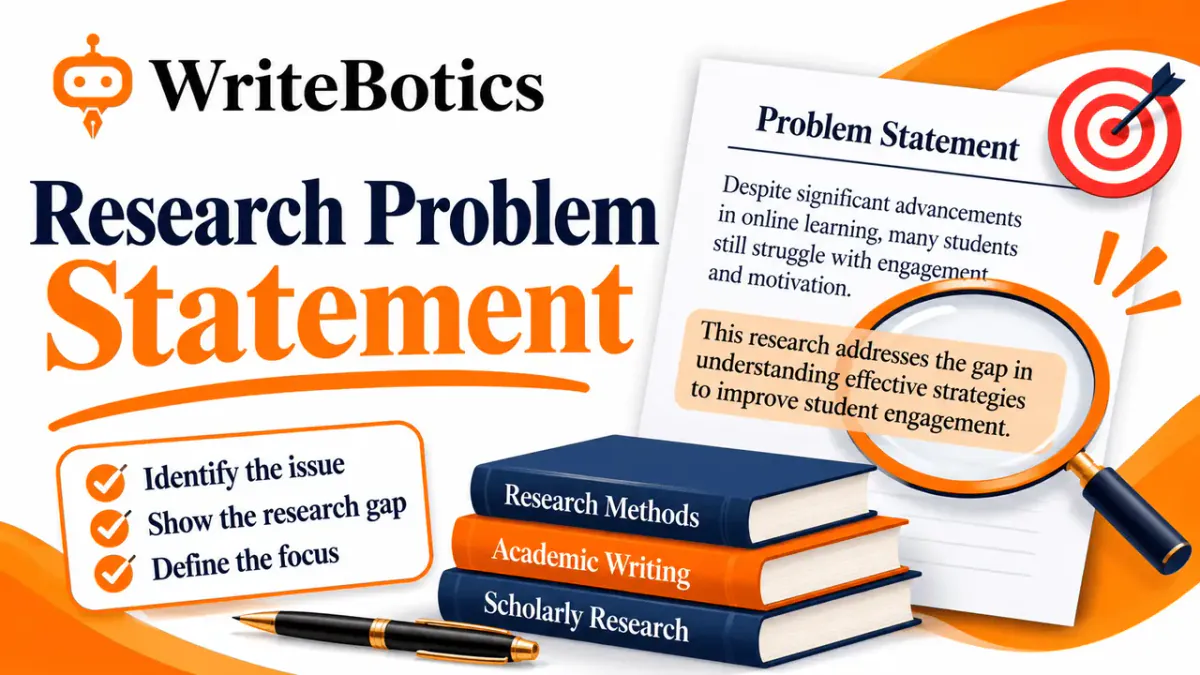
Every successful research project begins with a clear understanding of what needs to be investigated. Before collecting data, reviewing academic sources, or developing a research methodology, you must identify the specific problem your study intends to address. This is where a research problem statement becomes essential.
Learning how to write a Research Problem Statement helps you explain what is wrong, what is missing from existing knowledge, and why further investigation is necessary. A well-written statement also gives your research direction and helps readers understand the importance of your study.
Whether you are preparing a university assignment, dissertation, thesis, or professional research proposal, developing a strong problem statement is an important first step.
In this guide, you will learn how to structure a research problem statement, identify a research gap, and develop a clear statement using practical examples.
What Is a Research Problem Statement?
A research problem statement is a concise explanation of an issue, challenge, or knowledge gap that a research project aims to investigate.
It identifies the problem, provides relevant background information, explains what is currently unknown or insufficiently understood, and establishes why the issue deserves attention.
In simple terms, it answers four important questions:
- What is happening?
- Why is it a problem?
- What information or understanding is missing?
- Why does this problem need to be researched?
For example, imagine you are studying the impact of social media on university students' academic performance.
A general topic might be:
"Social Media and Academic Performance Among University Students."
However, this topic does not explain the specific research problem.
A more focused problem statement could be:
"Although social media platforms provide university students with opportunities to access educational resources, excessive non-academic use may reduce study time and concentration. However, the relationship between daily social media use and academic performance among undergraduate students at public universities remains insufficiently understood. This study will investigate how social media usage patterns relate to students' academic performance."
The second version identifies the issue, highlights an area requiring further investigation, and establishes the purpose of the research.
Why Is a Research Problem Statement Important?
A research problem statement is more than an introductory paragraph. It establishes the foundation of your entire research project.
Here are five reasons why it matters.
1. It Gives Your Research a Clear Direction
A well-defined problem helps you determine what your study should investigate.
Without a clear problem statement, research can become too broad, making it difficult to decide which information is relevant.
For example, instead of studying everything related to online education, you might focus specifically on the challenges university students experience with online learning platforms.
2. It Identifies the Research Gap
Research should contribute something meaningful to existing knowledge.
A problem statement helps identify what previous studies have overlooked, what questions remain unanswered, or which issues require further investigation.
This gives your research a clear academic purpose.
3. It Justifies the Need for Your Study
Readers need to understand why your research deserves attention.
A strong problem statement explains the practical, academic, or social consequences of the issue.
For instance, research into employee burnout may help organizations understand workplace conditions that affect productivity and employee well-being.
4. It Helps Develop Research Questions
Your research questions should directly emerge from the problem you identify.
If your problem concerns the relationship between remote working and employee productivity, your research questions should investigate that relationship rather than unrelated workplace issues.
5. It Supports Your Research Methodology
Once you understand the problem, you can choose an appropriate research approach.
For example:
- Quantitative research may measure relationships between variables.
- Qualitative research may explore personal experiences and opinions.
- Mixed-methods research may combine numerical data with detailed interviews.
A clear problem statement makes these decisions easier.
The Four Essential Parts of a Research Problem Statement
An effective research problem statement usually follows a logical structure. One practical framework includes four components: context, problem, evidence of the gap, and significance.
Research problem statement framework
Context
Introduce the research topic and explain the background.
Problem
Identify the specific issue that needs investigation.
Evidence of the research gap
Explain what existing research has not adequately addressed.
Significance
Explain why investigating the problem matters.
Let's examine each component.
1. Context: Introduce the Research Area
Begin by providing background information about the topic.
Your opening should help readers understand the broader situation before introducing the specific problem.
For example:
"Online learning has become an increasingly important part of higher education. Universities use digital platforms to deliver lectures, distribute educational materials, and communicate with students."
This establishes the research context without introducing unnecessary details.
Writing tip: Keep your background relevant. Avoid including general information that does not help explain your research problem.
2. Problem: Identify the Specific Issue
After introducing the context, explain what is wrong or what challenge needs attention.
Be specific about the issue rather than describing the entire subject area.
For example:
"Despite the growing use of online learning platforms, many university students experience difficulties maintaining engagement during virtual lectures."
This statement identifies a particular issue within the broader topic.
A useful problem description should explain:
- Who experiences the problem?
- Where does it occur?
- What exactly is happening?
- What are its possible consequences?
3. Evidence of the Research Gap: Explain What Is Missing
A research gap is an area that existing research has not adequately explored, explained, or resolved.
Identifying this gap helps demonstrate why your study is necessary.
For example:
"Although previous studies have examined student satisfaction with online education, limited research has investigated how internet connectivity challenges influence participation among students in rural universities."
This highlights a potentially underexplored area.
You should support research-gap claims with credible academic literature. Avoid claiming that no research exists unless you have conducted a sufficiently thorough literature search.
4. Significance: Explain Why the Problem Matters
The final component explains why investigating the problem is important.
Consider its potential contribution to academic knowledge, professional practice, policy development, or society.
For example:
"Understanding these challenges may help universities develop more accessible online learning systems and improve educational participation among students in underserved communities."
This explains the potential value of the research.
How to Write a Research Problem Statement Step by Step
Now that you understand its structure, follow these steps to develop your own problem statement.
Step 1: Choose a Specific Research Topic
Start with a general subject that interests you or relates to your academic field.
Examples include:
- Social media and student performance.
- Employee motivation in remote workplaces.
- Artificial intelligence in higher education.
- Climate change and agricultural productivity.
- Digital marketing and consumer behavior.
Avoid selecting a topic that is too broad.
For instance, "Technology in Education" covers too many issues. A more focused topic would be "The Impact of AI Writing Tools on Academic Writing Skills Among Undergraduate Students."
Step 2: Conduct Preliminary Research
Before defining your problem, explore existing academic research.
Look for journal articles, research papers, dissertations, and credible academic publications.
Pay attention to:
- Findings from previous studies.
- Limitations identified by researchers.
- Conflicting research results.
- Questions that remain unanswered.
- Populations or geographical areas that have received limited attention.
These findings can help you identify a meaningful research gap.
Step 3: Identify the Specific Research Problem
Once you have reviewed relevant sources, define the issue your study will address.
Ask yourself:
- What is the main challenge?
- Who is affected?
- What happens if the issue remains unresolved?
- Which aspect requires further investigation?
Your answer should be narrow enough to investigate within your available time and resources.
Step 4: Find Evidence Supporting the Problem
A strong problem statement should be based on evidence rather than personal assumptions.
Use relevant statistics, published research findings, institutional reports, or credible observations.
For example, if your study concerns student engagement, academic research on online participation and learning outcomes can help establish why the problem deserves attention.
Make sure every factual claim is supported by an appropriate source.
Step 5: Explain the Research Gap
Compare what researchers already know with what still needs investigation.
For example:
"Previous studies have explored the benefits of remote learning, but fewer have examined how limited access to reliable internet affects participation among students in rural educational institutions."
This establishes a direction for further investigation.
Step 6: Explain the Significance of Your Research
Describe who could benefit from the findings and how they might be useful.
Your research may contribute to:
- Academic understanding.
- Better organizational decisions.
- Improved educational practices.
- Public awareness.
- Policy development.
- Practical solutions to existing challenges.
Avoid promising outcomes that your research cannot guarantee.
Step 7: Write, Review, and Refine
Combine the four components into a coherent statement.
After writing your first draft, check whether it:
- Introduces the research context.
- Clearly identifies the problem.
- Establishes a research gap supported by evidence.
- Explains why the study matters.
- Uses precise and understandable language.
- Aligns with your research objectives and questions.
Remove unnecessary background information and vague statements.
Research Problem Statement Examples
Practical examples make it easier to understand how the four-part framework works across different academic subjects.
Example 1: Social Media and Academic Performance
Research topic: The impact of social media usage on university students' academic performance.
Problem statement:
Social media platforms have become an important part of university students' daily lives, providing opportunities for communication, entertainment, and educational interaction. However, excessive use of these platforms for non-academic purposes may interfere with students' study habits and concentration. Although previous research has explored the relationship between social media and academic performance, further investigation is needed to understand how different patterns of social media usage relate to academic outcomes among undergraduate students. This study aims to examine the relationship between social media usage and academic performance to provide insights that may support more effective digital habits among university students.
Why this works: It introduces the context, identifies a specific concern, highlights an area for further investigation, and explains the study's purpose.
Example 2: Employee Motivation and Remote Work
Research topic: The relationship between remote working conditions and employee motivation.
Problem statement:
Remote working has become an increasingly common arrangement across many organizations. While it offers flexibility and reduces commuting requirements, employees may experience challenges related to communication, isolation, and work-life balance. Existing research has examined several aspects of remote employment, but organizations still need context-specific evidence about the factors influencing employee motivation in remote working environments. This study will investigate the relationship between remote working conditions and employee motivation to help organizations understand how workplace practices may support employee engagement.
Example 3: Artificial Intelligence in Education
Research topic: The influence of AI writing tools on students' academic writing skills.
Problem statement:
Artificial intelligence writing tools are increasingly being used by students to generate ideas, improve grammar, and organize academic content. Although these tools can support the writing process, concerns remain about their influence on students' independent writing abilities and critical thinking skills. While existing research has explored the educational applications of artificial intelligence, further investigation is needed into how regular use of AI writing tools affects students' ability to develop academic writing skills independently. This study aims to examine students' use of AI writing tools and its relationship with their academic writing development.
Important: These examples demonstrate structure and wording. For an actual research proposal, replace general gap statements with findings from your own literature review and clearly defined study population.
Common Mistakes to Avoid When Writing a Research Problem Statement
Even a well-researched project can lose clarity if its problem statement is poorly developed.
Here are some common mistakes to avoid.
| Common mistake | How to improve it |
|---|---|
| Choosing an overly broad topic | Narrow the subject to one specific issue. |
| Providing too much background | Include only context relevant to the problem. |
| Making unsupported claims | Use credible research and reliable evidence. |
| Ignoring the research gap | Explain what existing studies have not adequately addressed. |
| Focusing only on solutions | First establish the problem and why it matters. |
| Using vague language | Identify the population, issue, and research context. |
| Including unrelated information | Keep every sentence connected to the research objective. |
Another important mistake is confusing a research problem statement with a research question.
A problem statement explains the issue that needs investigation, while a research question identifies the specific question your study will answer.
For example:
Problem statement: Limited evidence exists about how excessive social media use relates to academic performance among undergraduate students at a particular university.
Research question: How does daily social media usage relate to the academic performance of undergraduate students at that university?
Both are connected, but they serve different purposes.
Research Problem Statement vs. Research Question vs. Research Objective
These three elements are closely related, but each has a different function.
| Element | Main purpose | Example |
|---|---|---|
| Problem statement | Explains what needs investigation | Limited evidence exists about the relationship between social media use and academic performance. |
| Research question | Identifies what the study will answer | How does social media use relate to academic performance? |
| Research objective | Explains what the study aims to achieve | To examine the relationship between social media use and academic performance. |
Your problem statement should provide the foundation for both your research questions and objectives.
For a more detailed explanation, explore the related guide on how to write research questions.
How Long Should a Research Problem Statement Be?
There is no universal word limit for a research problem statement. Its length depends on your institution's requirements, the complexity of the research, and the type of academic document.
As a general writing guideline:
- Short academic assignments: Approximately 100–200 words.
- Research proposals: Approximately 200–400 words.
- Theses and dissertations: May require a longer, more detailed discussion.
These are suggested ranges, not fixed academic standards. Always follow your university's formatting and submission guidelines.
The most important goal is to communicate the research problem clearly without unnecessary repetition.
Improve Your Research Writing with Writebotics
Developing a strong research problem statement requires careful organization, clear language, and logical connections between ideas.
Even after identifying the right research problem, you may need to refine sentences, remove repetitive wording, improve readability, and make your academic writing more precise.
This is where the Writebotics Writing Improver can support your writing process.
Use it to review your draft, improve sentence clarity, and identify awkward expressions. You can then evaluate the suggested changes and ensure your final statement accurately represents your research.
Remember that writing tools can improve presentation, but they cannot replace academic research, credible evidence, or your own critical judgment.
Frequently Asked Questions
What are the four parts of a research problem statement?
The four essential parts are context, problem, evidence of the research gap, and significance. Together, they explain the research background, identify the issue, establish what remains unknown, and justify the need for further investigation.
How do you start a research problem statement?
Start with a brief introduction to your research area. Provide relevant background information before identifying the specific issue that needs investigation. Avoid beginning with overly broad statements that do not establish a clear research context.
What makes a good research problem statement?
A good research problem statement is specific, evidence-based, relevant, and researchable. It clearly identifies the issue, demonstrates why further investigation is necessary, and explains the potential significance of the study.
Can a research problem statement be one paragraph?
Yes. A research problem statement can be written as one paragraph, particularly for shorter academic assignments. Longer research proposals and dissertations may require multiple paragraphs to explain the context, problem, research gap, and significance in sufficient detail.
What is an example of a research problem statement?
For example, a study investigating online learning might identify limited student engagement during virtual lectures as its main problem. It could then examine existing research, identify an underexplored factor affecting engagement, and explain how the findings may help educational institutions improve online learning experiences.
What is the difference between a research problem and a research gap?
A research problem is the broader issue or challenge that needs investigation. A research gap is a specific area that existing research has not adequately addressed. Identifying a research gap can help establish the academic justification for investigating a particular problem.
Final Thoughts
Learning how to write a research problem statement is an essential skill for developing successful academic research. A clear statement helps you move from a general topic to a focused, researchable issue while explaining why your study deserves attention.
Remember the four essential components: introduce the context, identify the problem, establish the research gap, and explain the significance.
Support your claims with credible academic sources, keep your writing focused, and ensure your problem statement aligns with your research questions and objectives.
Most importantly, do not rush this stage of the research process. A well-defined problem provides a stronger foundation for your literature review, research methodology, data collection, and final conclusions.