
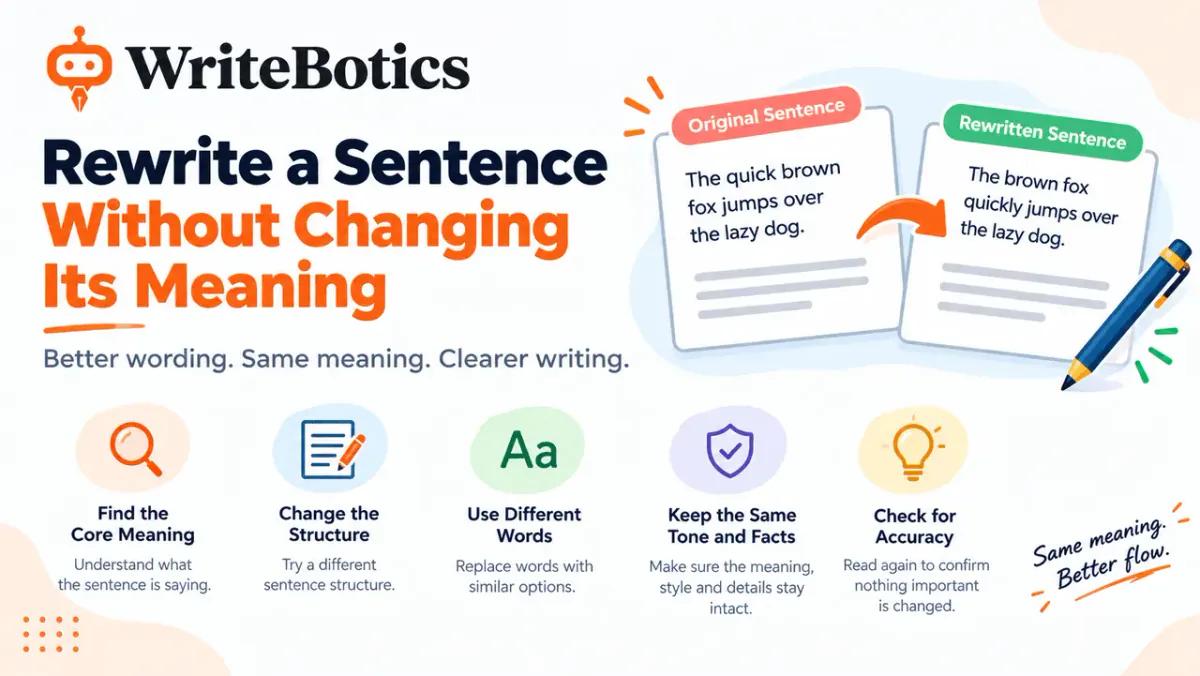
If you want to rewrite a sentence without changing its meaning, focus on the idea before the wording. Identify the sentence's core claim, then change its structure, vocabulary, or order while keeping the same facts, relationships, qualifications, and tone.
A good rewrite should feel different to read but equivalent in meaning. That sounds simple, but it is easy to accidentally add information, remove an important qualification, change the strength of a claim, or introduce a different tone.
The safest approach is a meaning-first rewrite: understand what the original sentence actually says, separate the essential information from its wording, and then rebuild the sentence in a clearer way.
Start With the Meaning, Not the Words
Before rewriting a sentence, ask yourself one question:
What is this sentence actually saying?
Do not begin by replacing individual words with synonyms. Instead, identify the basic meaning and the relationships between the ideas.
For example:
The new scheduling system reduced the amount of time employees spent arranging meetings.
The core meaning is:
- There is a new scheduling system.
- Employees spend less time arranging meetings.
- The system caused or contributed to that reduction.
A rewrite could be:
Employees spent less time arranging meetings after the new scheduling system was introduced.
The wording and sentence structure have changed, but the central information remains the same.
This approach is more reliable than changing words one at a time because individual synonyms can subtly alter meaning.
The Meaning-First Method
Use these five steps when you need to rewrite a sentence without changing its meaning.
1. Identify the core claim
Find the main thing the sentence communicates.
Ask:
- Who or what is the sentence about?
- What happened?
- When did it happen, if timing matters?
- Why did it happen, if a reason is given?
- What conditions or limitations are included?
- How certain is the statement?
For example:
Because the store closed earlier than expected, several customers could not complete their purchases.
The core information includes both the early closure and its consequence. A rewrite that removes either part would change the meaning.
2. Separate facts from wording
Next, mentally remove the original phrasing.
Instead of thinking:
"Because the store closed earlier than expected..."
Think:
Early closure → customers could not finish purchases.
Now rebuild the sentence using different language.
Several customers were unable to finish their purchases because the store closed earlier than expected.
The structure has changed, but the relationship between the events remains.
3. Change the sentence structure
Structure is often more important than vocabulary.
You can:
- Move a dependent clause.
- Change active voice to passive voice or vice versa.
- Turn a noun phrase into a verb.
- Combine or separate clauses when the meaning remains intact.
- Change the order of related information.
- Replace a repetitive construction with a more natural one.
For example:
The manager approved the request after reviewing the revised proposal.
Could become:
After reviewing the revised proposal, the manager approved the request.
The sentence has a different structure, but the same action and sequence remain.
4. Replace vocabulary carefully
Once the structure is different, adjust wording where appropriate.
Do not assume every synonym means exactly the same thing.
For example, these words can have different levels of certainty:
- suggest — indicates something without proving it
- show — indicates evidence or an observable result
- prove — establishes something conclusively
Changing "suggests" to "proves" may make the sentence stronger than the original.
The goal is not to make every word different. The goal is to make the sentence clearer while preserving its exact intended meaning.
5. Compare the two versions
Finally, compare your rewrite with the original.
Check the facts, relationships, timing, qualifications, and tone. If anything important has changed, revise the new sentence.
For longer passages, a paraphrase tool can provide an alternative version, but you should still review the result yourself.
Preserve Facts, Qualifications, and Tone
A rewrite can look excellent while still being inaccurate.
Three areas deserve special attention: facts, qualifications, and tone.
Preserve facts
Do not change:
- Names
- Numbers
- Dates
- Locations
- Actions
- Results
- Comparisons
- Conditions
Original:
The company opened three new offices in 2025.
Accurate rewrite:
In 2025, the company opened three additional offices.
Inaccurate rewrite:
The company opened several new offices last year.
The second version changes the specific number and makes the timing relative to the current date.
Preserve qualifications
Words such as may, often, generally, some, and in certain cases can carry important meaning.
Original:
Regular exercise may improve sleep quality for some people.
Do not rewrite it as:
Regular exercise improves sleep quality.
The second sentence makes a stronger, more general claim.
A safer rewrite is:
For some people, exercising regularly may lead to better sleep quality.
Preserve tone
The same information can sound formal, casual, cautious, enthusiastic, or critical.
Original:
The proposal has several weaknesses that should be addressed before approval.
A neutral rewrite:
Several issues in the proposal should be resolved before it is approved.
An overly harsh rewrite:
The proposal is seriously flawed and should not be approved.
The last version changes the tone and potentially the meaning.
Eight Examples of Rewriting Without Changing Meaning
The following examples show how to change sentence structure and wording while keeping the original idea intact.
Example 1: Simple sentence
Original:
The meeting starts at 9 a.m. tomorrow.
Rewrite:
Tomorrow's meeting begins at 9 a.m.
The date and time remain unchanged.
Example 2: Cause and effect
Original:
Heavy traffic caused the delivery to arrive late.
Rewrite:
The delivery arrived late because of heavy traffic.
The cause and result are still connected in the same way.
Example 3: Conditional statement
Original:
You can access the report if you have the correct password.
Rewrite:
The report is accessible to anyone who has the correct password.
The condition remains important. Removing it would change the meaning.
Example 4: Active and passive voice
Original:
The technician repaired the damaged equipment.
Rewrite:
The damaged equipment was repaired by the technician.
The grammatical structure changes, but the actor and action remain the same.
Example 5: Professional tone
Original:
We need to finish the project before Friday.
Rewrite:
The project needs to be completed by Friday.
Both sentences communicate the same deadline and requirement.
Example 6: Longer sentence
Original:
Although the first test produced promising results, the researchers decided to collect more data before reaching a conclusion.
Rewrite:
The researchers saw encouraging results in the first test, but they chose to gather additional data before drawing a conclusion.
The positive initial result and decision to gather more evidence are both preserved.
Example 7: Qualification
Original:
Some customers reported difficulty using the updated checkout process.
Rewrite:
The updated checkout process was difficult for some customers to use.
The rewrite should not become "The updated checkout process was difficult to use," because that could imply that everyone experienced the problem.
Example 8: Comparison
Original:
This year's report contains more detailed information than last year's report.
Rewrite:
Compared with last year's report, this year's version provides greater detail.
The comparison remains between the same two reports, and the claim remains about the level of detail.
Use This Accuracy Checklist
Before finalizing a rewritten sentence, run through this quick checklist.
| Check | Question |
|---|---|
| Core idea | Does the new sentence communicate the same main point? |
| Facts | Are names, numbers, dates, and actions unchanged? |
| Relationships | Are cause, contrast, condition, and comparison still accurate? |
| Qualifications | Did you preserve words such as "may," "some," or "often"? |
| Tone | Does the sentence have the same level of formality and certainty? |
| Structure | Is the sentence genuinely restructured rather than just synonym-swapped? |
| Clarity | Is the new version easier to understand? |
| Context | Does the sentence still make sense where it will be used? |
If the answer to each question is yes, your rewrite is much more likely to preserve the original meaning.
Common Mistakes When Rewriting a Sentence
Changing only a few words
Replacing several words with synonyms while keeping the same sentence structure often produces an awkward result.
Instead, understand the idea first and rebuild the sentence naturally.
Making the claim stronger
Watch for changes in certainty.
"May help" is not the same as "will help." "Some users" is not the same as "all users." "Can reduce" is not the same as "always reduces."
Small words can carry significant meaning.
Removing important details
A rewrite should not become a summary unless that is what you intend.
If the original includes a condition, exception, timeframe, or limitation, keep it.
Adding information that was not there
Do not introduce new reasons, conclusions, opinions, or facts simply because they seem logical.
A rewrite should express the existing idea—not expand it without a reason.
Losing the original tone
A professional sentence should not suddenly sound casual, and a cautious statement should not become overly confident.
Match the intended audience and purpose.
When a Rewriting Tool Can Help
Manual rewriting gives you the most direct control, but a rewriting tool can be useful when you are stuck on phrasing or want to compare different ways of expressing the same idea.
For a single sentence, start with the WriteBotics Paraphrase Tool and review the suggested wording carefully.
If you are working with a larger passage, the WriteBotics Content Rewriter can help you explore alternative wording across more text.
You can also learn more about sentence-level paraphrasing in How to Paraphrase a Sentence Clearly.
The important step comes after generating a rewrite: compare it with your original and verify that the meaning has not shifted.
A tool can suggest wording, but you are responsible for deciding whether the final sentence is accurate and appropriate for your context.
Final Thoughts
To rewrite a sentence without changing its meaning, start with the idea rather than the individual words. Identify the core claim, preserve the facts and qualifications, change the sentence structure, choose vocabulary carefully, and compare the result with the original.
The best rewrite is not necessarily the version with the most changed words. It is the version that communicates the same idea more clearly, naturally, or appropriately for its audience.
If you are stuck on a sentence, try rewriting it manually first. Then use the WriteBotics Paraphrase Tool to explore another version and review both for accuracy before choosing the final wording.
FAQs
How do I rewrite a sentence without changing its meaning?
First, identify the sentence's core idea and important details. Then change the structure and wording while preserving facts, relationships, qualifications, and tone. Finally, compare the rewritten version with the original to check for meaning changes.
Is changing synonyms enough to rewrite a sentence?
Usually, no. Simply replacing words can produce unnatural phrasing and may leave the original sentence structure largely unchanged. A stronger rewrite considers the sentence as a whole and may reorganize clauses, change grammatical structure, or reorder information.
How can I tell if my rewrite changed the meaning?
Compare the two sentences for facts, numbers, conditions, timing, cause and effect, certainty, and scope. Pay particular attention to words such as "may," "some," "usually," and "always," because changing them can alter the claim.
Can I change the sentence structure without changing the meaning?
Yes. Changing sentence structure is one of the most useful ways to rewrite accurately. For example, you can move clauses, change active voice to passive voice, or turn a phrase into a different grammatical construction while preserving the same information.
Can a paraphrasing tool rewrite a sentence accurately?
A paraphrasing tool can suggest alternative wording, but you should review the result before using it. Check whether the facts, qualifications, relationships, and tone still match the original sentence.
Is paraphrasing the same as summarizing?
No. Paraphrasing generally restates an idea with different wording while retaining its meaning and much of its detail. Summarizing condenses information and leaves out some details. If your goal is to preserve the complete meaning of a sentence, paraphrasing is usually the better approach.
Should I keep the same tone when rewriting?
Yes, unless you intentionally want to change the tone. A meaning-preserving rewrite should normally maintain the original level of formality, certainty, attitude, and emphasis.
What is the safest way to rewrite a sentence?
Use a meaning-first process: understand the sentence, identify its essential information, write a new version from that understanding, and compare the two versions carefully. This reduces the risk of accidentally adding, removing, or changing important information.