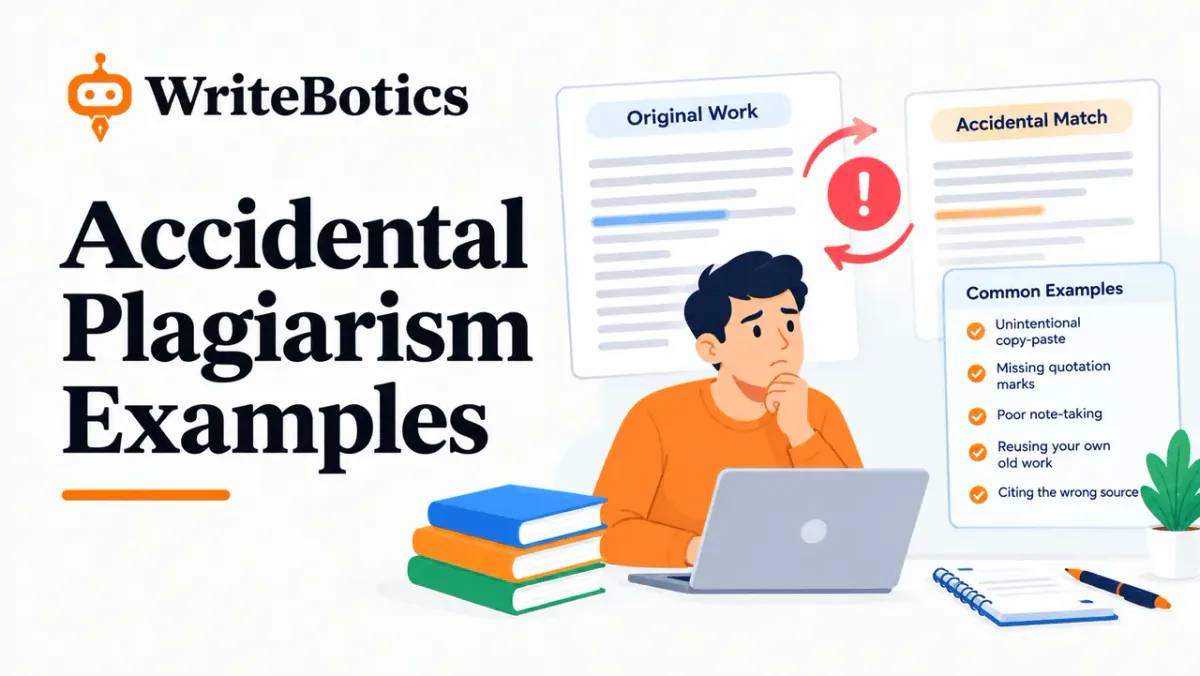
Accidental plagiarism happens when a writer uses another person's words, ideas, or work without giving credit, even though they did not mean to misrepresent the source. It can result from hurried note-taking, unclear paraphrasing, missing citations, or confusion about citation rules.
Intent does not automatically make an uncited passage acceptable. Schools, publishers, and workplaces set their own policies and may handle mistakes differently. If you discover a problem after submitting work, check the relevant policy and contact your instructor or editor rather than quietly changing a submitted copy.
Below are ten common examples, with practical ways to prevent or correct each one before submission.
1. Leaving out an in-text citation
What happens: You summarize a researcher's finding in your own words but do not identify the source.
Example: A paper says that a particular study found a link between sleep and memory, but the sentence has no citation.
How to fix it: Add an in-text citation in the style required for the assignment, and include the source in the reference list or bibliography. Cite borrowed claims and findings, not only exact quotations.
2. Paraphrasing too closely
What happens: You replace a few words with synonyms but keep the source's sentence structure and sequence of ideas.
Example: Source: "Regular feedback helps learners recognize gaps in their understanding." Close paraphrase: "Frequent feedback helps students recognize gaps in their knowledge."
How to fix it: Read the source, set it aside, and explain the idea in a genuinely new sentence structure and in your own words. Keep the citation: paraphrasing does not remove the need to credit the source. If the original phrasing is important, quote it instead.
3. Forgetting quotation marks
What happens: You copy an exact phrase into your notes and later paste it into a draft as if you wrote it.
How to fix it: Mark copied wording as a quotation when taking notes. In the final draft, use quotation marks or the block-quote format required by your style guide, cite the source, and include a page or other locator when the style guide requires one.
4. Citing the wrong source
What happens: A secondary article describes a study, and you cite the original study even though you have not read it.
How to fix it: Whenever possible, locate and read the original source before citing it. If you cannot access it, follow your required citation style's rules for citing a source quoted or discussed in another work. Do not imply that you consulted material you did not read.
5. Mismatching citations and the reference list
What happens: An in-text citation has no corresponding reference entry, or a reference-list entry is never cited in the text.
How to fix it: Compare every in-text citation with the reference list before submitting. Confirm that names and dates match and that each source is traceable. Citation styles differ, so follow the style specified for your work.
6. Losing track of sources in research notes
What happens: Notes from several articles become mixed together, and you can no longer tell which source supports a particular claim.
How to fix it: Record the author, title, publication details, URL or DOI, and page or section alongside each note. Clearly distinguish copied quotations from summaries and your own observations. Keep source details as you draft rather than trying to reconstruct them at the end.
7. Reusing your own submitted work without permission
What happens: You submit all or part of an earlier assignment again without telling the instructor or getting approval.
How to fix it: Ask the instructor or editor whether reuse is allowed. If it is, explain what material is reused and cite or disclose the earlier work as required by the applicable policy. Rules about reusing one's own work vary.
8. Copying from a website without acknowledging it
What happens: A sentence, definition, chart, image, or other material from a webpage is added to an assignment without credit.
How to fix it: Cite the original page and identify the creator where possible. Use quotation marks for copied wording. Check the site's license and your institution's rules before reusing images, charts, or other media; attribution alone does not necessarily grant permission to reuse copyrighted material.
9. Using a source's distinctive idea without credit
What happens: You describe a particular argument, interpretation, or framework in fresh wording but do not acknowledge who developed it.
How to fix it: Cite the source of the idea, even if the wording is entirely yours. Common knowledge may not need a citation, but whether a claim counts as common knowledge depends on the audience and context. When uncertain, ask your instructor or editor.
10. Relying on an incorrect or incomplete citation tool result
What happens: A citation generator produces a reference with missing authors, dates, or publication details, and the entry is copied without review.
How to fix it: Treat generated citations as drafts. Check the source itself and verify each field against the required citation guide. A properly formatted reference does not replace an in-text citation, quotation marks, or accurate attribution.
A quick check before you submit
Use this checklist to catch common citation problems:
- Mark every sentence that uses a source's words, findings, or distinctive ideas.
- Check that exact wording is quoted and attributed.
- Check that paraphrases use your own wording and sentence structure and still cite the source.
- Match every in-text citation to its reference-list entry.
- Confirm that your notes identify where each source was used.
- Review the rules for reused work and third-party images or media.
- Follow the citation style and academic-integrity policy specified for the assignment.
If you are unsure whether a passage needs a citation, ask your instructor or editor before submission. The safest approach is to keep careful source notes, cite borrowed ideas clearly, and follow the rules that apply to your work.