Before submitting an essay, check it for plagiarism by reviewing potentially matching text, verifying quotations and citations, and rewriting any passages that rely too closely on a source. A Plagiarism Checker can help you identify possible overlaps, but you should review every match in context rather than treating the results as a final verdict.
A careful plagiarism check does more than catch copied sentences. It can help you find missing citations, accidental copying from research notes, and paraphrases that are too similar to their original sources. The goal is to submit an essay that represents your own work while giving proper credit to other people's ideas.
Whether you are preparing a school assignment, a college research paper, or an academic essay, a few simple steps can help you review your writing before submission.
What Does a Plagiarism Check Find?
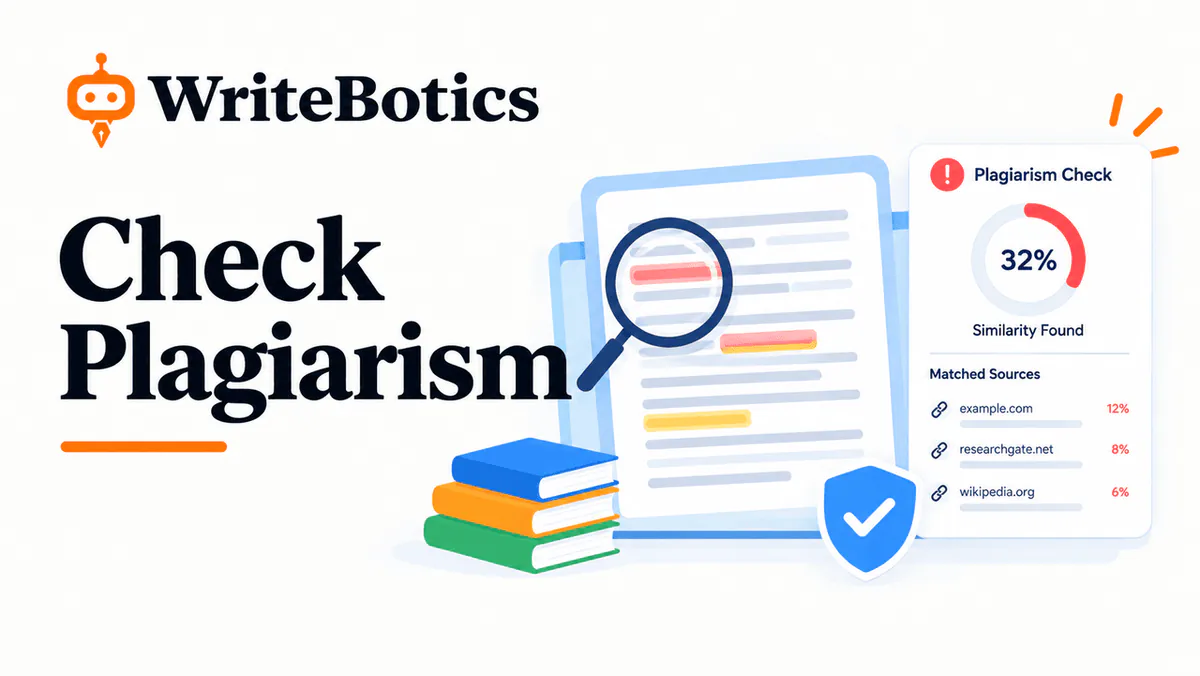
A plagiarism check compares your writing against content available to the checking tool and identifies text that may match other sources. Depending on the tool and its available sources, the results may highlight exact phrases, similar passages, or repeated content.
However, a match does not automatically mean plagiarism has occurred. Common expressions, properly quoted material, technical terminology, and correctly cited passages may also appear in the results.
Understanding what a checker can and cannot tell you will help you interpret its findings accurately.
1. Exact or Verbatim Matches
An exact match occurs when your essay contains wording that also appears in another source.
For example, imagine you write:
Regular exercise can improve physical health and support mental well-being.
If that sentence appears in a source you consulted, a checker may highlight it.
The match alone does not establish whether the sentence is plagiarized. It could be a properly cited quotation, a common statement, or wording that needs closer review.
If you copied the sentence directly, use quotation marks when required and cite the original source. If you intended to paraphrase it, express the idea in your own words and cite the source where appropriate.
2. Close Paraphrasing
Close paraphrasing happens when you change a few words but keep the original sentence structure and wording largely intact.
Consider this example:
Original source: "Public libraries provide communities with access to educational resources and digital information."
Too-close paraphrase: "Public libraries give communities access to learning resources and digital information."
The second sentence replaces a few words but follows the original closely.
A more independent paraphrase might be:
Better paraphrase: "By offering learning materials and online resources, libraries help people find information regardless of whether they have these resources at home."
The revised sentence expresses the central idea differently. Because the idea still comes from the original source, it should be cited when required.
3. Missing Attribution
A plagiarism checker may identify text that resembles a published source, but it cannot always determine whether you have credited that source correctly.
You might quote a researcher accurately but forget to include an in-text citation. You might also paraphrase an argument in your own words without acknowledging its author.
Both situations require attention.
Review your in-text citations, footnotes, and reference list alongside the matched passages. A low similarity score does not prove that every borrowed idea has been properly attributed.
4. Repeated or Previously Used Content
A checker may also flag material that appears elsewhere, including text from your own earlier work.
For example, you might reuse a paragraph from a previous assignment or repeat a substantial passage from an earlier publication.
Whether this is permitted depends on your instructor's rules, the assignment requirements, and the relevant publication policy. Some institutions restrict submitting the same work for multiple assignments without approval.
The important point is to review the match and follow the rules that apply to your work.
How to Prepare Your Essay Before Checking It
Running a plagiarism check on a rough draft can be useful, but checking a nearly finished essay gives you a clearer picture of what you may actually submit.
Before using a checker, prepare your document.
Step 1: Finish Your Main Draft
Complete the introduction, body paragraphs, and conclusion before performing your final check.
Your draft should include the sources you used and the citations you have added so far. This makes it easier to distinguish intentional quotations from text that needs revision.
You do not need to wait until your essay is perfect. An earlier check can help you identify problems while there is still time to correct them.
Step 2: Organize Your Sources
Review the books, articles, websites, and other materials you consulted while writing.
Make sure you can identify where borrowed ideas and quotations came from. If you collected research notes, compare them with your draft to find passages you may have copied unintentionally.
For each source, record the information required by your citation style, such as the author's name, publication date, title, and relevant page number.
Do not invent missing publication details. Check the original source whenever information is incomplete.
Step 3: Review Your Citation Style
Determine whether your assignment requires APA, MLA, Chicago, or another citation style.
Each style has its own rules for quotations, in-text citations, footnotes, and reference lists.
For example, an APA-style paraphrase generally includes the author's surname and publication year. A direct quotation also requires a page number or another appropriate locator when available and applicable.
Follow the specific requirements provided by your instructor or institution.
Step 4: Save a Clean Copy
Save the version you intend to submit, preferably with a clear filename.
Remove temporary notes, drafting comments, and unfinished passages that are not part of the final essay. Check that the document includes the complete text and any required references.
If you use an online checker, review its privacy policy before uploading your work, particularly if your essay contains unpublished research or personal information.
How to Check an Essay for Plagiarism: Step by Step
Once your essay is ready, use the following process to review it systematically.
Step 1: Choose a Plagiarism Checker
Select a plagiarism checker that fits your needs and the requirements of your assignment.
A useful tool should present potentially matching text in a way that allows you to review the relevant passages. Also consider its stated limitations, supported document formats, and privacy practices.
You can start with the WriteBotics Plagiarism Checker to review your essay for possible text matches.
Remember that different checkers may search different collections of content. No single result should be treated as proof that your essay is completely original.
Step 2: Enter Your Essay
Follow the tool's instructions to provide your essay.
Depending on the tool, this may involve pasting text into an input field or uploading a supported document.
Before proceeding, make sure you have selected the correct version of your essay. If you made substantial changes after copying the text into the checker, review the updated version as well.
Step 3: Run the Check
Start the plagiarism check and wait for the results.
The tool may identify matching phrases, display possible source references, or provide an overall similarity figure, depending on its functionality.
Read the results carefully. Do not assume that every highlighted passage is problematic or that unhighlighted text is necessarily free from plagiarism.
Step 4: Review Each Match
Open or examine each available match and compare it with the relevant passage in your essay.
Ask yourself:
Did I copy these exact words from a source?
Have I used quotation marks where necessary?
Have I credited the original author?
Is my paraphrase too close to the source?
Is the wording a common expression or standard technical term?
Does the passage need to be rewritten, cited, or left unchanged?
Use these questions to decide what action is appropriate.
Step 5: Make the Necessary Corrections
Correct each genuine issue without changing the meaning of your argument.
Add missing citations, format direct quotations properly, and rewrite close paraphrases where needed. If a match is a common phrase or a properly cited quotation, you may not need to change it.
After making corrections, save the updated essay.
Step 6: Check the Revised Version
Run the revised essay through the checker again if appropriate.
This follow-up can help you see whether the passages you changed still contain substantial overlaps. It also gives you an opportunity to catch new citation or wording issues.
Do not keep rewriting sentences simply to lower a similarity figure. Your priority should be accurate attribution, original expression, and clear academic writing.
How to Review Plagiarism Matches Correctly
One of the most important parts of checking an essay is understanding what the results mean.
A similarity score represents the amount of text identified as matching according to a particular tool's methods. It is not automatically a plagiarism score.
For example, two essays with the same similarity percentage could have very different issues. One might contain properly cited quotations, while the other might contain uncited copied paragraphs.
Use the context of each match to decide what needs attention.
| Type of match
|
What to check
|
Possible action
| | --- | --- | --- | |
Direct quotation
|
Quotation marks and citation
|
Correct formatting or attribution
| |
Close paraphrase
|
Wording and sentence structure
|
Rewrite and cite the source
| |
Common phrase
|
Whether the wording is distinctive
|
Usually no change needed
| |
Technical definition
|
Accuracy and source requirements
|
Quote or paraphrase with attribution
| |
Reference-list entry
|
Citation style and formatting
|
Correct if necessary
| |
Previously submitted text
|
Assignment or institution rules
|
Seek approval or revise as required
|
Should You Aim for a Zero Similarity Score?
Not necessarily.
A zero score is not a universal requirement, and a nonzero score does not automatically indicate plagiarism. Proper quotations, references, standard terminology, and common phrases can all contribute to matching text.
Instead of trying to eliminate every match, focus on resolving genuine problems.
Your essay should accurately represent your work, acknowledge borrowed ideas, and follow the academic rules that apply to your assignment.
How to Handle Quotations and Citations
Quotations and citations are essential parts of responsible academic writing. They help readers distinguish your ideas from information drawn from other sources.
Use Quotation Marks for Exact Wording
If you reproduce a source's exact words, follow the quotation rules of your required citation style.
For example:
According to the author, "regular reading supports vocabulary development" (Author, Year, p. 24).
This is an illustrative example, not a quotation from an actual publication. Replace the placeholder details with accurate information from your source.
Short quotations are generally incorporated into the paragraph, while longer quotations may require block formatting, depending on the citation style.
Do not put quotation marks around a passage and assume that attribution is complete. Include the required citation as well.
Cite Paraphrased Ideas
Changing the wording does not make someone else's idea your own.
Suppose a source explains that access to public transportation can improve employment opportunities by connecting people with more workplaces.
You might paraphrase that idea as follows:
"Reliable public transportation can expand the range of jobs that people can reasonably reach."
If this statement is based on a particular source, cite that source according to your required style.
A citation acknowledges the original idea even when the wording is entirely yours.
Match In-Text Citations to Your References
Check that each source cited in the essay appears in the reference list or bibliography when required.
Then check the reverse: every reference-list entry should correspond to a source used in the essay, unless your citation style or assignment instructions say otherwise.
Verify names, dates, titles, page numbers, and publication details against the original materials.
Correct citation formatting is important, but accurate source information matters just as much.
How to Paraphrase Carefully Without Plagiarism
Paraphrasing is useful when you want to explain a source's ideas in a way that fits your essay. The challenge is to preserve the original meaning without copying its distinctive wording or structure.
Use this process to paraphrase more carefully.
1. Understand the Original Passage
Read the passage until you understand its main point and supporting details.
If you cannot explain the idea clearly, spend more time understanding the source before rewriting it.
2. Set the Source Aside
Look away from the original passage and explain the idea in your own words.
This encourages you to reconstruct the meaning rather than follow the source sentence by sentence.
3. Write in Your Own Structure
Use a sentence structure that fits your argument.
You might explain the cause before the effect, combine related points, or focus on the part of the idea that is most relevant to your paragraph.
Do not rely on replacing individual words with synonyms while preserving the original structure.
4. Compare the Two Versions
Return to the source and check your paraphrase.
Make sure you have not changed the meaning, removed an important qualification, or repeated distinctive wording unnecessarily.
If the passage still follows the original too closely, revise it again.
5. Add the Citation
Include the required attribution even when your paraphrase is substantially different from the source.
For more detailed guidance, read How to Paraphrase an Essay Correctly.
The goal is not to disguise borrowed writing. It is to understand the source, explain its ideas accurately, and give credit where it is due.
Final Plagiarism Checklist Before Submitting Your Essay
Use this checklist as your last review before submitting your work.
Essay submission checklist
0 of 10 complete
I reviewed all significant matches reported by the plagiarism checker.
I rewrote close paraphrases using my own wording and structure.
I added citations for borrowed ideas and information.
I formatted direct quotations according to the required style.
I checked that in-text citations match my reference list.
I verified source details against the original materials.
I followed my instructor's rules on previously submitted work.
I reviewed the final version after making corrections.
I checked the essay for grammar, clarity, and formatting.
I saved the correct version of the essay for submission.
Reset checklist
Once you have completed these checks, read your essay one final time. Make sure the argument is clear, the evidence supports your points, and the writing reflects your understanding of the subject.
For an additional review, you can use the WriteBotics Plagiarism Checker to identify possible text matches before submitting your essay.
Frequently Asked Questions
How can I check my essay for plagiarism for free?
You can use an online plagiarism checker that offers a free checking option. Enter your essay or upload it if the tool supports document uploads, then review the results and investigate any significant matches.
Check the tool's current limitations and privacy policy before submitting your work. A free check may not search the same sources as every other service.
What is an acceptable plagiarism percentage for an essay?
There is no single acceptable percentage for every essay or institution.
Your instructor or institution may have specific requirements, and the meaning of a similarity score depends on the matched content. Properly cited quotations and references can contribute to a score, while uncited borrowing may be a problem even when the overall score is low.
Follow your institution's guidelines and review individual matches rather than relying on a universal threshold.
Can a plagiarism checker detect paraphrased content?
A plagiarism checker may identify paraphrased content when the wording or structure remains similar to a source it can access.
However, detection varies between tools and sources. A checker may not identify every paraphrase, particularly when the wording has changed substantially or the original source is unavailable to it.
Always cite borrowed ideas, whether or not a checker identifies a match.
Does a low similarity score mean my essay is plagiarism-free?
No. A low score means the checker found relatively little matching text according to its own methods. It does not establish that every idea is properly attributed or that every source has been acknowledged.
Review your research notes, citations, and paraphrases to catch problems that a text-matching tool may miss.
Should I include references when checking an essay?
Yes, when they are part of the document you intend to submit. However, references and bibliographies can contribute to similarity results.
Some tools may offer ways to exclude certain sections from a report. If yours does, use those options only when appropriate and consistent with your institution's requirements. Do not exclude material simply to conceal copied text.
How many times should I check an essay for plagiarism?
There is no fixed number. A practical approach is to check a developed draft, correct any genuine issues, and review the final version after substantial changes.
A second check can help identify remaining overlaps, but it should complement—not replace—careful citation and source review.
Can I submit an essay if the plagiarism checker finds matches?
Possibly. Some matches may be properly cited quotations, common expressions, or references that do not require changes.
Before submitting, examine the highlighted passages, correct any missing attribution, and follow your instructor's rules. If you are unsure whether a particular match is acceptable, ask your instructor for guidance.
Is a plagiarism checker the same as an AI detector?
No. A plagiarism checker looks for text that matches other material, while an AI detector estimates whether writing displays patterns associated with AI-generated text.
These tools answer different questions. Neither result, by itself, proves who wrote a passage or whether academic misconduct occurred.
Final Thoughts
Checking an essay for plagiarism before submission is a straightforward way to review your use of sources and identify passages that need attention. Prepare your draft, examine the matches, correct close paraphrases, and make sure every borrowed idea receives appropriate credit.
A plagiarism checker can support this process, but it cannot guarantee that an essay is entirely original or that every citation is correct. Your own judgment remains essential.
Before you submit, take a few minutes to review your essay carefully. Use the WriteBotics Plagiarism Checker as part of your final review, then confirm that your writing, citations, and references meet your assignment's requirements.