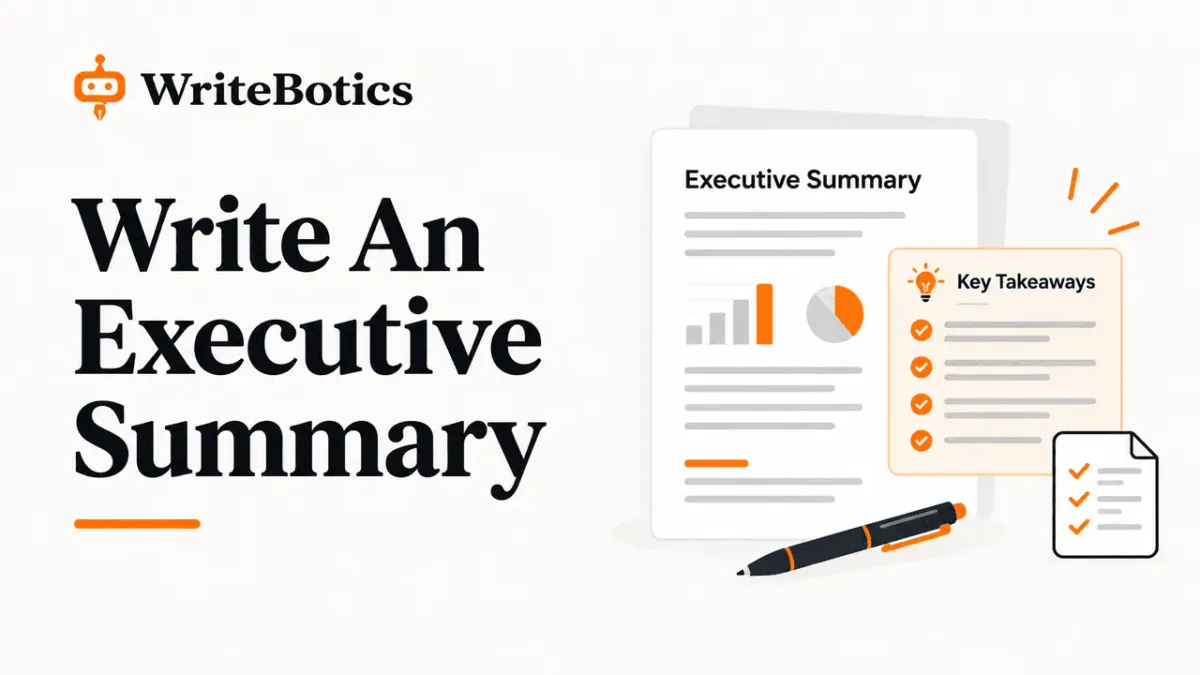
An executive summary gives readers the most important information from a longer report, business plan, or proposal without requiring them to read the entire document first. To Write An Effective Executive Summary, explain the purpose of the document, identify the main problem or opportunity, present the most relevant evidence, recommend a course of action, and describe the expected impact. Keep it concise, specific, and focused on the decisions your audience needs to make.
The best executive summaries are easy to scan and understandable on their own. A busy executive should be able to read yours and understand what the document says, why it matters, and what should happen next.
Whether you are preparing a business report, project proposal, research document, or strategic plan, the same principle applies: lead with the main message, support it with meaningful details, and make the next step clear.
What Is an Executive Summary?
An executive summary is a short overview of a longer document. It presents the central findings, recommendations, and implications so that readers can understand the essential message quickly.
It is commonly used in:
Business plans and strategic plans
Project proposals and funding requests
Market research and feasibility studies
Consulting reports and business analyses
Annual reports and performance reviews
Project evaluations and internal business reports
An executive summary is usually written for decision-makers, such as business owners, executives, investors, clients, or project stakeholders. However, it can be useful for any reader who needs the main points without reviewing every detail.
Executive Summary vs. Abstract vs. Introduction
These three sections may appear at the beginning of a document, but they serve different purposes.
| Feature
|
Executive summary
|
Abstract
|
Introduction
| | --- | --- | --- | --- | |
Main purpose
|
Explain the key message and implications
|
Summarize a scholarly or technical study
|
Introduce the topic and establish context
| |
Typical content
|
Problem, findings, recommendations, impact
|
Research question, methods, results, conclusion
|
Background, scope, objectives
| |
Common audience
|
Executives and decision-makers
|
Researchers and academic readers
|
Anyone reading the document
| |
Can stand alone?
|
Yes, as a decision-focused overview
|
Yes, as a brief research overview
|
Usually leads into the main document
| |
Common documents
|
Business reports and proposals
|
Research papers and scholarly articles
|
Reports, essays, plans, and papers
|
An executive summary often includes the document's conclusions and recommendations. An introduction usually prepares the reader for the discussion that follows.
An abstract, meanwhile, typically emphasizes the research question, methodology, and findings. It may not include the practical recommendations or business implications that an executive summary needs.
How to Write an Executive Summary Step by Step
Writing an executive summary becomes easier when you build it around the document's central message rather than trying to shorten every section equally.
Follow these seven steps.
Step 1: Understand the Purpose of the Document
Before writing, identify what the original document is trying to accomplish.
Ask yourself:
What problem, question, or opportunity does it address?
Who will read the executive summary?
What does the reader need to understand?
What decision or action might follow?
Which findings are essential to that decision?
For example, an executive summary for a marketing strategy should explain the business challenge, the proposed strategy, the supporting evidence, and the expected business outcome.
It should not devote half its space to the history of the company unless that background directly affects the recommendation.
Writing tip: Complete this sentence before drafting: "This document explains ___ and recommends ___ because ___."
That sentence can become the foundation of your summary.
Step 2: Identify the Main Problem or Opportunity
Explain why the document exists.
A clear problem statement helps readers understand the importance of the findings and recommendations that follow.
For example, instead of writing:
"Our company has experienced several changes in customer behavior over the past year."
Write:
"Our online store is losing potential sales because mobile visitors encounter a complicated checkout process."
The second statement identifies a specific business problem and gives the reader a reason to keep reading.
If the document focuses on an opportunity rather than a problem, state it directly. For example, a company may have an opportunity to enter a new market, improve customer retention, or reduce operating costs.
Avoid introducing multiple unrelated problems unless they are necessary to explain the document's main purpose.
Step 3: Select the Most Important Evidence
An executive summary should include enough evidence to make its conclusions credible.
Review the original document and select the findings that most directly support its main message.
Depending on the document, useful evidence might include:
Relevant financial figures
Survey or research findings
Project performance data
Customer feedback
Operational measurements
Results from an analysis
Documented risks or constraints
Use exact figures when they are available and relevant. Include the period, comparison, or context needed to interpret them.
For example:
"During the second quarter, the support team received 320 billing-related tickets, representing 40% of all recorded support requests."
This gives the reader a concrete finding. If the original analysis establishes that a billing-page redesign could address the issue, the summary can connect the evidence to that recommendation.
Never invent statistics to make an executive summary appear more convincing. If a finding is an estimate, label it as an estimate. If evidence is incomplete, explain the limitation.
Step 4: Present the Recommendation or Main Conclusion
Tell readers what the document recommends or concludes.
A recommendation should be specific enough to guide a decision.
Weak: "The company should improve its customer experience."
Stronger: "The company should simplify the mobile checkout process, clarify shipping costs before payment, and review checkout completion rates after implementation."
The stronger recommendation identifies practical actions.
For a research report, the central conclusion may be more important than a proposed action. In that case, explain what the findings establish and what they mean for the organization.
If the document presents several options, summarize the preferred option and the main reason for selecting it. Mention important trade-offs when they could affect the decision.
Step 5: Explain the Expected Impact
Connect the recommendation to its practical consequences.
Depending on the subject, the impact might involve:
Lower operating costs
Better customer retention
Reduced project risk
Faster workflows
Improved service quality
More informed investment decisions
Progress toward a business objective
Distinguish between a measured result and a projected outcome.
For example, "The proposed changes are expected to reduce manual processing" is a projection. "The changes reduced manual processing time during the pilot" is a claim about an observed result and requires supporting evidence.
If the document does not establish a financial benefit, do not add a made-up revenue or savings estimate. Explain the expected qualitative benefit instead.
Step 6: Write the Summary After Reviewing the Full Document
Although the executive summary appears near the beginning, it is often easiest to write after completing the main document.
At that point, you know which findings matter most and how the argument fits together.
Draft the summary using your own words. Avoid copying paragraphs from different sections and joining them together without a clear narrative.
A useful sequence is:
State the purpose and main message.
Describe the problem or opportunity.
Present the strongest supporting evidence.
Explain the recommendation or conclusion.
Summarize the expected impact and next step.
This creates a logical progression from the reason the document matters to the action the reader should consider.
Step 7: Edit for Clarity and Accuracy
Read the summary separately from the main document.
Can someone understand the issue, the evidence, and the recommendation without opening the full report?
Remove unnecessary background, repeated ideas, vague phrases, and technical terms that your audience may not understand.
Check every number, date, name, and factual claim against the original document. Confirm that the summary does not overstate the findings or introduce a recommendation that the full document does not support.
Finally, check that the summary is proportionate to the document and the reader's needs. Concise does not mean incomplete: preserve any qualification that could change the reader's interpretation.
Recommended Executive Summary Structure
There is no single structure that fits every document. However, the following five-part format works well for many business reports and proposals.
- Purpose and key message
Explain what the document covers and why it matters. State the central conclusion or proposal early.
- Problem or opportunity
Describe the challenge, need, or opportunity that prompted the report or proposal.
- Evidence and key findings
Include the most relevant data, observations, and conclusions from the document.
- Recommendation or proposed solution
State the action, decision, or approach supported by the findings.
- Expected impact and next steps
Explain the anticipated benefit, relevant risks, and immediate action required.
Use these elements in the order that makes the argument easiest to follow. A research report may need more space for findings, while a funding proposal may emphasize the requested investment and its intended use.
What to Include: Problem, Evidence, Recommendation, and Impact
Four elements deserve particular attention because they connect the document's central issue to a practical conclusion.
| Element
|
Question to answer
|
Example
| | --- | --- | --- | |
Problem
|
What needs attention?
|
Customers abandon the checkout process.
| |
Evidence
|
What supports this concern?
|
Analytics show that checkout completion is lower on mobile than on desktop.
| |
Recommendation
|
What should happen?
|
Simplify the mobile checkout and make delivery costs visible earlier.
| |
Impact
|
What should the action achieve?
|
Reduce avoidable checkout friction and improve the shopping experience.
|
The examples above illustrate the structure, not verified findings from a real business.
The connection between these elements matters. A recommendation should respond to the problem, the evidence should support the reasoning, and the expected impact should follow logically from the proposed action.
If one of these links is missing, the summary may feel like a collection of statements rather than a coherent argument.
Executive Summary for a Report vs. a Proposal
The format changes depending on whether you are explaining completed work or asking someone to approve future work.
Executive Summary for a Report
A report summary focuses on what was examined, what the analysis found, and what those findings mean.
Include:
The report's purpose and scope
The central findings
Relevant supporting evidence
Conclusions drawn from the analysis
Recommendations, if appropriate
Important limitations or implications
For example, a customer service report might explain that billing questions account for a substantial share of support requests, identify the main causes, and recommend changes to billing communications.
The emphasis is on findings and their implications.
Executive Summary for a Proposal
A proposal summary focuses on a problem that needs solving and the plan being put forward.
Include:
The client's or organization's need
The proposed solution
Why the approach is appropriate
The scope of the proposed work
The expected outcomes
The requested decision, resources, or approval
For example, a website redesign proposal might describe the usability issues identified during an initial review, outline the proposed improvements, and explain the intended benefits.
Include a budget, schedule, or resource request when those details are available and relevant to the decision. Do not present unconfirmed estimates as approved commitments.
Executive Summary Template
Use this template as a starting point for a business report, project plan, or proposal. Replace the bracketed text with details from your own document.
Copy-and-Use Template
Purpose: This (report/proposal) examines (topic, problem, or opportunity) and aims to (primary objective).
Problem or opportunity: (Describe the main issue or opportunity) is important because (explain the business, operational, or strategic consequence).
Key findings: The analysis found that (most important finding). Supporting evidence includes (relevant data, observations, or research). These findings indicate that (main conclusion).
Recommendation: We recommend (specific action or solution) because (reason supported by the evidence).
Expected impact: The proposed approach is intended to (expected outcome). Key considerations include (important risk, limitation, or dependency).
Next steps: The next step is to (specific action), with (responsible person or team) taking the lead and (approval, resource, or milestone) addressed as needed.
For a proposal, make the requested decision explicit. For a completed report, emphasize the conclusions and any action that follows from them.
Delete sections that do not apply, and replace every placeholder with specific, accurate information. The template should organize your thinking, not force every document into an identical format.
Executive Summary Example
The following fictional example shows how the structure works in practice.
Example: Customer Support Improvement Proposal
Purpose: This proposal outlines a plan to reduce avoidable customer support requests by improving the information available on the company's billing and account pages.
Problem: Customers frequently contact support for clarification about invoice details, payment status, and account changes. These requests take time away from more complex customer issues.
Evidence: An internal review of support tickets identified recurring questions about billing information and account management. The review suggests that some requests may be preventable through clearer self-service information.
Recommendation: Update the billing and account pages with clearer explanations, more visible payment information, and answers to common customer questions. Review the revised pages with the support team before publishing.
Expected impact: The proposed changes are intended to make account information easier to understand, reduce avoidable confusion, and help customers resolve straightforward questions independently.
Next steps: The product and support teams should agree on the page changes, assign responsibility for the updates, and review support-ticket patterns after implementation.
This example works because it connects a defined problem to supporting evidence, a practical recommendation, and an intended outcome. It does not claim a specific reduction in support requests because no measured result has been provided.
How Long Should an Executive Summary Be?
The appropriate length depends on the original document, its complexity, and the audience.
For a short business report, a few concise paragraphs may be enough. A more detailed strategic plan or business proposal may need a longer summary with clear sections.
As a practical starting point, aim for approximately 5–10% of the source document's length, then adjust based on the content and any instructions from the intended reader. This is a flexible guideline, not a universal requirement.
For example, a 2,000-word report might need a summary of around 100–200 words, while a complex proposal may require additional detail to explain its recommendations and implications.
Prioritize the information readers need over a fixed word count. If the summary is so short that it omits the main finding or requested decision, it needs more substance. If it repeats the report in miniature, it needs editing.
Common Executive Summary Mistakes to Avoid
Even a well-researched document can have an ineffective executive summary. Watch for these common problems.
Starting With Too Much Background
Readers should not have to work through several paragraphs of company history before discovering the purpose of the document.
Fix: Lead with the main issue, conclusion, or proposal. Include background only when it helps explain the decision.
Including Too Many Details
A summary that repeats every section, table, and supporting argument defeats its purpose.
Fix: Keep the most decision-relevant findings and leave detailed explanations in the main document.
Making Unsupported Claims
A confident tone cannot replace evidence. Unsupported statistics, guaranteed outcomes, and exaggerated benefits can undermine trust.
Fix: Verify claims against the source document and distinguish actual results from expectations.
Hiding the Recommendation
Readers should not have to guess what action the document supports.
Fix: State the recommendation clearly and explain why the evidence supports it.
Using Unclear or Technical Language
Unexplained acronyms and specialized terminology can make the summary difficult to understand.
Fix: Use plain English, define essential technical terms, and prefer specific wording over vague business jargon.
Treating the Summary as an Introduction
An introduction leads readers into a document. An executive summary communicates the document's essential message, including its findings and recommendations.
Fix: Make sure the summary can stand alone and accurately reflects the completed document.
Executive Summary Checklist
Before submitting your executive summary, review the following points.
Final review
0 of 10 complete
The purpose of the document is clear.
The main problem or opportunity is stated directly.
The most important findings are included.
Numbers and factual claims match the source document.
The recommendation or conclusion is explicit.
The expected impact is realistic and appropriately qualified.
Important risks or limitations are acknowledged.
The language is clear, concise, and audience-appropriate.
The summary can be understood without reading the full document.
The next step or requested decision is clear, if applicable.
Reset checklist
How to Use AI to Draft an Executive Summary
AI writing tools can help you organize information, identify recurring themes, and create a first draft. They are particularly useful when you are working with a lengthy report and need a starting point.
However, the final summary should still reflect your document accurately and serve the needs of its intended audience.
A practical workflow is:
Review the original document and identify its main purpose.
Extract the most important findings, evidence, and recommendations.
Draft a summary using the structure in this guide.
Check every factual claim against the original.
Edit the draft for clarity, relevance, and length.
If you are starting with a long source document, the WriteBotics Text Summarizer can help you condense text into a shorter version for review. Use the result as a starting point, not as a substitute for checking the original.
Once you have a draft, the WriteBotics Content Rewriter can help you explore clearer wording. Review any revised text to make sure the meaning, qualifications, and factual details remain intact.
For a related guide to condensing longer material, see AI Summary Generator: Summarize Long Text Fast.
The goal is not simply to produce a shorter document. It is to make the essential information easier to understand and act on.
Frequently Asked Questions
What is the main purpose of an executive summary?
The main purpose is to give readers a concise, standalone overview of a longer document. It explains the document's central message, important findings, recommendations, and implications so decision-makers can understand what matters without reading every section first.
How do you start an executive summary?
Start with the purpose of the document and its main message. State the problem, opportunity, or decision being addressed. Avoid opening with lengthy background information that delays the central point.
What should an executive summary include?
Most executive summaries include the purpose, main problem or opportunity, key evidence, findings, recommendation or conclusion, and expected impact. A proposal may also include its scope, resource requirements, and requested approval.
How many paragraphs should an executive summary have?
There is no fixed number. A short report may need only two or three paragraphs, while a complex proposal may require several short sections. Organize the information around the reader's needs rather than a specific paragraph count.
Should an executive summary be written in the first or third person?
Either can work. Choose the perspective that suits the document and your organization's writing conventions. A proposal may use "we recommend," while a formal report may use "the analysis indicates." Consistency and clarity matter more than the choice of person.
Is an executive summary the same as a conclusion?
No. A conclusion closes the main document and interprets its findings in the context of the preceding discussion. An executive summary provides an overview of the entire document, including its purpose, evidence, conclusions, and recommendations.
Can an executive summary be written before the report?
You can create an outline or provisional summary before writing the report. However, the final executive summary is usually best written after the main document is complete. This allows you to reflect the actual findings and recommendations rather than what you initially expected to discover.
Can AI write an executive summary?
AI can help draft or organize an executive summary from supplied material. However, its output should be checked against the original document for accuracy, missing context, unsupported claims, and incorrect recommendations. The person responsible for the document should review and approve the final version.
Final Thoughts
Learning how to write an executive summary is about identifying what matters most and communicating it clearly. Start with the purpose, explain the problem, present the strongest evidence, state the recommendation, and show why it matters.
Use a structure that fits your document, keep the language straightforward, and verify every important claim. Most importantly, make the summary useful to someone who has not read the full report.
A good executive summary does more than shorten a document. It helps readers understand the issue, evaluate the findings, and decide what to do next.