
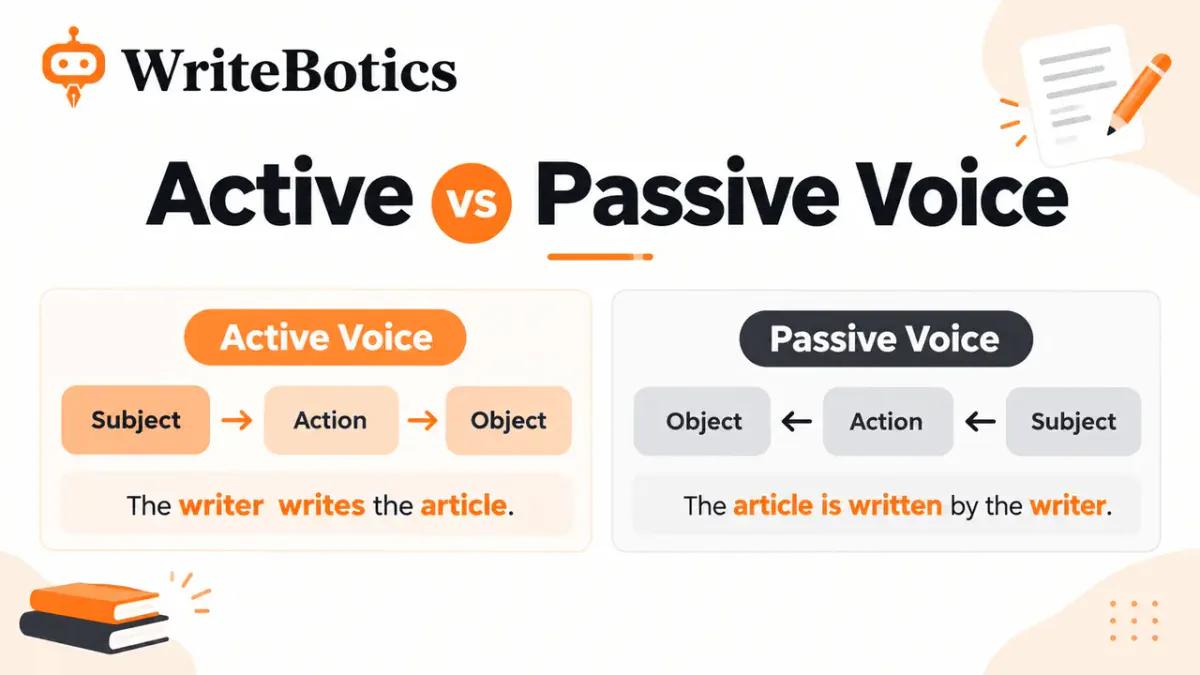
Active and passive voice describe how a sentence presents the relationship between the subject and the action. In active voice, the subject performs the action: “The manager approved the proposal.” In passive voice, the subject receives the action: “The proposal was approved by the manager.”
Neither voice is automatically better. Active voice is often clearer and more direct, while passive voice can be useful when the action, result, or recipient matters more than the person performing it. The best choice depends on your meaning, audience, and context.
What Is Active Voice?
Active voice puts the person, thing, or group performing the action in the subject position.
Basic structure:
Subject + verb + object
For example:
The marketing team launched the campaign.
Here, the marketing team performs the action, launched is the verb, and the campaign receives the action.
More examples:
- The student completed the assignment.
- The engineer tested the new system.
- Our team reviewed the proposal.
- The company changed its return policy.
- Maria sent the report to her manager.
Active voice usually makes it immediately clear who did what.
What Is Passive Voice?
Passive voice puts the person or thing receiving the action in the subject position.
Basic structure:
Subject + form of “be” + past participle + optional “by” phrase
For example:
The campaign was launched by the marketing team.
The campaign is now the grammatical subject, even though it does not perform the action.
More examples:
- The assignment was completed by the student.
- The new system was tested by the engineer.
- The proposal was reviewed by our team.
- The return policy was changed by the company.
- The report was sent to the manager.
The person performing the action can be included with a by phrase, but it can also be omitted:
The report was sent yesterday.
That version does not say who sent it.
Active vs Passive Voice: The Key Difference
The easiest way to understand the difference is to ask:
Who performs the action?
In active voice, the answer normally appears at the beginning of the sentence.
In passive voice, the receiver of the action appears at the beginning, and the performer may appear later or may not be mentioned.
| Feature | Active Voice | Passive Voice |
|---|---|---|
| Focus | Person or thing performing the action | Person or thing receiving the action |
| Typical structure | Subject + verb + object | Subject + be + past participle |
| Clarity | Usually direct and easy to follow | Can be less direct |
| Length | Often shorter | Can require more words |
| Actor | Usually stated | May be stated or omitted |
| Best use | Direct communication and clear instructions | Results, processes, unknown actors, or formal contexts |
Consider these two sentences:
Active: The technician repaired the server.
Passive: The server was repaired by the technician.
Both are grammatically correct and communicate essentially the same event. The difference is the emphasis.
The active sentence focuses on the technician. The passive sentence focuses on the server.
When Should You Use Active Voice?
Active voice is often a strong choice when clarity, directness, and accountability matter.
1. Business communication
Business writing frequently benefits from clear statements about responsibility.
Instead of:
The project deadline was missed.
You could write:
The development team missed the project deadline.
The second version identifies who was responsible. That can make a status update more useful.
2. Instructions
Active voice makes directions easier to understand.
Instead of:
The form should be completed before the meeting.
Try:
Complete the form before the meeting.
The active version tells the reader exactly what to do.
3. Marketing copy
Marketing content often needs concise, energetic language.
Passive:
A free consultation is offered by our team.
Active:
Our team offers a free consultation.
The active version gets to the point more quickly.
4. General web writing
Online readers often scan rather than read every sentence carefully. Direct sentence structures can make important information easier to find.
For example:
You can download the report from your account.
is generally more direct than:
The report can be downloaded from your account.
The passive version is not wrong, but the active version speaks directly to the reader.
When Is Passive Voice Useful?
Passive voice is not a grammatical mistake, and avoiding it at all costs can make writing less natural.
There are situations where passive voice is the better choice.
1. The person performing the action is unknown
If you do not know who performed an action, passive voice can express the fact without inventing an actor.
The window was broken during the night.
If the person responsible is unknown, there is no reason to force an active construction.
2. The person performing the action is unimportant
Sometimes the result matters more than who performed the action.
The package was delivered this morning.
If the important information is that the package arrived, the delivery person's identity may not matter.
3. The reader already knows the actor
A passive sentence can avoid unnecessary repetition.
Suppose a paragraph is already discussing a research team:
The researchers collected the samples. The samples were stored at a controlled temperature.
Repeating “the researchers” in every sentence could become distracting. The passive sentence keeps attention on the samples.
4. Formal and academic writing
Passive constructions can be appropriate when the focus is on a method, process, observation, or result.
For example:
The samples were analyzed using the revised procedure.
The emphasis is on the samples and the analysis, not necessarily on the person who performed the analysis.
However, academic writing does not require passive voice. Active constructions can often be clearer:
We analyzed the samples using the revised procedure.
The right choice depends on the discipline, publication requirements, and purpose.
5. Sensitive situations
Passive voice can sometimes describe an event without immediately assigning blame.
For example:
Several errors were identified during the review.
This may be appropriate in an initial incident report when the facts are still being established.
That does not mean passive voice should be used to hide responsibility. If accountability is important and the responsible party is known, an active sentence may be more informative.
Active vs Passive Voice in Academic Writing
Academic writers often encounter both voices.
Consider:
Active: The researchers interviewed 40 participants.
Passive: Forty participants were interviewed by the researchers.
The active version emphasizes the researchers and their action. The passive version emphasizes the participants.
Another example:
Active: We measured the temperature every 10 minutes.
Passive: The temperature was measured every 10 minutes.
The second sentence may be useful when the measurement process is more important than who performed it.
A practical rule is to choose the voice that keeps the most important information prominent. Do not switch to passive voice simply because you think academic writing must sound formal.
Active vs Passive Voice in Business Writing
Business writing often needs to communicate responsibility, decisions, and next steps efficiently.
Compare:
The budget was approved by the finance team.
The finance team approved the budget.
The active version is usually more concise.
But passive voice can be useful when the business document is focused on an outcome:
The budget was approved on Friday.
If the identity of the approver is already known or irrelevant, mentioning it may add unnecessary detail.
For customer communication, direct language is often helpful:
We processed your refund on Monday.
rather than:
Your refund was processed on Monday.
Both work. The active version makes the company the actor and can sound more personal. The passive version places emphasis on the refund.
How to Change Passive Voice to Active Voice
Converting passive voice to active voice is usually straightforward.
Step 1: Find the action
Identify the main verb or action.
Example:
The report was prepared by Elena.
The action is prepared.
Step 2: Find the person or thing performing the action
Look for the actor, often introduced by by.
by Elena
Elena performs the action.
Step 3: Make the actor the subject
Move the actor to the beginning:
Elena...
Step 4: Choose the appropriate active verb
Change the passive construction into an active verb while preserving the original tense.
Elena prepared...
Step 5: Keep the receiver of the action as the object
The report remains the object:
Elena prepared the report.
Example
Passive:
The final proposal was reviewed by the director.
Active:
The director reviewed the final proposal.
Another example:
Passive:
The customer accounts were updated by the support team.
Active:
The support team updated the customer accounts.
What if the actor is missing?
Consider:
The documents were misplaced.
You cannot always convert this directly into active voice because the original sentence does not tell you who misplaced the documents.
You could write:
Someone misplaced the documents.
But that introduces information that was not in the original sentence.
If you do not know the actor, keeping the passive voice may be the more accurate choice.
A Quick Checklist for Choosing the Right Voice
Before changing a sentence, ask:
- Who performed the action?
- Does the reader need to know who performed it?
- Is the receiver of the action more important?
- Would active voice make the sentence clearer?
- Would changing the voice remove an important qualification?
- Am I using passive voice because it serves a purpose, or simply out of habit?
If the actor is important and known, active voice is often a good option.
If the actor is unknown, irrelevant, or deliberately secondary, passive voice may work better.
Common Active and Passive Voice Examples
| Active | Passive |
|---|---|
| The editor revised the article. | The article was revised by the editor. |
| The company launched a new service. | A new service was launched by the company. |
| The manager approved the request. | The request was approved by the manager. |
| The technician fixed the printer. | The printer was fixed by the technician. |
| The team completed the project. | The project was completed by the team. |
Notice that changing voice does not necessarily change the underlying event. It changes which participant receives the grammatical emphasis.
How to Make Your Writing Clearer Without Eliminating Passive Voice
The goal is not to make every sentence active. The goal is to make each sentence serve its purpose.
When editing, look for passive constructions that are:
- unnecessarily vague,
- longer than necessary,
- hiding an important actor,
- making instructions less direct, or
- making responsibility difficult to understand.
For example:
It was decided that the meeting would be postponed.
A clearer active version might be:
The committee decided to postpone the meeting.
But if the identity of the decision-maker genuinely does not matter, the passive construction may be appropriate.
If you are reviewing a longer draft, a writing-improvement workflow can help you examine clarity, grammar, and tone separately. WriteBotics Writing Improver
For a larger rewrite, you can also use the WriteBotics Content Rewriter to create an alternative version of an existing passage and compare the wording yourself.
FAQs About Active vs Passive Voice
Is active voice better than passive voice?
Not always. Active voice is often clearer and more direct, but passive voice is useful when the receiver of an action matters more, the actor is unknown, or the actor is not important to the sentence.
How can I tell if a sentence is passive?
Look for a form of the verb to be followed by a past participle, such as “was completed,” “were reviewed,” or “is written.” Not every sentence containing “be” is passive, so consider whether the subject receives the action.
Why do writers avoid passive voice?
Writers often avoid unnecessary passive voice because it can make sentences longer or obscure who performed an action. However, passive voice itself is not incorrect.
Is passive voice bad for academic writing?
No. Passive voice can be useful in academic writing when the process, method, or result deserves emphasis. Academic writers should choose between active and passive voice based on meaning and the conventions of their field.
Can passive voice make writing less clear?
It can, particularly when the actor is important but omitted or pushed into a long construction. For example, “The decision was made” does not tell the reader who made the decision.
How do I change passive voice to active voice?
Find the person or thing performing the action, make it the subject, use the appropriate active verb, and keep the receiver of the action as the object. If the actor is unknown, do not invent one simply to create an active sentence.
Should I remove every passive sentence from my writing?
No. A blanket rule against passive voice can make writing awkward or remove useful emphasis. Edit passive constructions when they weaken clarity, but keep them when they communicate the intended meaning effectively.
Final Takeaway
The difference between active and passive voice is mainly about focus.
Active voice emphasizes who performs an action:
The researcher analyzed the results.
Passive voice emphasizes who or what receives the action:
The results were analyzed by the researcher.
Use active voice when directness, clarity, and responsibility are important. Use passive voice when the action, result, receiver, or process deserves greater emphasis—or when the actor is unknown or unimportant.
Good writing is not about choosing one voice every time. It is about choosing the sentence structure that communicates your meaning most clearly.
If you want to improve a draft after checking its voice, start with a targeted review rather than rewriting everything automatically. The WriteBotics Grammar Checker can help you review grammar, spelling, punctuation, and sentence clarity before you finalize the piece.