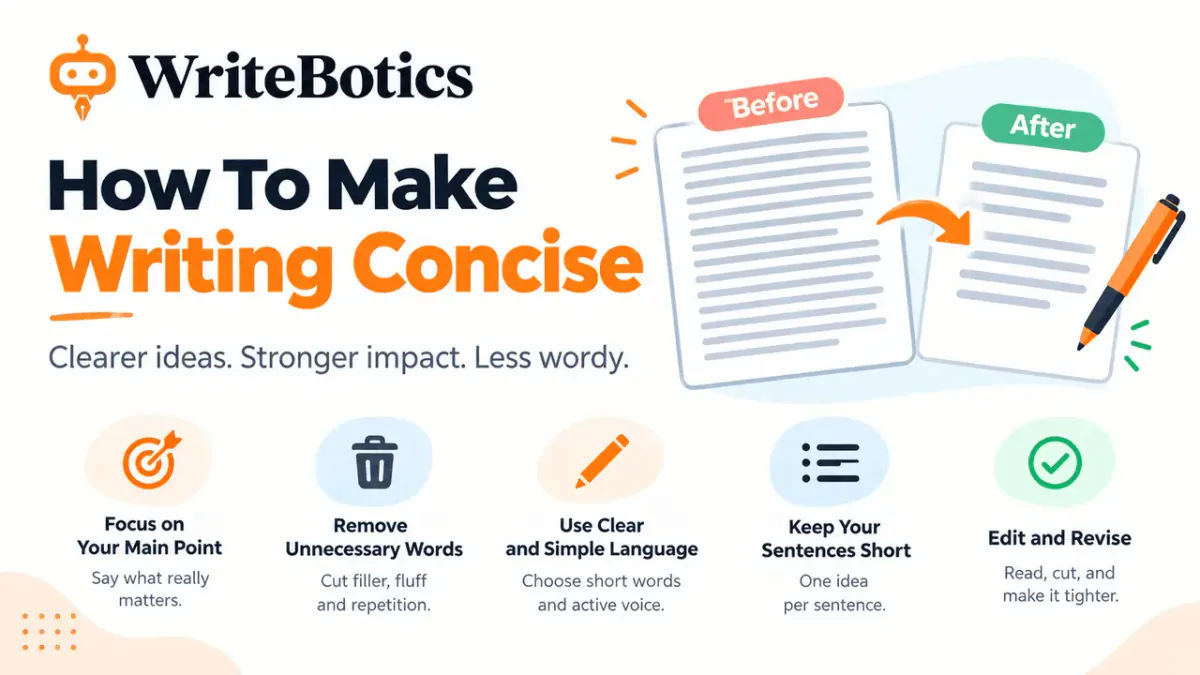
Concise writing communicates an idea with no unnecessary words, repetition, or detours. To make your writing more concise, remove filler, replace wordy phrases with simpler ones, combine repeated ideas, and keep the context your reader actually needs.
The goal is not to make every sentence short. It is to make every word useful.
A concise sentence can still be detailed, persuasive, professional, or conversational. The difference is that the reader can understand the point without working through unnecessary language first.
Whether you are editing an email, essay, report, blog post, or website copy, the following techniques can help you make your writing clearer while preserving its meaning.
Why Concise Writing Matters
Readers usually want to understand your point quickly. Unnecessary wording creates friction between the idea and the reader.
Compare these two sentences:
Due to the fact that the meeting was postponed to a later date, we will need to reschedule our plans for a future time.
Because the meeting was postponed, we need to reschedule our plans.
The second version is shorter, but more importantly, it is easier to understand.
Concise writing can help you:
- Make important ideas easier to find.
- Reduce repetition.
- Improve readability.
- Make instructions easier to follow.
- Give emails and business writing a more direct tone.
- Keep readers focused on the main point.
- Preserve important information without burying it in unnecessary language.
Conciseness is especially useful when your audience is scanning rather than reading every word. However, shorter is not automatically better. Removing a necessary qualification can make a sentence inaccurate.
The real objective is maximum clarity with minimum unnecessary wording.
1. Remove Filler Words and Phrases
Filler is language that adds little or nothing to the sentence.
Common examples include:
- “in order to” → “to”
- “due to the fact that” → “because”
- “at this point in time” → “now”
- “in the event that” → “if”
- “a large number of” → “many”
- “in the near future” → “soon”
- “it is important to note that” → often remove it
- “has the ability to” → “can”
For example:
In order to improve the quality of your writing, it is important to remove unnecessary words.
A more concise version is:
To improve your writing, remove unnecessary words.
The meaning remains essentially the same, but the sentence gets to the point faster.
When editing, do not automatically delete every introductory phrase. Ask whether it adds meaning, emphasis, or necessary context. If it does not, cut it.
2. Replace Wordy Phrases With Direct Language
Some phrases are unnecessarily long because they use several words where one precise word would work.
| Wordy phrase | More concise alternative |
|---|---|
| At this point in time | Now |
| In the majority of cases | Usually |
| On a daily basis | Daily |
| In close proximity to | Near |
| For the purpose of | For |
| Make a decision | Decide |
| Provide assistance | Help |
| Conduct an analysis | Analyze |
| Come to the conclusion | Conclude |
| Give consideration to | Consider |
For example:
The team will conduct an analysis of the results before making a decision.
Becomes:
The team will analyze the results before deciding.
The shorter version uses stronger verbs and removes unnecessary nominalizations.
This technique is particularly useful in professional writing, where formal language can easily become wordy.
3. Cut Repetition
Writers often repeat an idea without realizing it.
Consider:
The new policy is completely new and introduces a new approach to customer support.
The word “new” appears three times, but the sentence needs it only once:
The policy introduces a new approach to customer support.
Look for repeated words, repeated ideas, and repeated explanations.
A paragraph might state a point in the opening sentence, explain it again in the middle, and then restate the same point at the end. If each version adds something useful, keep them. If they simply repeat the same idea, combine them.
A useful editing question is:
Have I already told the reader this?
If the answer is yes, either remove the repetition or add genuinely new information.
4. Keep Necessary Context
Concise writing does not mean stripping a sentence down until it becomes vague or inaccurate.
Consider:
The update may reduce processing time for some users, particularly those working with larger files.
If you shorten it to:
The update reduces processing time.
you have removed two important qualifications: the result is not guaranteed for everyone, and the effect may be more noticeable with larger files.
The shorter sentence sounds cleaner but changes the claim.
When editing, protect information such as:
- Conditions
- Exceptions
- Qualifications
- Dates
- Quantities
- Causes and effects
- Important limitations
- Who or what a statement applies to
A good concise sentence removes unnecessary language without removing necessary meaning.
5. Use Strong Verbs
Weak or indirect constructions often require extra words.
Compare:
The manager made a recommendation that the team should delay the launch.
With:
The manager recommended delaying the launch.
The second version is more direct because “recommended” replaces “made a recommendation.”
Other useful replacements include:
- “made an improvement” → “improved”
- “gave an explanation” → “explained”
- “made a comparison” → “compared”
- “provided a description” → “described”
- “conducted an investigation” → “investigated”
This does not mean every noun-based phrase is bad. Use the shorter verb when it makes the sentence clearer and more natural.
6. Combine Sentences That Repeat the Same Idea
Sometimes conciseness comes from combining sentences rather than deleting individual words.
Before:
The report is useful. It explains the main problems clearly. It also shows where improvements are needed.
After:
The report clearly explains the main problems and shows where improvements are needed.
The second version keeps all three ideas but avoids making the reader process three short sentences separately.
Be careful not to combine too many ideas into one sentence. If a sentence becomes crowded with clauses, split it again.
The best sentence length depends on the relationship between the ideas, not an arbitrary word count.
7. Remove Unnecessary Intensifiers
Words such as “very,” “really,” “extremely,” and “quite” can sometimes be removed without weakening a sentence.
Before:
The instructions are very easy to understand.
After:
The instructions are easy to understand.
If stronger language is genuinely necessary, choose a precise word instead:
The instructions are very difficult to understand.
could become:
The instructions are confusing.
Precision often creates more impact than adding an intensifier.
Before-and-After Examples
The fastest way to learn how to make writing concise is to compare an original sentence with a tighter version.
Example 1: Remove “in order to”
Before:
In order to improve your writing, you need to review your sentences carefully.
After:
To improve your writing, review your sentences carefully.
Example 2: Replace a wordy phrase
Before:
At this point in time, the company is considering several different options.
After:
The company is considering several options.
Example 3: Use a stronger verb
Before:
The team made a decision to postpone the launch.
After:
The team decided to postpone the launch.
Example 4: Remove repeated meaning
Before:
The final result was completely unexpected and surprising to everyone involved.
After:
The result surprised everyone involved.
“Unexpected” and “surprising” communicate essentially the same idea here.
Example 5: Cut unnecessary framing
Before:
It is important to remember that readers may not have the same level of knowledge about the subject as you do.
After:
Remember that readers may know less about the subject than you do.
Example 6: Simplify a business sentence
Before:
We are writing to inform you that the deadline has been changed to a later date.
After:
The deadline has changed.
If the new date matters, add it directly:
The deadline has moved to October 15.
Example 7: Remove an unnecessary phrase
Before:
The reason why the project failed was because the team lacked enough resources.
After:
The project failed because the team lacked resources.
Example 8: Combine related sentences
Before:
The guide explains the editing process. It includes practical examples. These examples show how to shorten common phrases.
After:
The guide explains the editing process with practical examples of how to shorten common phrases.
Example 9: Preserve an important qualification
Before:
The software can sometimes produce suggestions that change the original meaning of a sentence.
After:
The software may sometimes change a sentence's original meaning.
Here, “may” and “sometimes” both communicate uncertainty. The tighter version preserves the warning rather than removing it.
Example 10: Remove unnecessary words from instructions
Before:
Before you begin the process of editing your article, take some time to carefully read through the entire article from beginning to end.
After:
Before editing, read the entire article carefully.
The second version keeps the instruction while removing several layers of unnecessary wording.
A Quick Checklist for Concise Writing
Use this checklist when editing your next draft.
Cut unnecessary words
- Can I remove “in order to”?
- Can I replace “due to the fact that” with “because”?
- Can I remove unnecessary introductions?
- Does every phrase contribute meaning?
Strengthen the language
- Can I replace a weak phrase with a precise verb?
- Can I replace a long expression with one word?
- Have I removed unnecessary intensifiers?
- Have I avoided vague wording?
Remove repetition
- Does this sentence repeat an earlier point?
- Does this paragraph explain the same idea more than once?
- Can two related sentences become one?
Protect meaning
- Did I remove an important qualification?
- Did I accidentally make a claim stronger?
- Are conditions and exceptions still clear?
- Are dates, numbers, names, and facts unchanged?
Read the final version
- Does the sentence sound natural when read aloud?
- Is the main point easy to find?
- Does each paragraph have a clear purpose?
- Would removing another word make the sentence less clear?
If a shorter version loses useful information, keep the information. Conciseness should improve communication, not weaken it.
A Simple Editing Process You Can Reuse
You do not need to rewrite an entire document from scratch.
Try a three-pass process.
Pass 1: Find the message. Read the draft and identify the main point of each sentence and paragraph.
Pass 2: Cut and simplify. Remove filler, repetition, unnecessary qualifiers, wordy phrases, and indirect constructions.
Pass 3: Check meaning. Compare the edited version with the original. Make sure you have not removed an important condition, changed a claim, or altered the intended tone.
For a longer draft, a writing tool can help identify passages that deserve another editing pass. WriteBotics' [Content Rewriter] can be useful when you want to create a clearer alternative version of an existing draft, while the [Content Improver] guide explains a broader approach to improving clarity, word choice, conciseness, and flow.
You can also use the [Writing Improver guide] as a three-pass reference when you want to review clarity, grammar, and tone separately.
The final decision should still come from you. A shorter suggestion is not automatically a better one if it changes what you intended to say.
FAQs About Concise Writing
What does concise writing mean?
Concise writing expresses an idea clearly without unnecessary words, repetition, or filler. It does not necessarily mean using the fewest possible words. Necessary context and qualifications should remain.
How can I make my writing concise without losing meaning?
Start by removing filler and repeated ideas rather than important details. Replace wordy phrases with direct language, use stronger verbs, and then compare the edited version with the original to make sure the meaning has not changed.
What words should I remove to make writing more concise?
Look for phrases such as “in order to,” “due to the fact that,” “at this point in time,” and “for the purpose of.” Replace them when a shorter alternative communicates the same idea.
Does concise writing mean using short sentences?
No. Short sentences can be clear, but a series of overly short sentences can make writing choppy. Use the sentence length that best expresses the relationship between ideas.
How do I know if I have removed too much?
Read the edited version against the original and look specifically for missing qualifications, conditions, explanations, or evidence. If the shorter version makes a broader or stronger claim, you may have cut too much.
Can a writing tool help make my writing more concise?
A writing tool can help you identify or rewrite wordy passages, but you should review the result yourself. Check the final text for meaning, accuracy, context, and tone before publishing or sending it.
Final Takeaway
Learning how to make writing concise is less about making every sentence short and more about making every word earn its place.
Remove filler. Replace wordy phrases. Use stronger verbs. Combine repeated ideas. Most importantly, protect the context and qualifications that make your writing accurate.
Once you make these checks part of your normal editing process, concise writing becomes much easier. And when a draft still feels wordy, use an editing workflow to identify the sentences that need another pass rather than rewriting everything from scratch.