Academic writing requires clear communication, logical organization, and precise language. However, many students and researchers make their writing unnecessarily complicated by using too many words to express simple ideas. This problem is known as wordiness.
Learning how to Avoid Wordiness in Academic Writing can make your essays, research papers, dissertations, and assignments easier to read and understand. Concise writing does not mean removing important information or making every sentence extremely short. It means communicating your ideas using only the words necessary to express your intended meaning.
Whether you are preparing a university assignment or working on a research article, eliminating unnecessary words can improve readability, strengthen arguments, and make your academic writing more professional.
In this guide, you will discover practical strategies for identifying wordy expressions, replacing redundant phrases, improving sentence structure, and editing your work for clarity.
What Is Wordiness in Academic Writing?
Wordiness occurs when a writer uses more words than necessary to communicate an idea.
It often involves unnecessary phrases, repeated information, excessive modifiers, complicated expressions, and redundant sentence structures.
For example:
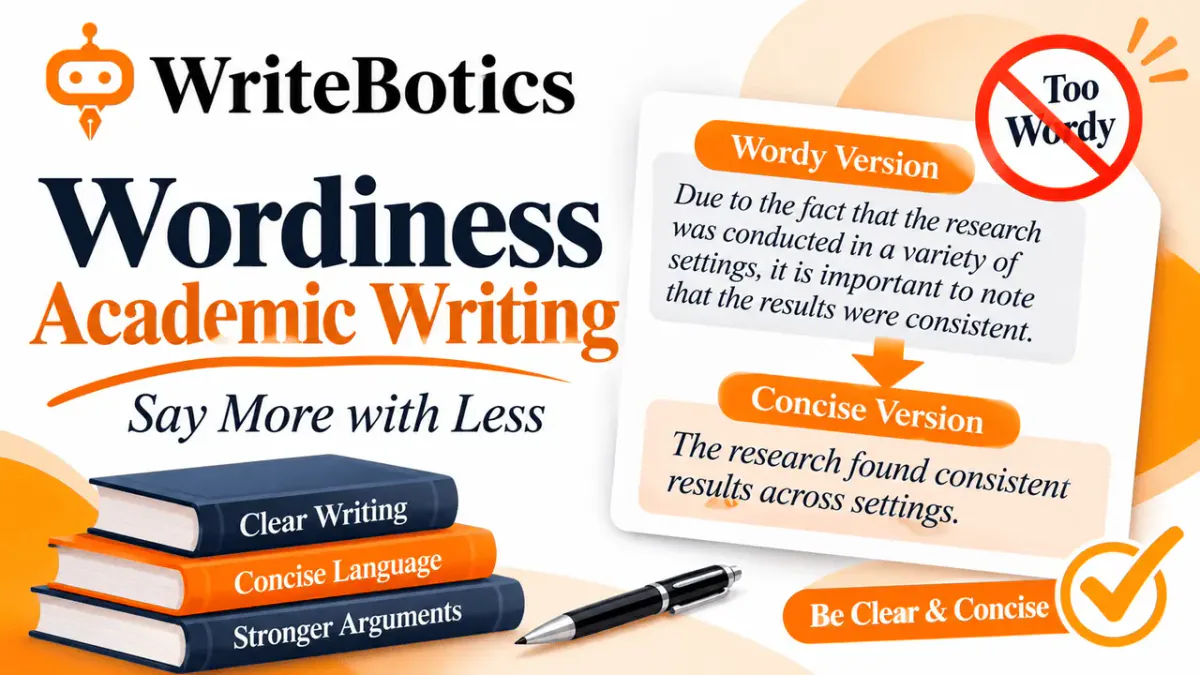
Wordy: Due to the fact that students have limited time, they should make an effort to plan their assignments in advance.
Concise: Because students have limited time, they should plan their assignments in advance.
Both sentences communicate the same message, but the second version is shorter and more direct.
Wordiness can make academic writing difficult to follow because readers must process unnecessary language before reaching the main point.
Common examples include:
- Using long phrases instead of simple words.
- Repeating the same information in different sentences.
- Including unnecessary introductory expressions.
- Using excessive adjectives and adverbs.
- Writing complicated sentences when simpler structures would work.
- Repeating ideas already explained elsewhere.
The goal is not to eliminate every long sentence. Some academic ideas require detailed explanations. Instead, focus on removing language that does not contribute meaningful information.
Why Is Avoiding Wordiness Important in Academic Writing?
Concise writing improves the quality of academic communication in several ways.
1. Improves Readability
Readers can understand your arguments more easily when sentences communicate ideas directly.
Removing unnecessary expressions helps readers focus on the important information rather than complicated wording.
2. Strengthens Your Arguments
A clear argument is easier to evaluate and understand.
When you remove repetitive explanations and irrelevant phrases, your main points become more noticeable.
3. Creates a Professional Writing Style
Academic writing should sound precise, objective, and organized.
Using unnecessarily complicated language can make your work appear less clear rather than more sophisticated.
4. Saves Readers' Time
Professors, researchers, and academic readers often work with large amounts of information.
Concise writing helps them identify your findings, explanations, and conclusions without unnecessary effort.
5. Improves Sentence Structure
Editing wordy expressions encourages you to use stronger verbs, clearer sentence patterns, and more direct language.
15 Common Wordy Phrases and Their Concise Alternatives
One of the easiest ways to avoid wordiness is to recognize expressions that can be replaced with shorter alternatives.
The following table provides practical examples you can use when editing academic assignments and research papers.
| Wordy expression | Concise alternative |
|---|---|
| Due to the fact that | Because |
| In order to | To |
| At this point in time | Now |
| In the event that | If |
| For the purpose of | For |
| A large number of | Many |
| In spite of the fact that | Although |
| Has the ability to | Can |
| In close proximity to | Near |
| With regard to | About |
| In the majority of cases | Usually |
| At the present time | Currently |
| In the near future | Soon |
| Make a decision | Decide |
| Give consideration to | Consider |
These alternatives can make your writing more direct without changing its meaning.
However, do not automatically replace every longer expression. Sometimes a longer phrase communicates a specific meaning that a shorter alternative cannot fully preserve.
How to Avoid Wordiness in Academic Writing: 8 Effective Strategies
Recognizing wordy phrases is important, but developing better writing habits will help you avoid unnecessary language from the beginning.
1. Replace Long Expressions With Simple Words
One of the most effective ways to reduce wordiness is to replace unnecessarily long expressions with shorter alternatives.
For example:
Wordy: It is important to note that regular exercise has a positive impact on physical health.
Concise: Regular exercise improves physical health.
The revised sentence removes an introductory expression that does not add meaningful information.
Look for phrases that can be replaced with simple words without changing your intended meaning.
2. Remove Redundant Words
Redundancy occurs when two or more words communicate the same information.
For example:
Wordy: The final outcome of the experiment was unexpected.
Concise: The outcome of the experiment was unexpected.
The word "final" is unnecessary because an outcome already refers to a result.
Other common redundant expressions include:
- Completely finished → Finished
- Past history → History
- Future plans → Plans
- Basic fundamentals → Fundamentals
- Unexpected surprise → Surprise
- Close proximity → Proximity
Removing redundant language makes your sentences more precise.
3. Use Strong Verbs Instead of Wordy Phrases
Weak verb constructions often make academic writing unnecessarily long.
For example:
Wordy: The researchers conducted an investigation into the effects of sleep deprivation.
Concise: The researchers investigated the effects of sleep deprivation.
The second sentence uses a direct verb instead of a longer expression.
More useful replacements include:
| Wordy construction | Stronger verb |
|---|---|
| Make an assessment | Assess |
| Conduct an analysis | Analyze |
| Provide an explanation | Explain |
| Reach a conclusion | Conclude |
| Perform an evaluation | Evaluate |
| Make an improvement | Improve |
| Give a description | Describe |
Strong verbs help communicate actions more efficiently.
4. Avoid Repeating the Same Ideas
Repeating information can make an academic paper feel unnecessarily long.
For example:
Wordy: Education is important for personal development. It plays a significant role in helping individuals develop their knowledge and skills.
Concise: Education supports personal development by improving individuals' knowledge and skills.
The revised version combines related ideas into one sentence.
Before submitting an assignment, check whether multiple sentences communicate essentially the same point.
If they do, consider combining them or removing the weaker repetition.
5. Eliminate Unnecessary Introductory Phrases
Some writers begin sentences with expressions that delay the main idea.
Examples include:
- It is important to mention that...
- It should be noted that...
- There is a possibility that...
- It is worth pointing out that...
- The fact of the matter is that...
These phrases are not always incorrect, but they often add unnecessary words.
Wordy: It is important to mention that technology has changed modern education.
Concise: Technology has changed modern education.
Start with the main subject or argument whenever possible.
6. Limit Excessive Adjectives and Adverbs
Adjectives and adverbs can improve descriptions, but using too many can make writing less precise.
For example:
Wordy: The research produced a very significant and extremely important result.
Concise: The research produced a significant result.
Academic writing benefits from accurate descriptions rather than excessive emphasis.
Choose modifiers carefully and remove those that do not contribute useful meaning.
7. Break Down Unnecessarily Complicated Sentences
Long sentences are not automatically wordy. However, sentences containing too many clauses and unnecessary expressions can become difficult to understand.
Wordy: Due to the fact that students frequently experience difficulties when attempting to manage their academic responsibilities alongside their personal commitments, it is essential for them to develop effective time-management strategies.
Concise: Students often struggle to balance academic and personal responsibilities. Therefore, they need effective time-management strategies.
The revised version separates the ideas into two manageable sentences.
Use shorter sentences when they improve clarity, but maintain logical connections between related ideas.
8. Use Active Voice When Appropriate
Active voice often creates more direct sentences by identifying who performs an action.
Wordy or indirect: An evaluation of the research findings was conducted by the academic team.
Concise: The academic team evaluated the research findings.
However, passive voice is not always inappropriate in academic writing. It can be useful when the action or result matters more than the person performing it.
Choose the sentence structure that communicates your intended meaning most clearly.
Before-and-After Examples of Concise Academic Writing
Practical examples can help you understand how small editing changes improve academic communication.
Example 1: Removing unnecessary phrases
Wordy
Due to the fact that the results were inaccurate, the researchers decided to repeat the experiment.
Concise
Because the results were inaccurate, the researchers repeated the experiment.
Shorter wording communicates the same information directly.
Example 2: Removing repetition
Wordy
The study examined the effects of stress on students and investigated how stress influences their academic performance.
Concise
The study examined how stress affects students' academic performance.
Combining related ideas eliminates repetition.
Example 3: Replacing weak verb phrases
Wordy
The researchers made an assessment of the collected data.
Concise
The researchers assessed the collected data.
A stronger verb makes the sentence more direct.
A Practical Editing Checklist for Removing Wordiness
After completing your first draft, review each paragraph using this checklist.
- Remove unnecessary introductory phrases.
- Replace long expressions with simpler alternatives.
- Eliminate repeated words and ideas.
- Replace weak verb constructions with strong verbs.
- Remove redundant adjectives and adverbs.
- Break down unnecessarily complicated sentences.
- Check whether every sentence contributes to the discussion.
- Remove unnecessary filler words.
- Preserve important explanations and supporting details.
- Read the revised paragraph aloud to check its flow.
A useful editing technique is to review your writing one paragraph at a time rather than attempting to fix everything simultaneously.
Common Mistakes to Avoid When Trying to Write Concisely
Although concise writing is important, removing too many words can create new problems.
Here are some mistakes to avoid.
1. Removing essential explanations
Do not delete important details simply to reduce your word count. Academic arguments still require sufficient context and supporting information.
2. Making every sentence extremely short
A series of short sentences can make writing sound repetitive or disconnected. Vary sentence length to maintain a natural academic flow.
3. Replacing precise terminology with vague words
Technical terms are sometimes necessary. Do not replace accurate academic terminology with simpler expressions that change the intended meaning.
4. Removing important transitions
Words such as "however," "therefore," and "consequently" help communicate relationships between ideas. Keep them when they contribute to logical flow.
5. Confusing concise writing with informal writing
Academic writing should remain professional and appropriate for its audience. Clear language does not mean using slang or conversational expressions in formal research papers.
How Writing Tools Can Help You Reduce Wordiness
Editing academic writing manually is valuable, but writing tools can make the process more efficient.
A reliable Writing Improver can help identify:
- Repetitive expressions.
- Unnecessarily complicated sentences.
- Redundant words.
- Weak sentence structures.
- Awkward phrasing.
- Opportunities to improve readability.
For example, you can paste a paragraph into a writing improvement tool and ask it to make the content more concise while preserving its original meaning, academic tone, and important details.
However, always review suggested changes carefully. Automated tools may remove important context or alter technical meanings.
The final responsibility for accuracy, clarity, and academic integrity remains with the writer.
Frequently Asked Questions (FAQs)
1. What does wordiness mean in academic writing?
Wordiness means using more words than necessary to communicate an idea. It commonly involves repetition, redundant expressions, unnecessary phrases, and complicated sentence structures.
2. How can I make my academic writing more concise?
Use simple language, replace long expressions with shorter alternatives, eliminate repetition, choose strong verbs, and remove unnecessary introductory phrases. Always preserve the information needed to explain your arguments.
3. Is wordiness bad in academic writing?
Excessive wordiness can reduce readability, weaken arguments, and make important information harder to understand. However, detailed explanations are sometimes necessary when discussing complex academic concepts.
4. What are examples of wordy phrases?
Common examples include "due to the fact that," "in order to," "at this point in time," and "with regard to." These can often be replaced with "because," "to," "now," and "about."
5. Does concise writing mean using fewer words?
Not necessarily. Concise writing means using the appropriate number of words to communicate an idea clearly. A longer sentence can still be concise if every part contributes meaningful information.
6. Can a Writing Improver help eliminate wordiness?
Yes. A Writing Improver can identify repetitive phrases, unnecessary expressions, and complicated sentences. It can also suggest clearer alternatives while helping maintain your original meaning.
7. How do I avoid wordiness in research papers?
Focus on clear topic sentences, precise terminology, strong verbs, and relevant supporting details. Remove unnecessary repetition and ensure every paragraph contributes to your research objectives.
Conclusion
Learning how to avoid wordiness in academic writing can improve the clarity, readability, and professionalism of your essays, assignments, and research papers.
The most effective approach is to use precise language, eliminate redundant expressions, choose stronger verbs, and remove unnecessary repetition. At the same time, make sure your editing does not remove important explanations, supporting evidence, or academic details.
Remember that good academic writing is not about using the fewest possible words. It is about communicating meaningful ideas as clearly and efficiently as possible.
With regular practice, careful proofreading, and the right writing improvement techniques, you can develop a more concise academic writing style that makes your work easier to understand and more persuasive.