If you are asking, “Can Turnitin detect humanized AI text?”, the short answer is yes, it can sometimes identify AI-generated text that has been rewritten or paraphrased with AI tools. But that does not mean Turnitin can prove who wrote a piece of text from an AI score alone.
Turnitin's current AI-writing capabilities include detection of content that may have been AI-generated and then AI-paraphrased or modified with certain bypassing tools. Its detection models are also updated over time, so a result from one version of the system may not be identical to a later result.
That distinction matters. An AI-writing report is a signal for an educator to review, not a verdict that automatically establishes academic misconduct. Turnitin itself says its technology provides information for educators to consider alongside academic and institutional policies.
For students, the safest approach is therefore not to search for a guaranteed way around detection. Instead, understand what the report means, make sure your submitted work reflects your own understanding, follow your institution's AI policy, and keep evidence of your writing process.
What Does Turnitin Actually Report?
Turnitin can provide more than one type of information about a submission, and those reports should not be confused.
Similarity is not the same as AI detection
The Similarity Report looks for text that matches material in Turnitin's databases, including internet content, publications, and previously submitted student work. A similarity percentage tells an instructor how much text resembles material found in those sources; it does not automatically mean the student plagiarized. Quotes, citations, references, and commonly used wording can contribute to similarity.
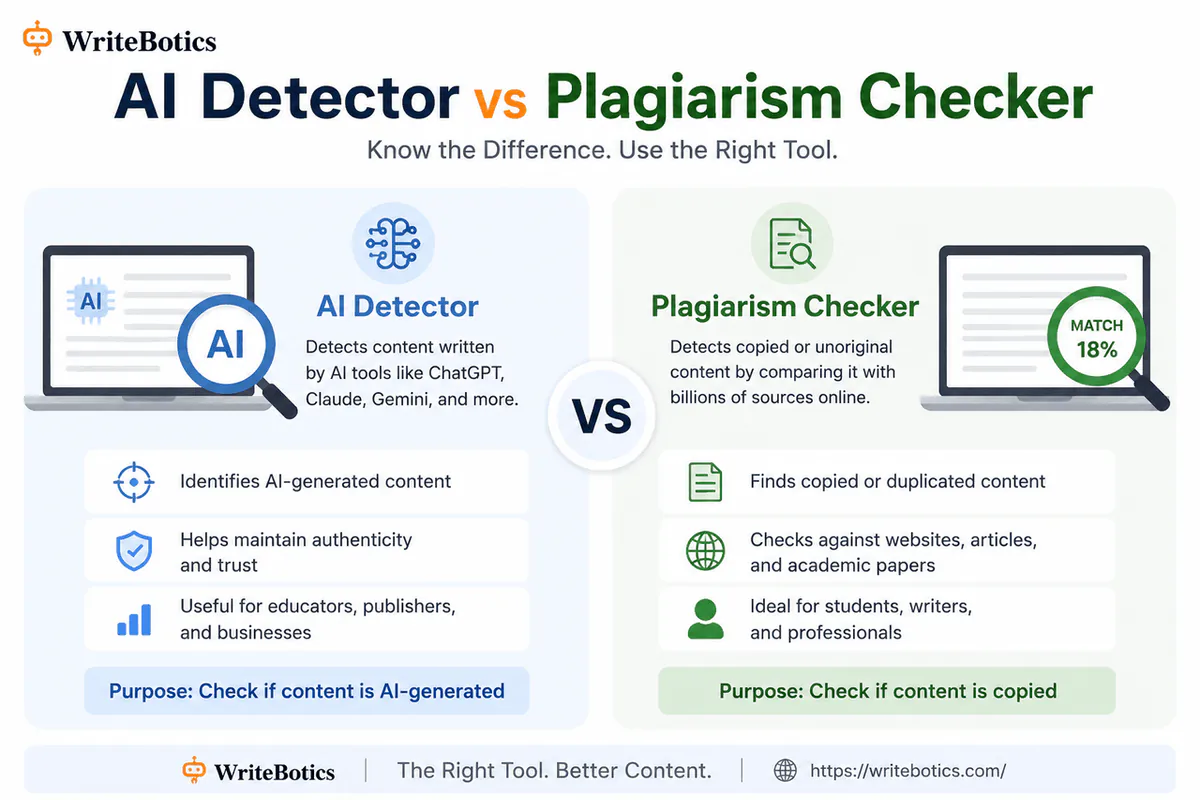
AI writing detection answers a different question: whether portions of the submission appear likely to have been generated by AI writing tools.
That means a paper can have:
| Result | What it generally tells you |
|---|---|
| High similarity | More text matches material in Turnitin's comparison sources |
| Low similarity | Less matching text was identified |
| AI-writing indicator | Some text appears likely to have AI-generated characteristics |
| AI-paraphrased/bypassed indication | Turnitin identifies patterns associated with AI-generated text that may have been subsequently modified |
| No AI indicator | The system did not identify qualifying AI-writing patterns; this is not a guarantee of human authorship |
Turnitin's current documentation says its AI writing report can distinguish between qualifying AI-generated text and AI-generated text that was subsequently AI-paraphrased.
A percentage is not a verdict
One of the most important points is that an AI percentage should not be treated like a laboratory measurement of authorship.
Turnitin says its AI detection technology is intended to provide data that educators can use when making informed decisions under their academic and institutional policies. It does not itself determine that misconduct occurred.
The technology is also continuously updated. For example, Turnitin released an AI-writing detection model update in February 2026 designed to improve recall while maintaining a low false-positive rate.
In other words, AI detection is an evolving technology, not a permanent authorship certificate.
Why Can Human-Written or Edited Text Still Be Uncertain?
AI detectors work by identifying patterns. Pattern-based systems can be useful, but patterns are not the same thing as proof of authorship.
Turnitin itself maintains resources explaining false positives and says that false positives are a consideration in AI detection. Its product documentation currently reports a false-positive rate of less than 1% for documents containing more than 20% AI-generated content, while also emphasizing that the technology does not independently determine misconduct.
There is another important detail: Turnitin previously changed its reporting behavior so that AI scores from 1% to 19% are not surfaced as a specific percentage, reducing the risk of over-interpreting very small signals.
Why might uncertainty happen?
Writing can naturally contain characteristics that overlap with patterns an AI detector examines.
For example, consider a student who writes:
“The study demonstrates that social media has significantly influenced communication among young adults.”
That sentence is perfectly plausible as human writing. It is also generic, formal, and predictable.
Now compare it with:
“I noticed this shift most clearly when our class discussion moved from face-to-face communication to group chats.”
The second sentence contains more specific context and a personal perspective. That does not make it “more human” in a technical sense, but it illustrates why writing style alone cannot establish authorship.
This is why a detector result should prompt a closer look at the student's work rather than replace that review.
Responsible Editing vs. Detection Evasion
There is an important difference between editing your writing responsibly and trying to defeat an academic-integrity system.
Responsible editing means improving a draft so that it accurately represents your ideas, reasoning, evidence, and voice.
That can include:
- Correcting grammar and spelling.
- Removing unnecessary repetition.
- Clarifying confusing sentences.
- Reorganizing an argument.
- Adding evidence you personally researched and understand.
- Replacing vague claims with precise explanations.
- Checking citations and quotations.
- Reading the final version carefully before submitting it.
Trying to manipulate a detector is different. Deliberately changing text solely to conceal unauthorized AI use can conflict with an institution's academic-integrity requirements. Turnitin has specifically developed detection capabilities intended to identify AI-generated content that has been modified by AI paraphrasing or bypassing tools.
So the goal should not be “How do I get Turnitin to say zero?”
A better question is:
“Does this submission accurately represent my own work, and can I explain how I produced it?”
That question remains useful even if detection technology changes tomorrow.
What If You Used AI for Editing?
The answer depends on the rules that apply to your assignment.
Some institutions or instructors may permit limited AI assistance for activities such as brainstorming, grammar review, or feedback. Others may require disclosure or prohibit generative AI for particular assignments.
Do not assume that “humanizing” a passage changes the underlying policy.
For example, suppose a professor allows AI for brainstorming but requires students to write the final essay themselves. Using AI to generate an entire essay and then running it through an editing tool would not necessarily become acceptable simply because the wording changed.
Before using any AI writing or rewriting tool for assessed work, check:
- The assignment instructions.
- Your syllabus.
- Your school's academic-integrity or AI-use policy.
- Any disclosure requirements.
- Your instructor's specific guidance.
If the policy is unclear, asking your instructor is safer than trying to interpret a detector score yourself.
Keep Evidence of Your Writing Process
One of the most useful habits for students is maintaining evidence of how an assignment developed.
This does not mean creating evidence after the fact. It means naturally preserving your legitimate work as you go.
Useful examples include:
- Early outlines.
- Research notes.
- Source lists.
- Drafts.
- Revision history.
- Teacher or peer feedback.
- Citation notes.
- Brainstorming documents.
- Version history in your writing application.
- Notes showing how your argument changed.
Imagine that your final essay contains a sentence an instructor questions. Being able to show an earlier outline, research notes, and several stages of revision can provide useful context about your writing process.
That evidence is more meaningful than trying to produce a particular detector score.
A Safe Student Workflow
If you are permitted to use AI tools as part of your writing process, keep the workflow focused on quality and compliance.
1. Understand the assignment
Identify exactly what your instructor expects you to produce and what forms of AI assistance are allowed.
2. Build your own argument
Before polishing language, make sure you understand the thesis, evidence, examples, and conclusions in the assignment.
3. Review AI-assisted material critically
If AI was permitted for brainstorming or editing, verify every factual claim and make sure you understand the material you submit.
4. Revise for clarity
Rewrite unclear passages in language you genuinely understand. Add appropriate evidence and explanation rather than artificial stylistic changes.
5. Check originality separately
AI detection and plagiarism detection address different issues. If you are concerned about matching source material, an originality check can help you identify passages that need proper quotation or attribution.
You can learn more about the difference in AI Detector vs. Plagiarism Checker.
6. Review the final document
Read the complete assignment from beginning to end. Check citations, facts, formatting, grammar, and whether the final work follows the assignment requirements.
For general writing review, WriteBotics also provides an AI Content Detector that can be used as an additional signal when reviewing writing patterns. It should not be treated as proof of authorship or as a way to predict a guaranteed Turnitin result.
Student Checklist Before Submission
- I understand my instructor's AI-use policy.
- I can explain the argument and evidence in my submission.
- I verified important facts and sources.
- I used quotations and citations correctly.
- I reviewed the document for accidental copied wording.
- I kept legitimate drafts, notes, or revision history where appropriate.
- I removed unclear or misleading claims.
- The final submission reflects the work I am permitted to submit.
- I did not deliberately manipulate the document to defeat an academic-integrity system.
- I am prepared to explain my writing process if asked.
FAQs
Can Turnitin detect humanized AI text?
Yes, potentially. Turnitin's AI-writing capabilities include detection of AI-generated content that may have subsequently been AI-paraphrased or modified with certain bypassing tools. However, detection is not the same as proving authorship.
Does humanizing AI text guarantee a lower Turnitin AI score?
No. There is no reliable guarantee of a particular Turnitin score. Detection models change, different passages can produce different results, and Turnitin itself describes its AI detection as information for educators rather than an automatic determination of misconduct.
Can Turnitin falsely flag human writing?
False positives are possible. Turnitin has published guidance specifically addressing false positives and has made model changes intended to maintain a low false-positive rate.
Is an AI score the same as a plagiarism score?
No. Similarity checking looks for matching text in comparison sources, while AI writing detection estimates whether qualifying text appears likely to have been generated by AI. The two reports answer different questions.
Should students use an AI humanizer before submitting an assignment?
Only if that type of AI assistance is permitted by the relevant institution or instructor. If AI use is restricted, changing AI-generated text with another AI tool does not necessarily make the use acceptable.
For permitted editing and readability work, you can explore the WriteBotics AI Humanizer, but always review the result yourself and follow your institution's rules.
What should I do if Turnitin says my writing may be AI-generated even though I wrote it?
Do not panic or assume the score proves anything by itself. Review the assignment instructions and ask your instructor how the institution handles AI-writing reports. If appropriate, provide legitimate drafts, notes, revision history, research records, or other evidence of your writing process.
Can an AI detector prove that a student used ChatGPT?
A detector can identify patterns that are consistent with AI-generated writing, but that is different from independently proving which tool was used or exactly who produced the text. Turnitin describes its AI indicator as information to support educator review rather than an automatic finding of misconduct.
The Bottom Line
So, can Turnitin detect humanized AI text? It can sometimes identify AI-generated writing even when that writing has been subsequently paraphrased or modified. Turnitin has specifically added capabilities for identifying AI-paraphrased and bypassed content, while continuing to update its detection models.
But there is no responsible way to turn an AI score into a definitive statement about authorship. Similarity scores, AI-writing indicators, and other signals need to be interpreted in context.
For students, the strongest protection is not a particular detector score. It is authentic understanding, permitted AI use, accurate attribution, careful revision, and a genuine record of the writing process.
If you are using WriteBotics to review a permitted draft, start with the AI Humanizer for readability, use the AI Content Detector as a secondary writing-pattern signal, and separately review originality and source attribution. Use these tools to improve your writing responsibly—not to make promises about what Turnitin will or will not detect.