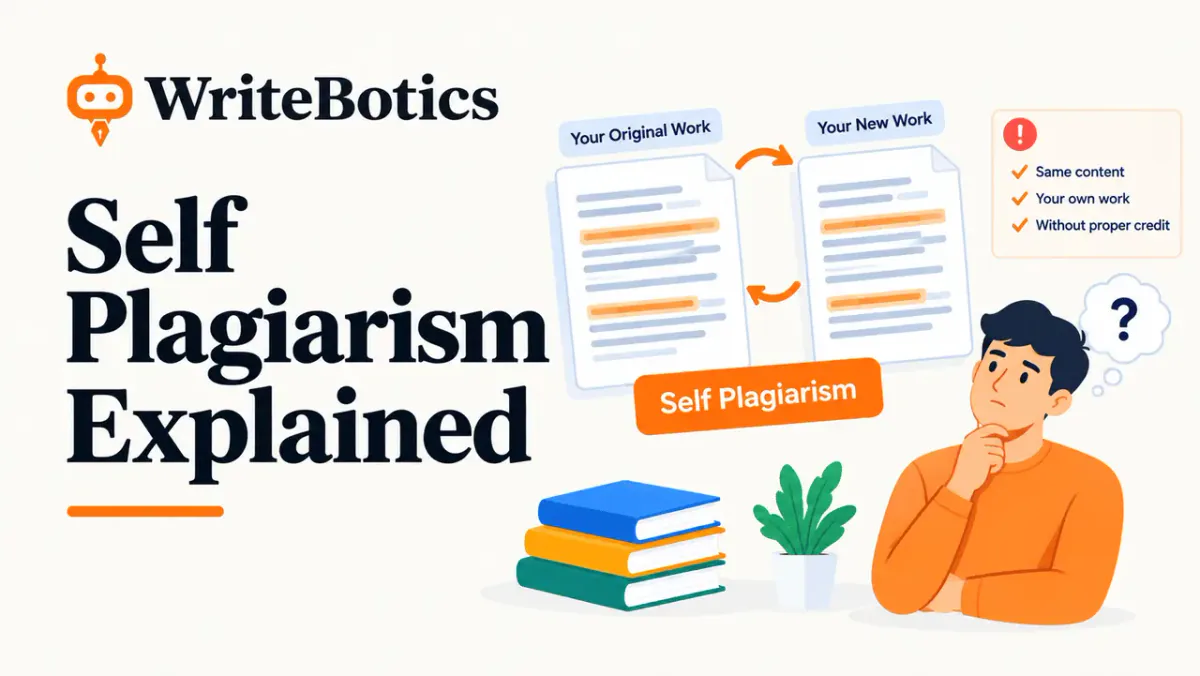
Self-plagiarism is the practice of reusing your own previously submitted, published, or presented work without appropriate disclosure or permission when new, original work is expected. It can occur when students submit the same essay for two classes, researchers reuse published material in a new paper, or writers republish an article without informing the relevant editor.
Although you created the original work, reusing it is not automatically acceptable. Academic institutions, journals, publishers, and employers may have different rules about previously used material. Understanding the meaning of self-plagiarism, recognizing common examples, and learning when reuse is permitted can help you protect your academic integrity and professional credibility.
What Is Self-Plagiarism? Meaning and Definition
Self-plagiarism occurs when someone presents their own previously used work as new or original without making the reuse clear when disclosure is required.
Unlike conventional plagiarism, which involves using someone else's words or ideas without proper acknowledgment, Self Plagiarism involves reusing material you created yourself.
For example, imagine that you wrote a 2,000-word research paper for one university course. A few months later, you submit the same paper for another course without asking your instructors or explaining that the work was previously submitted.
Even though you wrote every sentence, the second submission may violate your institution's academic integrity policy because the assignment was expected to represent new work.
The central issue is not simply who owns the words. It is whether the reuse meets the expectations and rules of the assignment, publication, or other context.
Self-plagiarism is sometimes called text recycling, particularly when previously published material is reused in a new publication. However, text recycling can have different implications depending on how much material is reused, where it appears, and whether the reuse is disclosed.
Self-Plagiarism vs. Traditional Plagiarism
Both practices can raise concerns about originality, but they involve different circumstances.
| Feature
|
Traditional plagiarism
|
Self-plagiarism
| | --- | --- | --- | |
Source of the material
|
Another person's work
|
Your own previous work
| |
Main concern
|
Using others' work without proper credit
|
Presenting reused work as new
| |
Common example
|
Copying a paragraph from a website without citation
|
Resubmitting an old essay without permission
| |
Possible solution
|
Quote, paraphrase, and cite appropriately
|
Obtain permission, disclose reuse, and follow applicable rules
|
The distinction matters because citing your earlier work may address an attribution problem, but it does not automatically make every form of reuse acceptable.
Common Examples of Self-Plagiarism
Self-plagiarism can occur in academic assignments, research publications, professional writing, and online content. The following examples illustrate situations where previously used material may create an originality concern.
1. Submitting the Same Assignment Twice
A student writes an essay about climate change for an environmental science course. Later, the student submits the same essay for a geography course without obtaining approval.
This may constitute self-plagiarism because the second assignment is being presented as new work.
Even if the two courses cover similar topics, the student should not assume that submitting identical work is acceptable.
How to handle it: Ask both instructors whether previous work can be reused. If reuse is permitted, clarify which material is being carried over and what new analysis is required.
2. Reusing Parts of a Previously Submitted Essay
A student writes a detailed introduction explaining the causes of inflation. For a later economics assignment, the student copies several paragraphs from that introduction into a new paper.
The student then adds a different conclusion and changes a few sentences.
Depending on the institution's rules and the amount of reused material, this may still be considered self-plagiarism. Changing some wording does not automatically make previously submitted work new.
How to handle it: Confirm whether the earlier material can be incorporated. If permission is granted, disclose the reuse when required and develop the new assignment according to its specific objectives.
3. Republishing Your Own Research Paper
A researcher publishes a study in an academic journal. Later, the researcher submits substantially the same paper to another journal as an original article without disclosing the earlier publication.
This can raise concerns about duplicate publication.
Academic journals generally expect authors to identify relevant prior publications and disclose overlapping submissions or content. The exact requirements depend on the journal's policies and the nature of the overlap.
How to handle it: Review the target journal's submission guidelines, disclose related publications, and obtain the necessary permissions before reusing published material.
4. Reusing Text From Your Previous Blog Posts
A content writer publishes an article about email marketing. Several months later, the writer copies large sections of that article into a new post on a different website.
The writer may own the original text, but the new publisher could expect exclusive or original content. Reusing the material without disclosure may breach an agreement or editorial policy.
How to handle it: Check the publishing agreement, explain the overlap to the editor, and establish whether republishing, adaptation, or linking to the original article is permitted.
5. Reusing Previously Published Research Findings
A researcher collects data for a study and publishes the results. Later, the researcher includes the same findings in another paper without explaining that the data or analysis has appeared previously.
This can create concerns about duplicate reporting and may mislead readers about how much new evidence a publication contributes.
How to handle it: Clearly identify the earlier study, disclose overlapping data, and explain what the new paper contributes. Follow the journal's rules for secondary analyses and related publications.
What Are the Risks of Self-Plagiarism?
The consequences of self-plagiarism vary according to the setting, the amount of reused material, the applicable policy, and whether the reuse was disclosed.
There is no single penalty that applies to every situation.
Academic consequences
At a school, college, or university, submitting previously assessed work without permission may violate academic integrity rules.
Possible consequences, depending on the institution's policy, include:
A request to revise or resubmit the assignment.
A reduced grade or a failing grade.
An academic integrity investigation.
Disciplinary action in more serious cases.
Students should consult their institution's academic integrity policy rather than assume that work they created themselves can always be submitted again.
Research and publishing consequences
In academic publishing, undisclosed reuse may lead to editorial concerns about originality, duplicate publication, or compliance with submission requirements.
Depending on the circumstances, a journal may reject a manuscript, request clarification, require revisions, or take further action under its publication policies.
If substantial overlap is discovered after publication, the journal may consider a correction, an expression of concern, or a retraction. These outcomes are not automatic; they depend on the specific case and the publisher's procedures.
Professional and reputational consequences
Writers, researchers, and content professionals may also face problems if reused material conflicts with a client's contract, a publisher's exclusivity terms, or an employer's expectations.
For example, a client who pays for a new article may reasonably expect original work unless repurposing was agreed upon.
Clear communication about previous material helps prevent misunderstandings and protects professional relationships.
When Is Reusing Your Own Work Allowed?
Reusing your own work is not always self-plagiarism. It can be acceptable when the relevant rules permit it and any required disclosure, citation, or permission is provided.
The important question is whether the reuse meets the expectations of the person or organization receiving the work.
1. When an Instructor Gives Permission
Some instructors allow students to build on earlier assignments, particularly when a new project extends previous research.
For example, a student might develop a short research proposal into a longer final paper. If the instructor approves this approach, the student can follow the agreed requirements.
Permission should be obtained before submitting the reused material, not assumed after the fact.
2. When a Journal Permits Text Recycling
Some publishers allow limited reuse of certain material, such as descriptions of established methods, when the reuse is appropriate and transparent.
However, policies differ. A journal may distinguish between reused methods, previously published results, and substantial overlap in an article's central argument.
Authors should read the journal's specific guidelines and disclose relevant overlap.
3. When Republishing Is Authorized
A writer may be allowed to republish or adapt an earlier article if the original publisher, client, or rights holder permits it.
This is particularly relevant when a contract includes exclusivity, copyright, or licensing terms.
Permission to reuse the material and compliance with originality expectations are related but separate questions. Make sure both are addressed.
4. When You Build on Your Previous Research
Research often develops over several stages. A later paper may legitimately extend an earlier study, test a new hypothesis, or analyze existing data from a different perspective.
The new work should make its relationship to the earlier research clear and explain its distinct contribution.
Simply changing the title or rearranging paragraphs does not turn an unchanged paper into a genuinely new study.
Quick Guide: Is Reuse Acceptable?
| Situation
|
What to do
| | --- | --- | |
Reusing an old assignment
|
Ask the instructor first
| |
Expanding your previous research
|
Cite and disclose the earlier work
| |
Reusing published article text
|
Check publisher rules and permissions
| |
Republishing a blog post
|
Confirm rights and editorial approval
| |
Reusing a standard methods description
|
Check the relevant journal's policy
| |
Unsure whether reuse is allowed
|
Seek written clarification before submission
|
How to Disclose and Cite Your Own Previous Work
When reuse is permitted, transparent disclosure helps readers, instructors, and editors understand which material is new and which material has appeared before.
The appropriate method depends on the context.
Cite the Earlier Publication
If you are using material from a previously published paper, cite that paper according to the required referencing style.
For example, a researcher might write:
A preliminary analysis of this dataset was reported in our earlier study (Author, Year). The present paper examines an additional research question using a separate analysis.
This is an illustrative example, not a citation to an actual study. Replace the placeholder with accurate publication details and ensure the description reflects what was genuinely done.
Disclose Reused Material to the Editor
If you are submitting a manuscript that overlaps with your previous publication, explain the relationship to the editor.
A disclosure might state:
Portions of the methods section are adapted from our previously published article. The earlier publication is cited, and the reused material is identified in accordance with the journal's guidelines.
Use wording that accurately describes the overlap. Do not claim that material is newly written if it has been copied or adapted from an earlier publication.
Follow the Required Citation Style
Different institutions and publishers may require APA, MLA, Chicago, or another citation system.
Check the rules for citing your own published work, including in-text citations, reference-list entries, footnotes, and any required permissions.
For additional help with attribution, see WriteBotics' guide to common citation mistakes .
Remember that citation alone does not necessarily authorize duplicate submission or repeated assessment. You must also follow the applicable reuse policy.
How to Avoid Self-Plagiarism: A Practical Checklist
Preventing self-plagiarism starts with keeping track of your previous work and understanding what each new assignment or publication requires.
Use this checklist before submitting an essay, research paper, blog post, or professional document.
Review the originality requirements. Read the assignment instructions, journal guidelines, or client agreement before reusing any material.
Keep copies of previous work. Maintain organized drafts and publication records so you can identify material you have already submitted or published.
Check for overlapping content. Compare your new draft with relevant earlier work, especially if you regularly write about the same subject.
Ask for permission when necessary. Get approval from your instructor, editor, publisher, or client before reusing material when required.
Disclose previous use. Identify earlier submissions, publications, or overlapping research wherever the applicable rules require it.
Cite your earlier publications. Give readers a clear reference to previously published work when appropriate.
Make the new contribution clear. Explain what is different about the new assignment, article, or research paper.
Check copyright and licensing terms. Confirm that you have the necessary rights to reuse published material.
Review the final draft. Look for copied passages, duplicated sections, and missing disclosures before submission.
A plagiarism checker can also help you identify matching passages that deserve a closer look.
If you want to review your draft before submitting it, try the WriteBotics Plagiarism Checker . Review any matches in context: a similarity result is not, by itself, proof of plagiarism or a policy violation.
You can also follow the guide to checking plagiarism before submitting an essay for a practical pre-submission review.
Self-Plagiarism FAQs
Is self-plagiarism considered plagiarism?
Yes, self-plagiarism is recognized as an academic and publishing integrity concern in many contexts. It involves presenting previously used work as new without the disclosure or permission required by the relevant rules. However, policies differ, and not every instance of reusing your own writing is prohibited.
Can I plagiarize myself if I wrote the original work?
Yes. You can violate an originality policy by reusing your own work without permission or disclosure, even though you wrote the original. The concern is the expectation that the new submission represents original work, not simply who created the words.
Is reusing my own essay always self-plagiarism?
No. Some instructors permit students to build on previous assignments, while others prohibit submitting the same work more than once. Check the course rules and obtain approval before reusing an essay.
Can I reuse my own published article?
Sometimes. Republishing or adapting an article may be allowed if the publisher's policies, copyright terms, and any relevant agreements permit it. Disclose the earlier publication when required and make sure the reuse is appropriate for the new context.
Does citing my previous work prevent self-plagiarism?
Not necessarily. Citing an earlier publication provides attribution, but it does not automatically satisfy rules against duplicate submissions, duplicate publication, or repeated assessment. Permission and disclosure may also be required.
Can a plagiarism checker detect self-plagiarism?
A plagiarism checker may identify matching passages from your previous work if that material is available within the sources it checks. However, coverage varies, and a tool may not find every instance of reuse. A match also does not establish whether the reuse is permitted.
What is the difference between self-plagiarism and duplicate publication?
Self-plagiarism is the broader concern of presenting previously used work as new without appropriate disclosure. Duplicate publication generally refers to publishing substantially overlapping work more than once as though it were a distinct publication. The terms can overlap, but their precise meanings depend on the context and applicable policies.
Is paraphrasing my own old work enough to avoid self-plagiarism?
No. Changing the wording does not automatically make previously submitted or published material acceptable for reuse. You still need to follow the relevant rules, disclose previous use when required, and ensure the new work makes an appropriate original contribution.
Final Thoughts on Self-Plagiarism
Understanding the meaning of self-plagiarism helps students, researchers, and professional writers make informed decisions about reusing their own work.
The key principle is transparency. Your previous writing can be a valuable foundation for a new project, but you should not assume that ownership gives you unrestricted permission to resubmit or republish it.
Before reusing an essay, research paper, or article, check the applicable rules, obtain permission where necessary, cite earlier publications, and disclose overlapping material.
If you are preparing a document for submission, use the WriteBotics Plagiarism Checker to review potential text matches. Examine the results carefully, correct genuine attribution problems, and confirm that your final work meets the expectations of your instructor, publisher, or client.
Originality is not just about producing different words. It is about being clear and honest about what is new, what came before, and how your work builds on it.