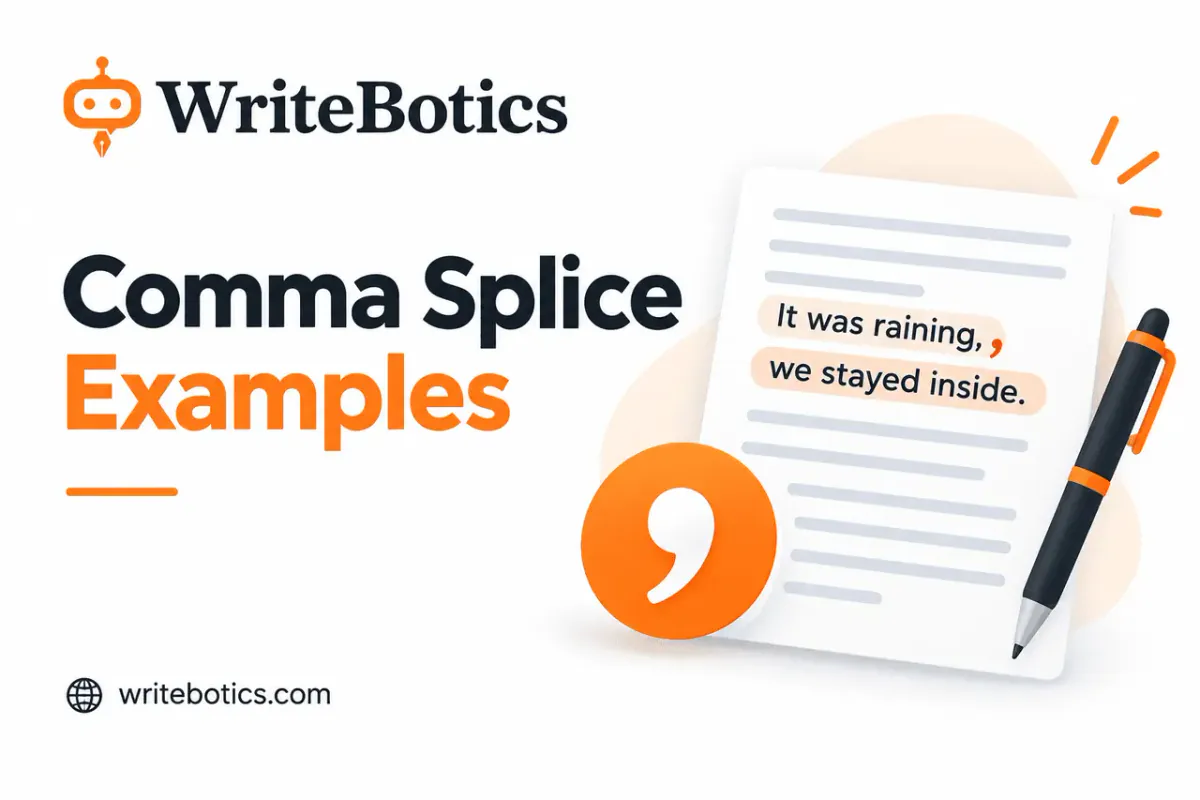
A comma splice happens when two complete sentences are joined with only a comma. For example, “The meeting ended, everyone went home.” Both parts can stand alone, so the comma is not strong enough to connect them.
Comma splices are easy to miss because the sentence may sound natural when you read it quickly. The good news is that they are also easy to fix. You can usually correct one by using a period, semicolon, coordinating conjunction, or by restructuring the sentence.
In this guide, you’ll learn how to identify comma splices, see clear comma splice examples, and choose the right correction for each situation.
What Is a Comma Splice?
A comma splice occurs when two independent clauses—complete sentences that could stand on their own—are connected with just a comma.
For example:
Incorrect: The store closes at six, we need to leave now.
There are two complete thoughts:
- The store closes at six.
- We need to leave now.
Putting a comma between them creates a comma splice.
Here are a few more comma splice examples:
| Comma splice | Why it is incorrect |
|---|---|
| I finished the report, I sent it to my manager. | Two complete sentences are joined only by a comma. |
| The weather was cold, we went for a walk anyway. | Both clauses can stand alone. |
| She wanted to call, she changed her mind. | A comma alone does not properly join the clauses. |
| The test was difficult, everyone passed. | The two independent clauses need a stronger connection. |
A comma is useful for separating parts of a sentence, but it generally cannot join two independent clauses by itself.
How to Identify a Comma Splice
The fastest way to find a comma splice is to check what appears on both sides of the comma.
Step 1: Look for the comma
Start with sentences containing a comma between two larger groups of words.
For example:
The deadline is tomorrow, we should finish today.
Step 2: Check both sides
Ask whether the words before and after the comma could each be complete sentences.
The deadline is tomorrow. Yes.
We should finish today. Yes.
That means you have two independent clauses.
Step 3: Check what connects them
Now look at the punctuation or connecting word.
If the two independent clauses are joined by only a comma, you probably have a comma splice.
Compare:
Comma splice: The deadline is tomorrow, we should finish today.
Correct: The deadline is tomorrow, so we should finish today.
The second version uses so to connect the ideas properly.
A simple comma splice test
Use this checklist:
- Is there a comma between two clauses?
- Can the words before the comma form a complete sentence?
- Can the words after the comma form a complete sentence?
- Is there no conjunction or other appropriate punctuation connecting them?
If all four answers are yes, you likely have a comma splice.
Four Easy Ways to Fix a Comma Splice
There is no single best correction for every sentence. The right choice depends on how closely the ideas are related.
1. Use a period
The simplest solution is often to make the two independent clauses separate sentences.
Before:
The restaurant was crowded, we decided to eat somewhere else.
After:
The restaurant was crowded. We decided to eat somewhere else.
This works well when both ideas deserve equal attention.
A period creates a clear boundary, so it is especially useful when the original sentence feels too long or crowded.
2. Use a semicolon
A semicolon can join two closely related independent clauses.
Before:
The forecast looked bad, we canceled the picnic.
After:
The forecast looked bad; we canceled the picnic.
The semicolon tells the reader that the two sentences are closely connected without requiring a conjunction.
A semicolon is most useful when the relationship between the ideas is obvious:
The store was closing soon; we hurried to the checkout.
The two clauses are independent, but their connection is strong.
3. Add a coordinating conjunction
You can also connect the clauses with a coordinating conjunction.
The most common coordinating conjunctions are for, and, nor, but, or, yet, and so. These are often remembered with the acronym FANBOYS.
Before:
Maya wanted to attend the event, she had another appointment.
After:
Maya wanted to attend the event, but she had another appointment.
The conjunction makes the relationship between the ideas clearer.
Choose the conjunction based on the meaning:
- and — adds information
- but — shows contrast
- or — presents an alternative
- so — shows a result
- yet — shows contrast or an unexpected result
- for — gives a reason, usually in more formal writing
- nor — continues a negative idea
For example:
The bus was late, so we arrived after the meeting started.
4. Restructure the sentence
Sometimes the best correction is not simply changing the punctuation. You can rewrite the sentence so the relationship between the ideas becomes clearer.
Before:
The project was behind schedule, the team added another work session.
After:
Because the project was behind schedule, the team added another work session.
Or:
The team added another work session because the project was behind schedule.
This option can produce a smoother sentence when one idea explains, qualifies, or depends on another.
Comma Splice Examples: Before and After
Here are several examples showing how the same comma splice can be corrected in different ways.
Example 1: Use a period
Before:
The movie started late, we missed the opening scene.
After:
The movie started late. We missed the opening scene.
Example 2: Use a semicolon
Before:
The instructions were unclear, several people made the same mistake.
After:
The instructions were unclear; several people made the same mistake.
Example 3: Add a conjunction
Before:
I wanted to order dessert, I was already full.
After:
I wanted to order dessert, but I was already full.
Example 4: Restructure the sentence
Before:
The road was flooded, the drivers found another route.
After:
Because the road was flooded, the drivers found another route.
Notice that the best correction depends on the intended relationship. A period separates the ideas, a semicolon keeps them closely connected, a conjunction explains the relationship, and restructuring can make the sentence more direct.
Comma Splice or Run-On Sentence?
Comma splices and run-on sentences are related, but they are not exactly the same.
A comma splice occurs when two independent clauses are incorrectly joined with a comma:
The store was closed, we went home.
A fused sentence, another type of run-on sentence, joins two independent clauses without appropriate punctuation:
The store was closed we went home.
Both have incorrect sentence boundaries, but the punctuation problem is different.
If you're dealing with a broader sentence-boundary problem, see our guide on how to fix run-on sentences.
It's also worth remembering that a comma splice is not the same thing as a sentence fragment. A fragment is an incomplete sentence rather than two complete sentences joined incorrectly. See our guide to sentence fragment examples and fixes for more examples.
Punctuation Choice Guide
Not sure which fix to use? Start with the relationship between the two ideas.
| Situation | Good choice | Example |
|---|---|---|
| Two separate ideas | Period | The store closed. We went home. |
| Two closely related ideas | Semicolon | The store closed; we went home. |
| Clear relationship such as contrast or result | Comma + conjunction | The store closed, so we went home. |
| One clause explains or depends on another | Restructure | Because the store closed, we went home. |
A useful rule is: fix the sentence based on meaning, not just punctuation.
If the ideas are independent and you simply want a clean break, use a period. If they are closely connected, a semicolon may work. If you need to show contrast, cause, addition, or another relationship, a conjunction or rewritten structure may be clearer.
Mini Quiz: Can You Spot the Comma Splice?
Try these before checking the answers.
1. Which sentence contains a comma splice?
A. The store was busy, but we found a table. B. The store was busy; we found a table. C. The store was busy, we found a table.
Answer: C.
Both sides of the comma can stand alone, and there is no conjunction or other appropriate punctuation between them.
2. Which correction is best?
The weather changed suddenly, we canceled the trip.
A. The weather changed suddenly, we canceled the trip. B. The weather changed suddenly. We canceled the trip. C. The weather changed suddenly we canceled the trip.
Answer: B.
A period cleanly separates the two complete thoughts.
3. Is this a comma splice?
When the meeting ended, everyone left the room.
Answer: No.
“When the meeting ended” cannot stand alone as a complete sentence in this context. The comma separates an introductory dependent clause from the independent clause.
4. Which version uses a conjunction correctly?
A. I was tired, I went home. B. I was tired, so I went home. C. I was tired so, I went home.
Answer: B.
The coordinating conjunction so correctly connects the two independent clauses.
How to Avoid Comma Splices While Writing
You do not need to stop and analyze every comma while drafting. Instead, watch for sentences that contain two complete thoughts.
When you finish a draft, look specifically for patterns like:
Complete thought + comma + complete thought
Then ask whether you should use a period, semicolon, conjunction, or a different sentence structure.
Reading your work aloud can also help. If you naturally pause strongly at the comma, check whether the sentence would be clearer with a stronger boundary.
For a final punctuation and grammar pass, you can use the WriteBotics Grammar Checker to review your draft. Treat automated suggestions as a second opinion, then review the changes yourself to make sure the meaning and tone are still right.
FAQs About Comma Splices
What is a comma splice in simple terms?
A comma splice happens when two complete sentences are joined using only a comma. For example, “I finished my work, I went home” is a comma splice because both sides can stand as independent sentences.
How do you fix a comma splice?
You can fix a comma splice in four common ways: separate the clauses with a period, join them with a semicolon, add an appropriate coordinating conjunction, or restructure the sentence.
Is a comma splice always wrong?
In standard edited English, joining two independent clauses with only a comma is generally considered an error. Some writers may use comma splices deliberately for stylistic effect, but that is different from accidentally creating one in formal or general-purpose writing.
What is the difference between a comma splice and a run-on sentence?
A comma splice uses a comma incorrectly to join two independent clauses. A fused sentence joins two independent clauses without appropriate punctuation. Both are sentence-boundary errors.
Can a semicolon fix a comma splice?
Yes. A semicolon can correctly join two closely related independent clauses.
For example:
The train was delayed; we arrived late.
The two clauses are complete sentences, and the semicolon provides the appropriate connection.
Do you need a comma before a coordinating conjunction?
When a coordinating conjunction joins two independent clauses, a comma normally comes before the conjunction.
For example:
I wanted to stay, but I had to leave.
The comma and conjunction work together to connect the two independent clauses.
Can a comma splice occur in a short sentence?
Yes. Sentence length does not determine whether something is a comma splice.
She called, I answered.
This is a comma splice even though it contains only four words.
What's the easiest way to remember how to fix a comma splice?
Remember four options: period, semicolon, conjunction, or restructure.
If you're unsure, a period is often the simplest choice because it clearly separates the two complete thoughts.
Final Takeaway
The easiest way to recognize a comma splice is to look at both sides of the comma. If each side could stand as a complete sentence and the only connection is the comma, the sentence needs revision.
You can usually fix it with a period, semicolon, coordinating conjunction, or a new sentence structure. The best option depends on how the ideas relate to each other.
Once you know what to look for, comma splices become much easier to spot during proofreading. For a quick final check of your writing, try the WriteBotics Grammar Checker, then review the suggested corrections yourself before publishing or submitting your work.