Plagiarism doesn't usually happen on purpose. It's rarely someone deliberately copying a paragraph and hoping no one notices. Far more often, it's a forgotten citation, a phrase that stuck too closely to a source you read weeks ago, or a paraphrase that ended up closer to the original than intended. An AI plagiarism checker exists to catch exactly that kind of accidental overlap — before a reader, a teacher, or an editor does.
This piece looks at why originality is worth protecting in the first place, how a plagiarism checker actually works, and how to build writing habits that keep it from becoming an issue at all.
Why originality matters, beyond avoiding a penalty
It's easy to think of plagiarism checking as a rule to follow — something you do because a school or publication requires it. But originality matters for reasons that go beyond compliance.
It protects your credibility
Writing that leans on someone else's words, even unintentionally, weakens the reader's trust once it's discovered. That trust is hard to rebuild.
It's where your actual thinking lives
Summarizing someone else's argument is not the same as forming your own. The value in most writing — an essay, an article, a report — comes from what you add to the source material, not from repeating it more smoothly.
It has real consequences
Academic institutions treat plagiarism as an integrity violation, not a style issue, and penalties can range from a failed assignment to expulsion. Publishers and employers take a similar view — unoriginal content damages a professional reputation quickly, and often permanently.
None of this requires perfection. Even careful writers occasionally echo a source too closely. What matters is catching it before it goes out the door.
How an AI plagiarism checker actually works
You paste in your text, and the tool compares it against a large index of web pages, articles, and published content, looking for matching or near-matching phrasing. The result is typically a similarity score — a percentage estimating how much of your text overlaps with existing sources — along with highlighted sections showing exactly where the matches are and where they came from.
- A low score isn't zero, and that's normal. Common phrases, technical terms, and proper nouns will often register as matches even in fully original writing. A 3–5% score usually isn't a problem.
- A flagged section isn't automatically a violation. It's a prompt to check: is this a common phrase, a properly cited quote, or something that needs to be reworded or credited?
- The report shows you the source. This is the most useful part — you can read the original and decide for yourself whether the overlap is coincidental or needs fixing.
What counts as plagiarism (it's broader than copy-paste)
Direct copying is the most obvious form, but it's not the only one:
Patchwork writing
pulling a phrase from one source and a phrase from another, then stitching them together. It still counts, because none of the sentence structure or wording is genuinely yours.
Missing attribution
summarizing someone else's idea accurately but forgetting to credit where it came from. The idea itself needs the citation, not just direct quotes.
Close paraphrasing
Rewording a sentence just enough that it isn't an exact match, while keeping the same structure and most of the original wording. A plagiarism checker often catches this because the phrasing pattern still resembles the source closely.
Self-plagiarism
Reusing your own previously submitted or published work without disclosing it. Most academic and publishing guidelines treat this as a violation too, since the expectation is new work each time.
Building habits that keep your writing original
A checker is a safety net, not a substitute for good habits while you write. A few that make the biggest difference:
- Take notes in your own words from the start. If you're summarizing a source as you read it, rather than copying a sentence to reword later, you're far less likely to end up with close paraphrasing.
- Close the source before you write the section based on it. Reading a paragraph, then writing what you understood from memory, naturally produces more original phrasing than writing with the source open next to you.
- Quote sparingly and deliberately. Use a direct quote only when the original wording matters — otherwise, put the idea in your own words and cite the source.
- Run a check before you consider a draft final. Catching an unintentional match at this stage is a quick fix. Catching it after publication is not.
Close paraphrasing vs. proper paraphrasing
It helps to see the difference, since this is the most common way originality slips without anyone intending it.
"Remote work has shifted from a temporary pandemic measure to a permanent fixture of how companies structure their teams."
Close paraphrase (still flagged — same structure, swapped words):
"Remote work has moved from a temporary pandemic solution to a permanent part of how companies organize their teams."
Proper paraphrase (own structure, own wording, idea credited):
"What started as a stopgap during the pandemic has become standard practice — most companies now build their team structure around remote work by default."
The first paraphrase changes a handful of words but keeps the original's sentence shape almost exactly, which is why a checker still flags it. The second reorganizes the sentence entirely and expresses the same idea in different language. Both convey the same point; only the second is genuinely original.
Plagiarism checking and AI content detection are different tools
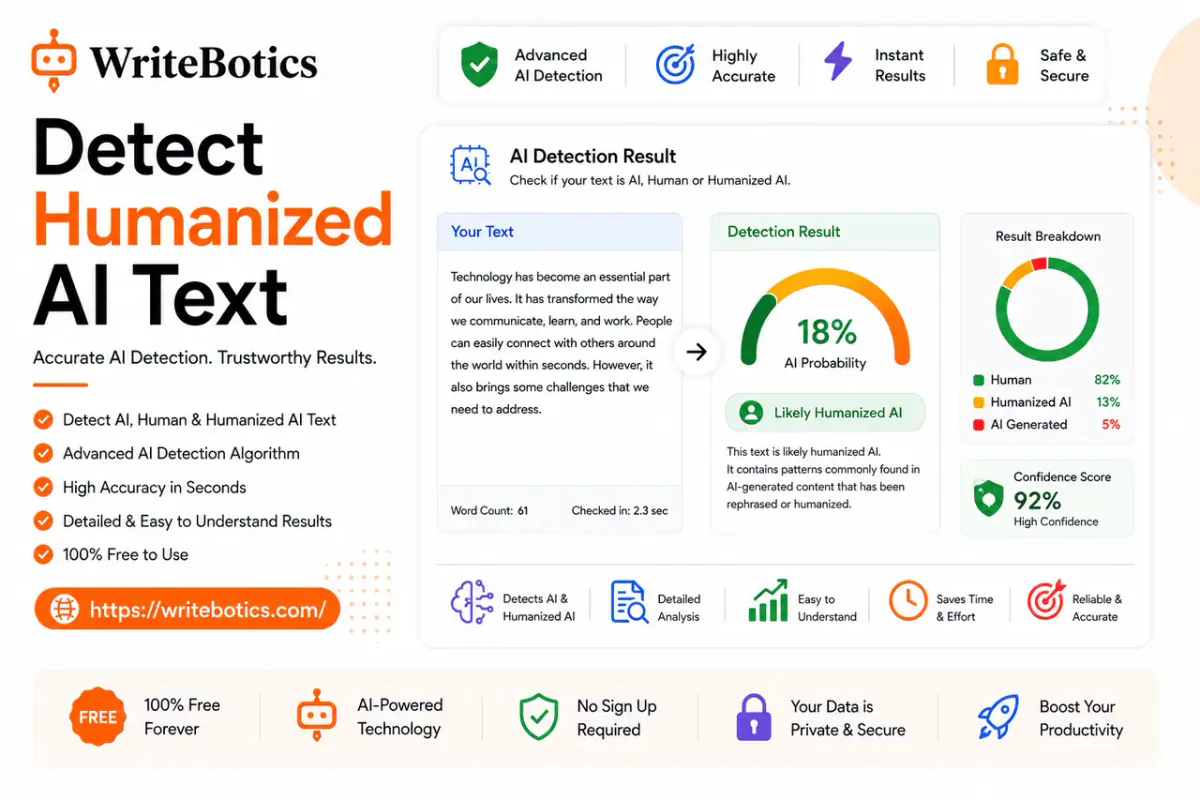
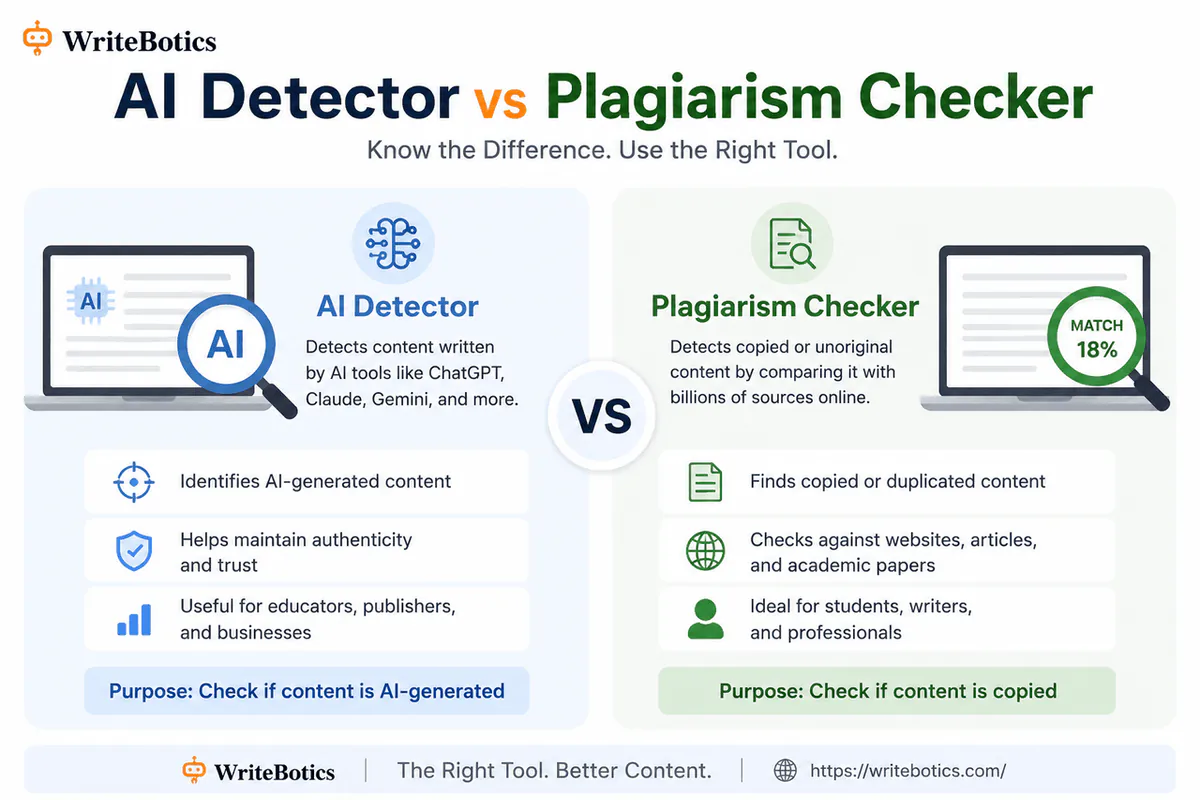
These two often get bundled together, but they answer different questions. A plagiarism checker asks: does this text match existing published content? An AI content detector asks a different question: does this text show patterns common in AI-generated writing?
You can write something entirely original and still have an AI detector flag it, because detectors measure writing patterns, not authorship. Similarly, a plagiarism checker won't catch AI-generated text that happens to be original — it's only looking for matches to existing sources. If you need to verify both originality and authorship concerns, the two tools answer separate questions and are worth running independently rather than assuming one covers the other.
FAQs
What's considered a good similarity score?
Scores under 10% are generally considered strong, though the right threshold depends on the context — an academic paper, a blog post, and a legal document may all have different expectations. When in doubt, check with whoever set the requirement.
Does a low similarity score guarantee my writing is plagiarism-free?
It's a strong signal, not a guarantee. Always review flagged sections individually — a low overall score can still include one section that genuinely needs a citation or a rewrite.
Can a plagiarism checker detect ideas that were paraphrased, not copied word-for-word?
Close paraphrasing that keeps the same sentence structure is often caught, since the underlying pattern still resembles the source. Looser paraphrasing that fully reworks the sentence is harder for any checker to flag — which is why citing the idea, not just matching wording, matters.
Is checking my own previously published work necessary?
Yes, if you're planning to reuse or adapt it. Many academic and publishing guidelines treat self-plagiarism — resubmitting your own past work without disclosure — as a violation, since the expectation is new work.
Will my writing be stored or shared when I run it through a checker?
This depends on the specific tool's privacy policy — check it before submitting anything sensitive, confidential, or unpublished. WriteBotics does not store or share the content you submit.
Is an AI plagiarism checker free to use?
WriteBotics' plagiarism checker is free to try, so you can run a check on your own draft before deciding whether it fits your workflow.
The bottom line
Originality isn't just a rule to satisfy before submitting or publishing — it's what makes your writing worth reading in the first place. An AI plagiarism checker is a useful last line of defense, catching the accidental overlaps that even careful writers occasionally produce. But the habits that prevent plagiarism in the first place — taking notes in your own words, quoting sparingly, and citing ideas as well as quotes — matter more than any single scan.
For more on keeping your writing both original and clean, see our guides on why a reliable plagiarism checker matters for writers and what an AI content detector can and can't tell you.
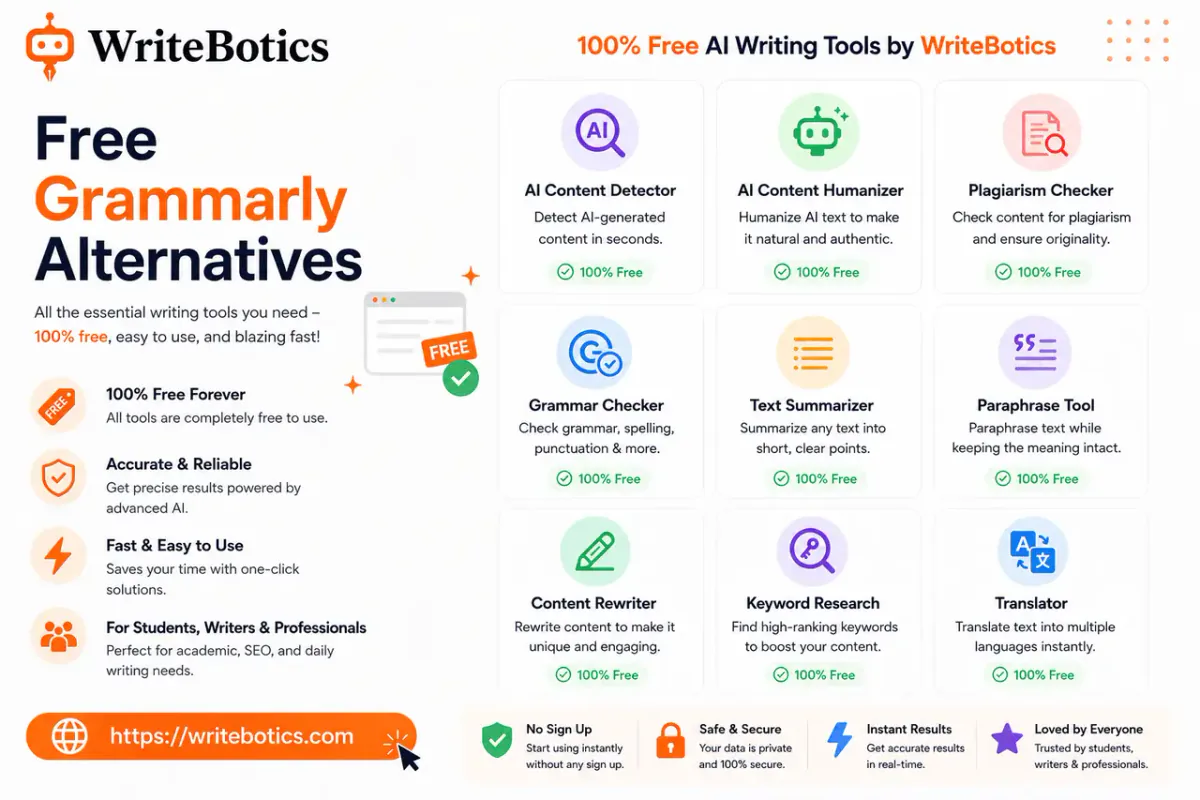
Ready to check your own draft? Explore WriteBotics' free writing tools and run your next piece through the plagiarism checker before you publish.