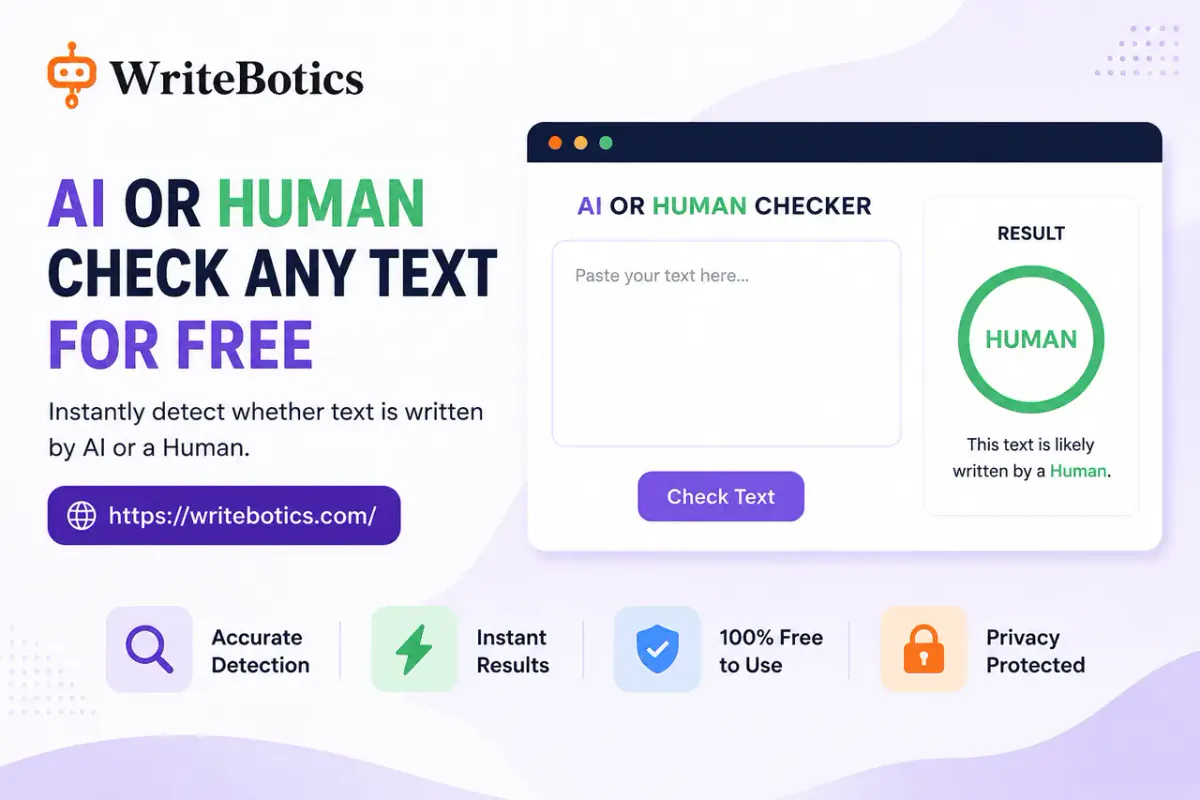
More writing than ever passes through an AI tool at some point — a first draft, a rough outline, a quick rewrite. That's made one question increasingly common: is this piece of text actually AI-generated, or did a person write it? Whether you're reviewing student work, checking a freelancer's submission, or just curious about your own draft, you don't need to pay for a subscription to get a useful answer. This guide walks through how to check if text is AI-generated for free, what these tools can and can't actually tell you, and how to read the result without over-trusting it.
How AI Content Detectors Actually Work
AI detectors don't "know" who wrote something. There's no database of every AI output to match against. Instead, most detectors analyze statistical patterns in the text — things like:
- Predictability of word choice. AI models tend to pick the most statistically likely next word more often than a human writer would.
- Sentence uniformity. Human writing naturally varies in rhythm — short sentences next to long ones, occasional fragments, inconsistent pacing. AI text is often more evenly structured.
- Repetition of structure. AI-generated paragraphs frequently repeat the same sentence shapes and transition phrases across a piece.
- Burstiness and perplexity. These are technical measures of how "surprising" or varied the word choices are throughout a text. Human writing tends to be burstier and less predictable.
A detector scores text against these patterns and returns a probability or percentage — not a definitive yes or no. That distinction matters more than most people realize.
Step-by-Step: How to Check Text for Free
1. Copy the text you want to check. Grab the full passage rather than a short snippet — most detectors need enough text (generally at least 100–150 words) to produce a reliable estimate.
2. Open a free, no-signup detector. Use a tool like WriteBotics' AI Content Detector, which lets you paste text directly into a workspace without creating an account first.
3. Paste the text and run the check. The tool will scan the passage and return an estimate of how closely it matches common AI-writing patterns.
4. Read the result as one signal, not a verdict. A high "AI-likely" score means the text shares statistical traits with AI output — it does not prove who wrote it. Treat it as a starting point for further review, not a final answer.
5. Cross-check with context. Look at the surrounding evidence: does the writing style match the person's other work? Is there a draft history? Does the content include specific, verifiable details that would be hard for a generic AI output to produce? Context often tells you more than the score alone.
6. Don't rely on a single tool. Different detectors are trained on different data and weigh signals differently, so results can vary between tools. If a decision genuinely matters, use more than one detector and see whether the results agree.
What a Free AI Detector Can Tell You
- A reasonable estimate of AI-typical patterns in the writing style
- A useful first signal when reviewing a large volume of text quickly
- A prompt to look closer, rather than a reason to stop looking
What It Can't Tell You
- Definitive proof of authorship. No detector can conclusively prove a specific person did or didn't write something.
- Whether the content is accurate. A detector measures writing patterns, not factual correctness.
- Whether AI was used at all in edited text. Heavily edited or humanized AI text can score as human-written, and unusual but genuinely human writing can occasionally score as AI-generated.
- Intent. Even confirmed AI assistance doesn't tell you why someone used it — for a first draft, for translation help, for accessibility reasons, or something else.
False positives and false negatives both happen. Building a decision entirely on one detector score — especially one with real consequences, like an academic or employment decision — is a mistake worth avoiding.
Why Free, No-Signup Detectors Make Sense for Most Checks
For a one-off check — a single email, a single paragraph, a quick sanity check before you publish something — creating an account just to run one scan is unnecessary friction. A free, no-signup detector lets you:
- Test a passage immediately without handing over an email address
- Avoid recurring accounts for something you might only need occasionally
- Compare a tool's usefulness before deciding whether you need anything more advanced
If you're doing this regularly — reviewing submissions at scale, for example — a recurring workflow with saved history might be worth the extra setup. But for the vast majority of one-time checks, free and immediate is the more practical choice.
A Quick Checklist Before You Trust a Result
- Did you paste enough text (100+ words) for a reliable score?
- Did you treat the result as an estimate, not proof?
- Did you check the writing against other context — style, history, specifics?
- Did you avoid basing a high-stakes decision on one detector alone?
- If the stakes are high, did you check with a second tool?
Frequently Asked Questions
Can I check if text is AI-generated without creating an account? Yes. Tools like WriteBotics' AI Content Detector let you paste text and get a result immediately, with no signup required.
How accurate are free AI detectors? No detector — free or paid — is fully accurate. They estimate probability based on writing patterns, and both false positives and false negatives occur. Use the result as one signal alongside other context, not as final proof.
Can AI detectors prove someone used ChatGPT or another AI tool? No. Detectors can't identify a specific tool or prove authorship. They can only flag that a text shares statistical patterns common in AI-generated writing.
Does editing AI text make it undetectable? Heavy editing, rewriting, or running text through a humanizer can lower a detector's confidence score, but that doesn't change any underlying policy about how AI assistance should be disclosed or used. Detector scores and institutional rules are two separate things.
Why did my own writing get flagged as AI-generated? This happens more than people expect, especially with very structured, formal, or repetitive writing. It's one of the clearest reasons not to treat detector scores as certainty — human writing can occasionally match the statistical patterns detectors look for.
Is a free AI detector good enough for academic or professional use? It can be a useful first check, but most institutions and workplaces have their own specific policies about AI use and detection tools. A detector score alone typically isn't sufficient evidence for a formal decision — check the relevant policy and treat the score as a starting point, not a conclusion.
Check Your Text Now
If you want a quick, honest read on a piece of writing, open the AI Content Detector on WriteBotics — no account needed. If the result comes back sounding more machine-written than you'd like, you can run it through the AI Humanizer to smooth out the tone, or explore the rest of the free writing tools for grammar, paraphrasing, and summarizing.
For more on working with AI-assisted writing responsibly, see AI Writing Assistant: Write Faster and Smarter Today and Best Writing Tools Online to Boost Your Creativity.