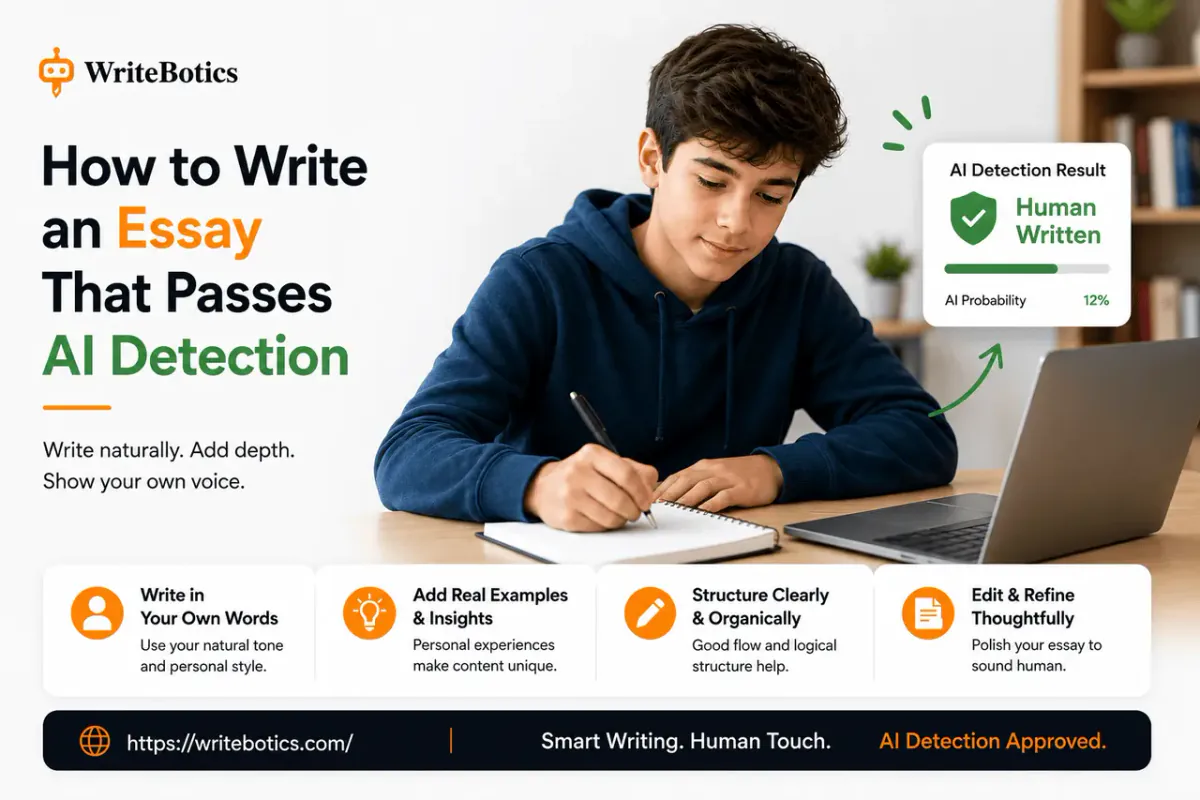
If you've written an essay entirely on your own and still had it flagged by an AI detector, you're not alone. This happens more often than people expect — and it's usually not because the writing is "too good," but because certain natural writing habits (short, uniform sentences, generic transitions, an overly formal tone) happen to overlap with patterns AI detectors are trained to flag.
This guide focuses on writing essays that are genuinely your own — clear, well-structured, and in your authentic voice — while also understanding why detectors sometimes flag human writing, and what you can actually do about it. It does not cover ways to disguise AI-generated work as your own, since that's a separate issue from writing quality, and one that depends entirely on your school's academic integrity policy — not on any tool or trick.
Why Honest Human Writing Sometimes Gets Flagged
AI detectors work by looking for statistical patterns: how predictable your word choices are, how uniform your sentence lengths are, and how repetitive your structure is across paragraphs. AI-generated text tends to be smoother and more evenly paced than human writing — but so does some human writing, especially:
- Writing done quickly under deadline pressure, where sentence variety gets sacrificed for speed
- Writing in a second language, where sentence structures often follow more predictable, textbook patterns
- Highly structured academic writing, especially the standard five-paragraph essay format taught in many schools
- Writing that's been heavily edited for "correctness" and grammar, which can strip out the natural quirks that make writing sound distinctly human
None of this means the writing is dishonest. It means detectors are estimating probability, not proving authorship — and understanding that difference is the first step to writing essays that read as clearly, authentically yours.
Start With Real Thinking, Not a Template
The biggest difference between an essay that reads as generic and one that reads as genuinely yours is where the ideas come from. If you start writing before you've actually worked out what you think, the result often defaults to safe, predictable phrasing — which is exactly the kind of writing that tends to look AI-typical, whether or not AI was involved.
Before you write a single sentence, try to answer these for yourself:
- What's the specific claim I'm making — not the general topic, but my actual argument?
- What's one detail, example, or piece of evidence that only I would think to include?
- Where do I actually disagree with the "obvious" take on this topic, even slightly?
Essays built from genuine, specific thinking naturally avoid the flat, generic phrasing that both weak human writing and AI writing tend to share.
Vary Your Sentence Structure Naturally
One of the clearest AI-writing tendencies is uniformity — sentences that are all roughly the same length, all built the same way (subject, verb, object), with transitions that follow a predictable pattern ("Furthermore," "In conclusion," "It is important to note that").
Human writing, even at a high level, has natural rhythm variation. A few practical habits:
Mix short and long sentences deliberately. A short, blunt sentence after a longer, more complex one creates rhythm. It also reads as more confident.
Cut throat-clearing phrases. Words like "it is important to note that," "in today's society," or "this essay will discuss" add length without adding meaning — and they're exactly the kind of filler phrasing detectors are trained to flag.
Let some sentences start differently. Not every sentence needs to open with the subject. Starting occasionally with a clause, a question, or a short fragment (used sparingly and correctly) breaks up predictable rhythm.
Read it out loud. If it sounds like you talking — with natural pauses and emphasis — it usually reads that way too. If it sounds like a textbook, it's worth rewriting.
Use Specific, Concrete Detail
Generic phrasing is one of the strongest shared traits between weak human writing and AI-generated text. "Many people believe that technology has changed society" could describe almost any essay on almost any topic. "My grandmother didn't own a cell phone until she was seventy, and she still calls it 'the computer phone'" could only be written by one person.
Specificity does two things at once: it makes your essay genuinely better, and it naturally reduces the kind of generic phrasing that tends to read as AI-typical. Whenever you notice a sentence that could apply to any essay on the topic, that's a signal to add a concrete detail, example, or personal observation.
Revise for Voice, Not Just Correctness
A lot of essay revision focuses purely on fixing errors — grammar, punctuation, word choice. That's necessary, but it's not the same as revising for voice. A heavily "corrected" essay can end up sounding more generic than the rough draft did, because editing for correctness alone tends to smooth out the very quirks that make writing sound like an individual person wrote it.
When you revise, read back through and ask: does this still sound like me? If a rewritten sentence is more "correct" but has lost your natural way of phrasing something, it's worth finding a version that keeps both the correctness and the voice.
This is where a tool like WriteBotics' AI Humanizer can help with a very specific, honest use case: taking a draft that's technically fine but reads stiff or overly formal, and smoothing the phrasing into something that sounds more natural — without changing your ideas, your argument, or your meaning. Used this way, it's a voice-and-clarity tool, not a way to disguise anything.
Check Your Draft Before You Submit
Since AI detectors can produce false positives on genuinely human writing, it's reasonable to check your own essay before submitting it — the same way you'd proofread for grammar. WriteBotics' AI Content Detector gives you an estimate of whether your draft shows AI-typical patterns, which can flag sections worth revising for more natural phrasing.
If a section gets flagged, don't panic — it's an estimate, not a verdict. Look at that specific passage and ask whether it reads as generic or uniform. Often, adding one specific detail or breaking up a repetitive sentence structure is enough to make it read more distinctly as yours — because, if you wrote it honestly, it is yours.
What This Guide Isn't For
To be direct about it: if you used an AI tool to write some or all of an essay and you're looking for a way to submit that work as entirely your own without disclosure, that's an academic integrity question, not a writing-quality question — and it's one you need to resolve with your institution's actual policy, not with a blog post or a tool. Policies on AI use vary significantly between schools, courses, and even individual instructors, and misrepresenting AI-generated work as fully your own can carry serious consequences regardless of how "natural" the final text reads.
The guidance above is about writing your own essay well enough, and naturally enough, that it doesn't get incorrectly flagged for something it isn't. If your writing genuinely is your own thinking and your own words, that's the actual solution to false positives — not a workaround, but the real thing.
A Quick Pre-Submission Checklist
Before turning in an essay you've written yourself:
- Read it out loud. Does it sound like your natural speaking voice, or like a formula?
- Check for generic phrasing. Replace vague statements with specific details or examples only you would know.
- Vary your sentence rhythm. Mix sentence lengths; cut filler transitions.
- Revise for voice, not just grammar. Make sure corrections haven't flattened your natural phrasing.
- Run it through an AI Content Detector as one signal, not a final verdict, and revise any oddly uniform passages.
- Confirm you understand your institution's AI policy and that your submission genuinely follows it.
Frequently Asked Questions
Why did my essay get flagged as AI-written when I wrote it myself?
AI detectors estimate likelihood based on writing patterns like sentence uniformity and predictable phrasing — they don't verify authorship. Formal, heavily-edited, or formulaic human writing can sometimes share those patterns, leading to false positives.
Is there a guaranteed way to make an essay "pass" AI detection?
No tool can guarantee a specific detector result, and that shouldn't be the goal. The most reliable way to avoid false flags is to write with genuine, specific ideas and a natural sentence rhythm — the same qualities that make an essay good in the first place.
Can I use an AI humanizer to rewrite my essay before submitting it?
An AI Humanizer can help smooth stiff or overly formal phrasing in a draft you wrote yourself. It should not be used to disguise AI-generated content as your own original work — that's a separate issue governed by your school's academic integrity policy, not by writing tools.
Do all AI detectors give the same result on the same essay?
No. Different detectors use different models and thresholds so it's normal to get different results from separate tools on the same text. Treat any single result as one estimate, not a definitive answer.
What's the single biggest factor in making an essay read as authentically human?
Specific, concrete detail. Generic statements that could apply to any essay on the topic are the most common trait shared by weak human writing and AI-generated writing alike. Specific examples, personal observations, and precise claims are hard to fake and hard to flag.
Should I disclose if I used AI assistance on an essay?
Follow your institution's specific policy — some allow certain kinds of AI assistance with disclosure, others don't allow it at all. When in doubt, ask your instructor directly rather than guessing.
Write It Yourself, Check It Honestly
The most reliable way to write an essay that reads as authentically human is to make sure it actually is — built from your own thinking, your own examples, and your own voice. From there, tools like the AI Content Detector and AI Humanizer at writebotics.com can help you check for accidental false-positive patterns and smooth out stiff phrasing — no signup required.
For more on strengthening a draft before you submit or publish it, see AI Writing Assistant: Write Faster and Smarter Today and Best Writing Tools Online to Boost Your Creativity.