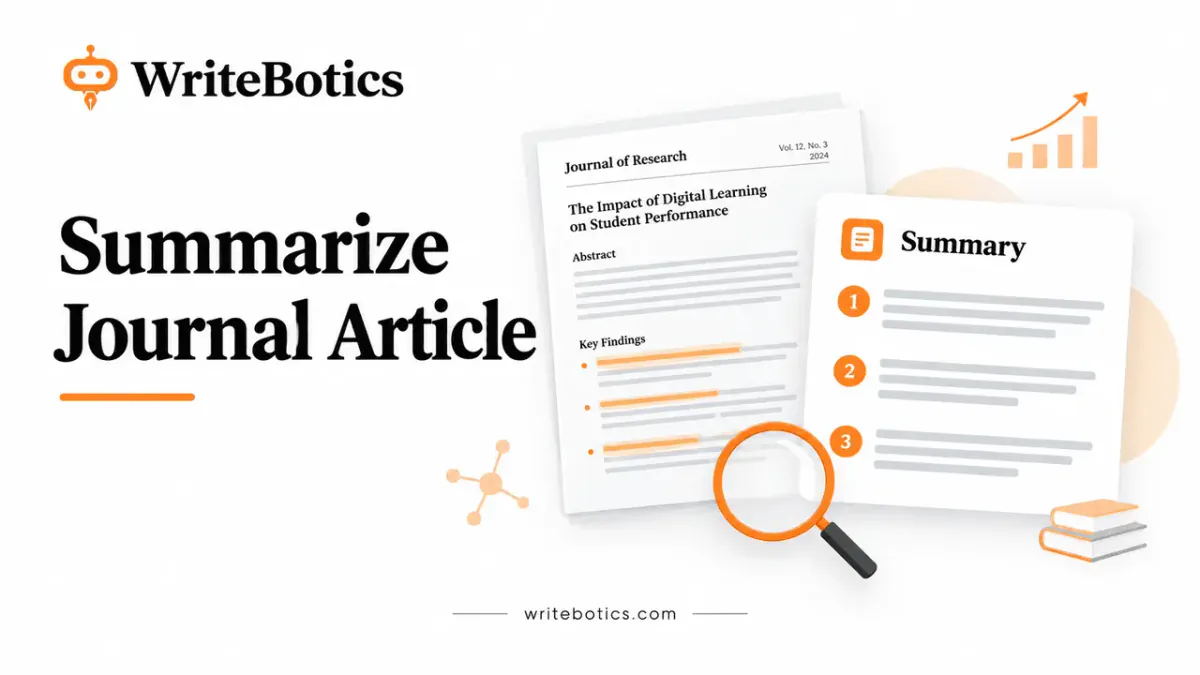
Learning how to summarize a journal article is an essential academic skill. Whether you are preparing a literature review, writing a research paper, or studying for an exam, you need to identify the author's main argument, understand the research methods, and preserve the findings that matter most.
A good journal article summary does more than shorten a long paper. It captures the study's purpose, approach, results, and conclusions without distorting the evidence or adding unsupported opinions.
The challenge is deciding what to keep and what to leave out. Academic articles often contain detailed background information, statistical analyses, methodological explanations, and multiple findings. Summarizing everything equally can make your summary too long, while removing too much may change the meaning of the research.
This guide explains how to summarize a journal article using a structured reading and note-taking workflow. You will learn how to identify key findings, organize research notes, write an accurate academic summary, and avoid common mistakes that weaken your work.
What Is a Journal Article Summary?
A journal article summary is a concise, objective account of a research article's central purpose, methods, findings, and conclusions. It presents the most important information in your own words while preserving the original study's meaning.
Unlike a critique, which evaluates a study's strengths and weaknesses, a summary primarily explains what the researchers investigated and discovered.
For example, if a journal article examines the relationship between sleep duration and academic performance, an effective summary would identify the research question, describe how the researchers collected data, report the main results, and explain the authors' conclusions.
It would not reproduce every statistic, repeat the entire introduction, or claim that the study proves something its design cannot establish.
The purpose is to help readers understand the essential contribution of the research without needing to read every detail of the original article.
How to Summarize a Journal Article in 6 Steps
The most reliable way to summarize a research article is to work through it systematically. Instead of reading once and immediately writing, use a workflow that separates understanding, note-taking, prioritization, and drafting.
Step 1: Read the Article Strategically
Start by identifying the article's overall structure before examining the details.
Most empirical research articles follow a version of the IMRaD structure:
- Introduction: Explains the research problem, background, and objectives.
- Methods: Describes the study design, participants, materials, and procedures.
- Results: Reports the findings and relevant analyses.
- Discussion: Interprets the findings, considers limitations, and explains implications.
The abstract provides an initial overview, but it should not be your only source of information. Important qualifications, limitations, and secondary findings may appear only in the main text.
Use this reading sequence:
- Read the title and abstract to understand the topic and main objective.
- Read the introduction to identify the research problem and question.
- Examine the methods to understand how the study was conducted.
- Read the results carefully to identify the main findings.
- Read the discussion and conclusion to understand the interpretation and limitations.
- Return to relevant tables, figures, or supplementary materials when necessary.
This sequence helps you understand the article's central message before deciding which details deserve space in your summary.
For theoretical or review articles that do not follow the IMRaD structure, identify the main argument, the themes or evidence examined, and the conclusions instead.
Step 2: Identify the Research Question and Purpose
Before recording individual findings, establish what the researchers intended to investigate.
Look for the research question, hypothesis, or objective in the abstract and introduction. Ask yourself:
- What problem does the article address?
- What did the researchers want to understand or test?
- Why is the question important?
- What population, setting, or subject does the study examine?
For example, suppose a study investigates whether a structured reading program improves reading comprehension among middle school students.
Your notes might look like this:
| Element | Notes |
|---|---|
| Research topic | Reading comprehension |
| Research objective | Examine the effect of a structured reading program |
| Population | Middle school students |
| Main question | Does participation in the program improve reading comprehension? |
These notes give you a clear framework for interpreting the findings.
Without understanding the research question, you may collect interesting details that do not directly contribute to the article's main purpose.
Step 3: Record the Methods and Study Context
The methods section explains how the researchers attempted to answer their question. You usually do not need to describe every procedural detail, but you should retain the information necessary to interpret the results.
Identify the following elements when relevant:
- Study design, such as an experiment, survey, interview study, or systematic review.
- Participants, sample size, or population.
- Data collection methods and measurements.
- Duration or setting of the study.
- Important comparison groups or experimental conditions.
For example, if researchers surveyed 500 university students about their sleep habits and academic performance, the survey design and participant group may be important to your summary.
However, if a study includes a long technical description of survey administration, you may not need to reproduce those details unless they affect the interpretation of the results.
The key question is: What methodological information does a reader need to understand how the researchers obtained their findings?
Preserve important context, particularly when the study design limits what can be concluded. A survey showing an association between two variables, for instance, does not automatically establish that one variable causes the other.
Step 4: Extract the Key Findings Without Losing Meaning
This is the most important stage of summarizing a journal article. Your goal is to distinguish the central results from supporting details while retaining the evidence needed to understand the study's contribution.
Read the results section alongside the discussion. Record the findings that directly answer the research question, then check how the authors interpret those findings.
Use this process:
- Identify the primary outcome or central result.
- Record important secondary findings that help explain the main result.
- Note relevant numerical results, comparisons, or effect estimates.
- Preserve uncertainty, qualifications, and unexpected outcomes.
- Separate the researchers' findings from their interpretation of those findings.
Suppose a hypothetical study reports that students who participated in a structured reading program improved their comprehension scores more than students in a comparison group.
A weak note might say:
"The program worked really well."
A more useful note would be:
"Students participating in the reading program showed greater improvement in comprehension scores than students in the comparison group over the study period."
The second version captures the result without exaggerating it.
If the difference was small, statistically uncertain, or limited to a particular outcome, include that qualification. If the study reports no statistically significant difference, do not rewrite the result as evidence that the intervention definitely works.
You should also retain numerical findings when they materially affect the interpretation. For example, an effect size, confidence interval, or percentage may be more informative than a vague statement that one group performed better.
Not every number belongs in the summary. Select only those that help readers understand the magnitude, reliability, or practical significance of the main findings.
Step 5: Create a Structured Research Note Sheet
Before drafting, organize your notes into a consistent format. This reduces the risk of overlooking an important finding or confusing the authors' conclusions with your own interpretation.
Use the following template:
| Research element | What to record |
|---|---|
| Citation | Author, publication year, article title, journal |
| Research purpose | Main question, hypothesis, or objective |
| Methods | Study design, participants, and relevant procedures |
| Key findings | Main results and essential supporting evidence |
| Authors' interpretation | What the researchers conclude from the results |
| Limitations | Important constraints identified by the authors |
| Relevance | How the study relates to your assignment or research question |
Complete the template while reading rather than relying entirely on memory afterward.
If you are summarizing several articles for a literature review, use the same categories for each paper. Consistent notes make it easier to compare results, identify disagreements, and recognize recurring themes across the literature.
Keep direct quotations in quotation marks and record page numbers when available. This helps distinguish the source's exact wording from your own paraphrases and reduces the risk of accidental plagiarism.
Step 6: Write, Check, and Refine the Summary
Once your notes are complete, draft the summary without repeatedly copying sentences from the original article.
A practical structure is:
Opening: Identify the article's main topic, research objective, and central question.
Middle: Explain the essential methods and the most important findings.
Closing: Present the authors' main conclusion and any limitation necessary to interpret the results accurately.
For example, a concise summary of the hypothetical reading study might read:
"The study examined whether a structured reading program improved reading comprehension among middle school students. The researchers compared changes in comprehension scores between students participating in the program and those in a comparison group. Students in the program showed greater improvement over the study period, suggesting that the intervention may support reading development in the studied context. However, the strength and generalizability of this conclusion depend on the study design, participant characteristics, and other limitations reported by the researchers."
This example demonstrates how to combine purpose, method, findings, and interpretation without including every detail.
After drafting, compare your summary against the original article. Check that the key findings are accurate, the conclusions are appropriately qualified, and every important claim is supported by the source.
How Long Should a Journal Article Summary Be?
The appropriate length depends on your assignment instructions, the complexity of the article, and the purpose of the summary.
A short class assignment may require one paragraph, while a research methods course or literature review may require a more detailed account.
As a general guideline, a short summary might contain around 100–200 words, while a more developed academic summary may require 200–400 words or more. These are planning estimates, not universal academic standards.
Regardless of length, prioritize the research question, essential methods, central findings, and conclusions. Follow any specific word count or formatting requirements provided by your instructor.
Common Mistakes to Avoid When Summarizing a Research Article
Even a well-written summary can misrepresent a study if important context or qualifications are removed.
Including Too Much Background Information
The original article may contain extensive context, definitions, and references to previous research.
How to improve it: Retain only the background needed to explain the study's purpose and the importance of its findings.
Focusing on Minor Findings Instead of the Main Results
Secondary observations may be interesting, but they can distract readers from the research question.
How to improve it: Identify the primary outcome first. Include secondary findings only when they help explain the central result or an important qualification.
Confusing Correlation With Causation
A study may find that two variables are associated without demonstrating that one causes the other.
How to improve it: Use language that reflects the research design. Phrases such as "was associated with" may be more accurate than "caused" when the evidence is observational.
Omitting Limitations
Removing important limitations can make the results appear more conclusive than they are.
How to improve it: Include limitations that materially affect how the findings should be interpreted, especially those involving sample size, study design, measurement, or generalizability.
Copying the Original Wording
Changing only a few words from the source is not an effective paraphrase and may create plagiarism concerns.
How to improve it: Understand the passage, write the idea from your notes in your own words, and compare it with the source to confirm accuracy. Cite the original article according to your required citation style.
Adding Your Personal Opinion
A summary should report what the researchers investigated and found rather than whether you personally agree with them.
How to improve it: Keep evaluation separate from summary unless your assignment explicitly requests a critical review.
Frequently Asked Questions
What should be included in a journal article summary?
A journal article summary typically includes the research objective, essential methodological details, main findings, and the authors' conclusions. Include limitations or numerical results when they are important for interpreting the study.
How do you identify the main findings of a research article?
Start with the research question and primary outcomes. Read the results section, examine relevant tables or figures, and check the discussion to understand how the authors interpret the evidence. Prioritize results that directly answer the central research question.
Should I include citations in an academic summary?
Yes. When summarizing a published article for an academic assignment, cite the original source using the required style, such as APA, MLA, or Chicago. Paraphrasing does not remove the need to acknowledge the source.
Is an abstract the same as a summary?
No. An abstract is a concise overview written as part of the published article, usually by its authors. A student-written summary is prepared for a particular assignment or purpose and may focus on different aspects of the research.
Can AI help summarize a journal article?
AI tools can help organize notes, explain terminology, and produce a preliminary summary. However, generated summaries can omit important qualifications, misinterpret statistical findings, or introduce unsupported claims. Always verify the output against the original article, especially its results, tables, limitations, and conclusions.
Final Thoughts
Learning how to summarize a journal article effectively requires more than shortening the original text. You need a structured approach that identifies the research question, captures the essential methods, prioritizes the key findings, and preserves the meaning of the evidence.
Read the article strategically, take organized notes, distinguish primary results from secondary details, and draft the summary using your own words. Then compare your writing against the original source to check for accuracy, missing qualifications, and unsupported conclusions.
If you need help organizing a research paper into a concise overview, try the Writebotics AI Summary Generator at https://writebotics.com/. Use AI-generated summaries as a starting point, and verify important findings against the original article before including them in academic work.