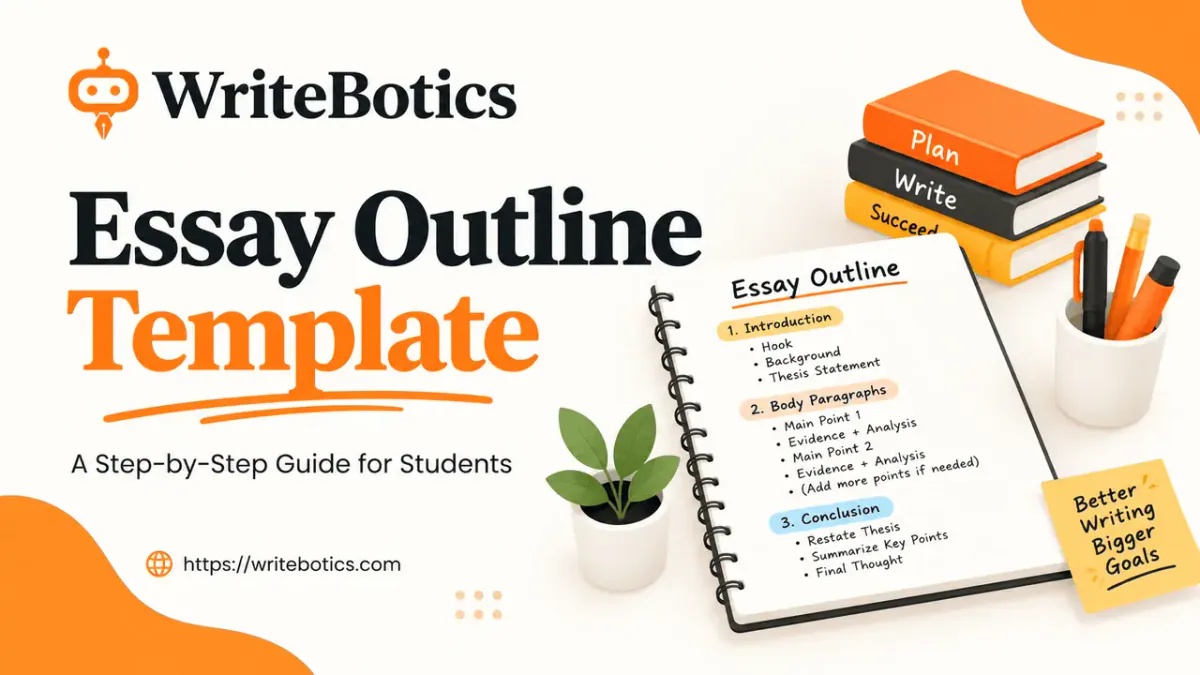
An essay outline template helps you organize your ideas before you start writing. It gives your essay a clear structure, shows how your main points connect to your thesis statement, and makes the writing process easier to manage.
Whether you are writing an argumentative essay, a persuasive paper, an informative essay, or a literary analysis, creating an outline can save time and help you develop a logical argument. Instead of staring at a blank page, you can follow a simple framework for your introduction, body paragraphs, and conclusion.
In this guide, you will find a reusable Essay Outline Template, a completed essay outline example, and practical steps for creating an outline that fits your assignment.
What Is an Essay Outline?
An essay outline is a structured plan that organizes the main ideas and supporting details of an essay before you write the full draft. It usually includes an introduction, body paragraphs, and a conclusion.
Each section has a specific purpose. The introduction introduces your topic and presents your thesis statement. The body develops your main points with evidence and explanations. The conclusion brings your argument together and reinforces your central message.
An outline helps you:
- Organize ideas in a logical order.
- Identify gaps in your argument before drafting.
- Keep each paragraph focused on one main point.
- Connect supporting evidence to your thesis statement.
- Write more efficiently and avoid unnecessary repetition.
An outline does not need to contain complete paragraphs. Short phrases, keywords, and bullet points are often enough to guide your writing.
Essay Outline Template You Can Reuse
Use the following essay outline template as a starting point for your next assignment. You can adapt it to different essay types, subjects, and word counts.
I. Introduction
A. Hook: Begin with an interesting fact, question, example, or statement that introduces the topic.
B. Background information: Provide the context readers need to understand the subject.
C. Thesis statement: State your main argument, position, or central idea.
II. Body Paragraph 1: First Main Point
A. Topic sentence: Introduce the first main point that supports your thesis.
B. Supporting evidence: Include a fact, example, quotation, statistic, or research finding.
C. Explanation: Explain how the evidence supports your point.
D. Transition: Connect this paragraph to the next idea.
III. Body Paragraph 2: Second Main Point
A. Topic sentence: Introduce your second main point.
B. Supporting evidence: Add relevant evidence or examples.
C. Explanation: Show how the evidence strengthens your argument.
D. Transition: Prepare the reader for the next paragraph.
IV. Body Paragraph 3: Third Main Point
A. Topic sentence: Present your third main point.
B. Supporting evidence: Include additional facts, examples, or analysis.
C. Explanation: Connect this evidence to your thesis.
D. Transition: Lead into the conclusion.
V. Conclusion
A. Restate the thesis: Express your central argument in fresh words.
B. Summarize the main points: Briefly bring together the most important ideas from the body paragraphs.
C. Closing statement: End with a meaningful final thought, implication, or recommendation.
This basic structure works well for many five-paragraph essays. Longer assignments may require additional body paragraphs, counterarguments, research sections, or subsections.
How to Write an Essay Outline in 5 Steps
Creating an effective outline is easier when you approach it one step at a time.
Step 1: Understand the Essay Assignment
Before outlining, identify what your instructor expects you to accomplish. Read the prompt carefully and look for keywords such as analyze, compare, argue, explain, or evaluate.
These instructions determine how you should organize your ideas.
For example:
- Argumentative: Present a clear position and support it with evidence.
- Compare and contrast: Explain meaningful similarities and differences.
- Expository: Explain a topic using organized facts and examples.
- Persuasive: Convince readers to accept a position or take action.
- Literary analysis: Interpret a text using specific examples and close reading.
Also, check the required word count, citation style, number of sources, and formatting instructions.
Step 2: Choose Your Main Idea and Write a Thesis Statement
Your thesis statement establishes the central idea your essay will develop. Writing a preliminary thesis before outlining helps you decide which points belong in the essay.
For example, consider the topic of school uniforms.
Broad topic: School uniforms
Focused thesis: School uniforms can reduce visible economic differences among students, simplify morning routines, and strengthen a shared sense of school identity.
This thesis suggests three main body paragraphs:
- Reducing visible economic differences.
- Simplifying morning routines.
- Supporting a shared school identity.
Your outline now has a clear direction. Each body paragraph can develop one reason that supports the thesis.
You can refine the thesis later as your research and writing progress.
Step 3: Brainstorm and Group Your Ideas
Write down the ideas, examples, facts, and arguments you might include. At this stage, focus on generating useful material rather than perfecting the wording.
Next, group related ideas under broader categories.
For an essay about the benefits of reading, your notes might include:
- Vocabulary development
- Reading comprehension
- Concentration
- Stress management
- Imagination
- Academic performance
You could organize these ideas into three main categories: language development, cognitive skills, and personal well-being.
Grouping related ideas helps you avoid repetition and gives each body paragraph a distinct purpose.
Step 4: Organize Your Main Points and Evidence
Arrange your points in an order that makes sense for your argument. You might move from the simplest point to the most complex, follow a chronological sequence, or organize your discussion by importance.
Under each main point, add the evidence and explanation you plan to use.
For example:
- Main point: Reading supports vocabulary development.
- Evidence: Research on reading exposure and vocabulary acquisition.
- Example: Encountering unfamiliar words in context.
- Explanation: Repeated exposure helps readers understand how words are used.
This structure gives you more guidance than a list of headings alone. It also helps you identify where you need additional research.
Step 5: Review and Refine Your Outline
Read through your outline before starting the full draft. Check whether each main point supports your thesis and whether the ideas appear in a logical order.
Ask yourself:
- Does the introduction establish the topic and thesis?
- Does every body paragraph have one clear purpose?
- Have I included relevant evidence for my main claims?
- Do my explanations show why the evidence matters?
- Are any points repeated or unrelated?
- Does the conclusion follow naturally from the argument?
Remove unnecessary ideas, rearrange sections where needed, and fill any gaps in your evidence.
A well-organized outline makes drafting easier because you already know what each section needs to accomplish.
Essay Outline Example: The Benefits of Reading
A completed example can show how a general template works in practice.
Essay topic: The benefits of reading
Thesis statement: Regular reading supports vocabulary development, strengthens critical thinking, and improves understanding of different perspectives.
I. Introduction
- Hook: Reading is a common activity that can support learning throughout life.
- Background: Books, articles, and other texts expose readers to information and ideas.
- Thesis: Regular reading supports vocabulary development, strengthens critical thinking, and improves understanding of different perspectives.
II. Body Paragraph 1: Vocabulary Development
- Topic sentence: Reading exposes people to new words and language patterns.
- Evidence: Examples from reading materials or credible research on vocabulary acquisition.
- Explanation: Encountering words in context helps readers understand their meanings and uses.
- Link to thesis: A broader vocabulary supports communication and comprehension.
III. Body Paragraph 2: Critical Thinking
- Topic sentence: Reading encourages readers to evaluate ideas and interpret information.
- Evidence: Examples of analyzing arguments, comparing viewpoints, or interpreting a text.
- Explanation: Readers must consider meaning, evidence, and the relationships between ideas.
- Link to thesis: These activities can strengthen analytical thinking.
IV. Body Paragraph 3: Understanding Different Perspectives
- Topic sentence: Reading introduces people to experiences and viewpoints beyond their own.
- Evidence: Examples from literature, history, biographies, or reported experiences.
- Explanation: Exposure to different perspectives can encourage reflection and understanding.
- Link to thesis: Reading provides opportunities to examine how other people see the world.
V. Conclusion
- Restate thesis: Regular reading can contribute to language development, analytical thinking, and broader perspectives.
- Summary: Review the three benefits discussed.
- Closing thought: Making reading a regular habit can support lifelong learning.
This outline provides a roadmap for the full essay without writing every sentence in advance. When drafting, you would expand each bullet point into complete sentences and support factual claims with appropriate sources where necessary.
Different Types of Essay Outline Templates
Not every essay follows the same structure. The best outline depends on the purpose of your assignment.
| Essay type | Recommended structure |
|---|---|
| Argumentative essay | Introduction and thesis, supporting arguments, counterargument and response, conclusion |
| Persuasive essay | Introduction, audience-focused reasons, supporting evidence, call to action or final recommendation |
| Compare-and-contrast essay | Introduction, comparison criteria, similarities and differences, conclusion |
| Expository essay | Introduction, explanation of key points, examples or evidence, conclusion |
| Narrative essay | Introduction or setting, sequence of events, turning point, resolution |
| Research essay | Introduction and research question or thesis, thematic sections, evidence and analysis, conclusion |
Argumentative Essay Outline
An argumentative essay should present a clear position and support it with evidence.
I. Introduction
- Introduce the issue.
- Provide relevant context.
- State your position in the thesis.
II. Supporting Argument 1
- Present the first reason.
- Provide evidence.
- Explain its significance.
III. Supporting Argument 2
- Present the second reason.
- Add supporting evidence.
- Explain how it strengthens the argument.
IV. Counterargument and Response
- Explain an opposing viewpoint fairly.
- Present evidence or reasoning that addresses it.
V. Conclusion
- Reinforce the central position.
- Summarize the strongest reasons.
- End with a relevant implication or recommendation.
Compare-and-Contrast Essay Outline
For this type of essay, you can organize the discussion by subject or by comparison criteria.
I. Introduction
- Introduce both subjects.
- Explain why the comparison matters.
- Present the main comparison or thesis.
II. First Comparison Criterion
- Discuss how both subjects compare on the first criterion.
- Include evidence and examples.
III. Second Comparison Criterion
- Explain another important similarity or difference.
- Support the discussion with relevant details.
IV. Third Comparison Criterion
- Analyze an additional criterion if needed.
- Connect the comparison to the thesis.
V. Conclusion
- Summarize the most important similarities and differences.
- Explain what the comparison reveals.
For longer essays, you may need several paragraphs under each criterion. Choose the structure that makes your comparison easiest to follow.
Common Essay Outlining Mistakes to Avoid
Even a useful template can become less effective if the outline lacks focus or structure.
Writing a thesis that is too broad. A thesis such as "Technology affects people" gives you little direction. Specify the technology, context, or effects you intend to discuss.
Listing ideas without organizing them. A collection of unrelated bullet points is not a clear outline. Group related ideas and arrange them in a logical sequence.
Including evidence without analysis. Facts and quotations need explanations that show how they support your point. Plan for both evidence and interpretation.
Repeating the same argument. Give each body paragraph a distinct purpose. If two sections make the same point, combine them or clarify their differences.
Ignoring the assignment requirements. A well-written outline may still be unsuitable if it does not answer the prompt or follow the required format.
Overplanning every sentence. An outline should guide the draft, not prevent you from developing ideas as you write. Use enough detail to stay organized while leaving room for improvement.
Frequently Asked Questions
How long should an essay outline be?
The length depends on your essay. A short assignment may need only a page of headings and bullet points, while a research paper may require several pages of detailed sections, evidence, and citations.
Should I write the outline before the introduction?
Yes, you can outline before drafting the introduction. Many writers find it easier to develop the thesis and main body points first, then write an introduction that accurately reflects the essay they intend to produce. You can revise the introduction later.
What is the difference between an essay outline and an essay draft?
An outline is a plan that lists the main ideas, sections, and supporting details. A draft turns that plan into complete paragraphs and sentences. The outline provides structure, while the draft develops the full discussion.
Can I use bullet points in an essay outline?
Yes. Bullet points are useful for organizing ideas, evidence, examples, and explanations. You generally do not need complete sentences unless your instructor specifically requests a sentence outline.
Do all essays need five paragraphs?
No. The five-paragraph format is a useful starting point for some short assignments, but essays can have more or fewer paragraphs depending on their purpose, complexity, and required length. Follow your assignment guidelines rather than forcing every essay into the same structure.
Start Your Essay With a Clear Plan
An essay outline template gives you a practical way to organize your ideas, develop your thesis, and build a logical argument before writing the full essay. By dividing your assignment into an introduction, focused body paragraphs, and a conclusion, you can make the writing process more manageable.
Start by understanding your assignment, defining your central idea, grouping related points, and identifying the evidence each paragraph needs. Then review the outline to ensure every section contributes to your overall purpose.
If you need help improving the clarity of your writing, the WriteBotics Writing Improver can help you review wording and readability as you develop your draft. Use it alongside a well-planned outline to keep your essay focused, organized, and easy to follow.