Learning how to write a counterargument and rebuttal is an essential skill for developing a strong argumentative essay. A convincing argument does more than explain why your position is correct. It also recognizes opposing viewpoints, examines the evidence behind them, and responds with clear reasoning.
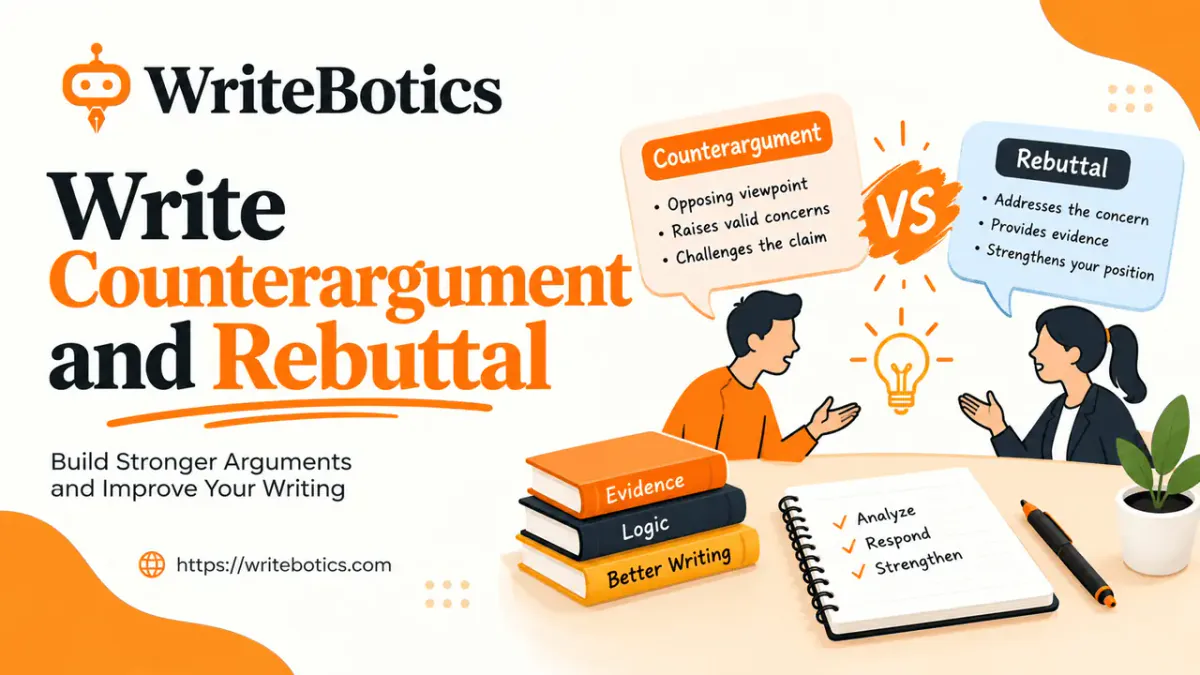
A counterargument presents a different perspective from your main claim, while a rebuttal explains why that opposing view may be incomplete, less convincing, or open to challenge. Together, they demonstrate critical thinking and help you build a balanced, evidence-based argument.
Whether you are writing a school essay, college paper, research assignment, or persuasive article, this guide explains how to write a counterargument and rebuttal, provides practical Counterargument Examples, and shows you how to integrate both into your writing.
What Is a Counterargument?
A counterargument is a statement that presents an opposing viewpoint to the main argument of an essay. It acknowledges that reasonable people may disagree with your position or interpret the evidence differently.
For example, imagine your essay argues that schools should allow students to use laptops during lessons.
Your main argument might be:
Schools should allow students to use laptops because digital tools can improve access to educational resources and support collaborative learning.
A counterargument could be:
However, critics argue that laptops can distract students from lessons and make it harder for them to concentrate.
This opposing viewpoint introduces a legitimate concern. Including it does not mean you have abandoned your position. Instead, it shows that you understand the issue from more than one perspective.
A strong counterargument should represent the opposing position fairly rather than exaggerating or misrepresenting it. This approach makes your response more credible and gives readers a reason to trust your reasoning.
What Is a Rebuttal?
A rebuttal is a response that challenges or qualifies a counterargument using logical reasoning, relevant evidence, or a clearer interpretation of the issue.
Continuing the laptop example, a rebuttal might be:
Although laptops can distract students, schools can reduce this risk through classroom technology policies, structured activities, and teacher supervision. These measures allow students to benefit from digital resources while limiting unnecessary distractions.
The rebuttal acknowledges the concern but explains why it does not necessarily invalidate the original argument.
A good rebuttal does not simply repeat your thesis or dismiss the opposing side. It identifies a weakness, limitation, unsupported assumption, or relevant exception in the counterargument and explains why that matters.
Counterargument vs. Rebuttal: What Is the Difference?
Although these terms are closely related, they perform different functions in an argumentative essay.
| Feature | Counterargument | Rebuttal |
|---|---|---|
| Purpose | Presents an opposing viewpoint | Responds to the opposing viewpoint |
| Main focus | Why someone might disagree | Why the opposing position may be limited or less persuasive |
| Typical wording | "Critics argue that..." | "However, this concern overlooks..." |
| Evidence | May include evidence supporting the opposing view | Uses reasoning and evidence to evaluate or challenge it |
| Role in the essay | Demonstrates awareness of alternative perspectives | Strengthens the writer's overall argument |
Think of the two as parts of a conversation. The counterargument explains what someone on the other side might say. The rebuttal answers that person with a reasoned response.
How to Write a Counterargument and Rebuttal in 5 Steps
Follow these steps to develop a balanced and convincing response to an opposing viewpoint.
Step 1: Establish Your Main Argument
Before writing a counterargument, make sure your own position is clear. Your thesis statement should express the central claim your essay intends to support.
For example:
Thesis statement: Universities should offer more online courses because they can improve access to education for students with work, family, or transportation commitments.
This claim gives you a clear position to defend. It also identifies a central issue that readers may reasonably debate.
If your thesis is too vague, it will be difficult to identify meaningful opposing viewpoints. For guidance on developing a clear central claim, explore a reliable guide to writing a thesis statement.
Step 2: Identify a Reasonable Opposing Viewpoint
Consider what an informed reader might disagree with and why. Look for a genuine concern rather than an exaggerated or easily dismissed objection.
For the online learning example, a reasonable counterargument might be:
Critics argue that online courses can reduce face-to-face interaction, making it harder for students to build relationships with classmates and instructors.
This viewpoint is specific and relevant to your thesis. It also identifies a possible limitation of online learning without claiming that every online course produces the same outcome.
To find strong counterarguments, consider questions such as:
- What are the main disadvantages of my proposed position?
- What evidence might support the opposing side?
- Are there situations where my argument would not apply?
- What concerns might readers have about my recommendation?
Researching these questions can help you develop a counterargument that reflects real concerns rather than assumptions.
Step 3: Represent the Counterargument Fairly
A strong argumentative essay does not create a weak version of the opposing position just to make it easier to defeat.
Instead, explain the opposing view accurately and give it enough context for readers to understand why someone might support it.
For example:
Some educators argue that online courses provide fewer opportunities for spontaneous classroom discussions and immediate feedback, which can be valuable for students who need additional academic support.
This is more effective than writing:
People who oppose online learning simply do not understand technology.
The second statement attacks the people who disagree rather than addressing their reasoning.
Fair representation helps you avoid straw man arguments, in which a writer distorts an opposing position to make it appear less reasonable than it actually is.
Step 4: Develop an Evidence-Based Rebuttal
After presenting the counterargument, respond directly to its central point. Your rebuttal should explain why the concern does not completely undermine your thesis.
For example:
However, online courses can incorporate live discussions, instructor consultations, group projects, and structured feedback. When these activities are designed effectively, they can provide meaningful opportunities for interaction even when students are not physically present in the same classroom.
Notice how this rebuttal addresses the concern about interaction rather than changing the subject.
You can strengthen your response by incorporating credible research, relevant statistics, expert analysis, or a well-supported example. Make sure any evidence genuinely supports your claim and reflects the context of your essay.
A useful rebuttal may:
- Challenge an assumption behind the opposing view.
- Explain why the opposing evidence does not apply in every situation.
- Present stronger or more relevant evidence.
- Identify a practical solution to the concern.
- Acknowledge the limitation while explaining why your main claim remains valid.
Not every counterargument needs to be completely disproved. Sometimes, the strongest response acknowledges that the opposing side has a legitimate point but demonstrates that the overall argument remains persuasive.
Step 5: Connect the Rebuttal to Your Thesis
Your rebuttal should ultimately help readers understand why your main argument still holds.
For example:
Although online courses may require deliberate efforts to maintain student interaction, their flexibility can make higher education more accessible to people who might otherwise struggle to attend traditional classes. Universities should therefore expand online learning while investing in effective communication and student-support systems.
This conclusion recognizes the limitation and reinforces the original position with a more nuanced recommendation.
The goal is not to pretend that your preferred position has no weaknesses. It is to show why your position remains reasonable after those weaknesses have been considered.
Counterargument Examples for Different Essay Topics
Examining different counterargument examples can help you understand how to apply this technique across academic subjects.
Example 1: Social Media and Teenagers
Main argument: Schools should teach digital literacy to help teenagers use social media responsibly.
Counterargument: Some people argue that digital literacy should be taught at home because parents are responsible for guiding their children's online behavior.
Rebuttal: Parents play an important role in teaching responsible technology use, but schools can reinforce these lessons through structured discussions about privacy, misinformation, online safety, and digital citizenship. Combining school-based education with parental guidance can address the issue more comprehensively.
Why it works: The rebuttal acknowledges parental responsibility while explaining how schools can contribute a distinct and complementary form of support.
Example 2: Homework in Schools
Main argument: Teachers should assign purposeful homework to reinforce classroom learning.
Counterargument: Critics argue that excessive homework can increase stress and reduce students' opportunities for rest and extracurricular activities.
Rebuttal: This concern highlights the importance of appropriate workload rather than proving that all homework is ineffective. Teachers can prioritize short, relevant assignments that reinforce essential concepts without unnecessarily overwhelming students.
Why it works: The response accepts the legitimate concern and narrows the original claim to a more defensible position.
Example 3: Renewable Energy
Main argument: Governments should increase investment in renewable energy infrastructure.
Counterargument: Opponents argue that renewable energy projects can involve substantial initial costs and may require additional infrastructure to manage variable electricity generation.
Rebuttal: These implementation challenges deserve serious consideration, but they do not automatically outweigh the potential long-term benefits. Governments can evaluate project costs, improve electricity storage and grid infrastructure, and develop phased investment plans based on local energy needs.
Why it works: The rebuttal addresses practical objections without claiming that renewable energy is always cheaper or suitable in every context.
Example 4: Artificial Intelligence in Education
Main argument: Schools should teach students how to use AI tools responsibly for learning.
Counterargument: Critics worry that students may rely on AI-generated answers instead of developing independent thinking and writing skills.
Rebuttal: This risk supports the need for clear educational guidelines rather than necessarily justifying a complete prohibition. Teachers can require students to explain their reasoning, verify AI-generated information, disclose permitted AI assistance, and demonstrate their own understanding through assessments.
Why it works: The response directly addresses the concern and proposes safeguards that support the original argument.
How to Structure a Counterargument and Rebuttal Paragraph
A well-organized paragraph helps readers follow the relationship between the opposing view and your response.
You can use this four-part structure:
- Introduce the opposing view. Explain what critics or alternative perspectives argue.
- Explain the concern. Give enough detail to represent the viewpoint fairly.
- Present the rebuttal. Respond with relevant reasoning or evidence.
- Connect to your thesis. Explain how the response supports or refines your central claim.
Here is a complete example:
Some critics argue that university attendance policies should be flexible because students may face illness, family responsibilities, or transportation difficulties. Strict attendance requirements can create additional barriers for students managing these challenges. However, universities can address these concerns through reasonable absence policies, alternative participation options, and accessible course materials while maintaining essential academic expectations. Therefore, flexible attendance policies can support student needs without eliminating accountability for learning.
This paragraph introduces a counterargument, explains its reasoning, responds with practical alternatives, and connects the rebuttal to a broader position.
Use the structure as a guide rather than a rigid formula. Your paragraph may need more evidence or explanation depending on the complexity of the topic.
Useful Counterargument and Rebuttal Sentence Starters
Sentence starters can help you organize your ideas, especially when you are writing your first argumentative essay. Choose phrases that fit your meaning instead of inserting them mechanically.
| Purpose | Sentence starters |
|---|---|
| Introduce a counterargument | "Critics argue that..." / "An opposing view is that..." |
| Explain the opposing position | "Those who support this position point out that..." |
| Acknowledge a valid concern | "It is reasonable to recognize that..." |
| Introduce a rebuttal | "However, this argument overlooks..." / "Nevertheless, the available evidence suggests..." |
| Challenge an assumption | "This reasoning assumes that..." |
| Add supporting evidence | "Research on this issue indicates that..." |
| Qualify your response | "Although this concern is valid,..." |
| Reinforce your thesis | "For these reasons, the evidence supports..." |
Avoid relying on transitions alone to make your argument convincing. Words such as however and nevertheless signal a change in direction, but the reasoning and evidence that follow must do the actual work.
Common Mistakes to Avoid
Even a well-written essay can become less persuasive when its counterargument and rebuttal are poorly developed.
Misrepresenting the opposing view. Do not exaggerate the other side's position or attack a claim that your opponents do not actually make. Present their strongest relevant reasoning fairly.
Using unsupported rebuttals. Simply stating that the opposing view is wrong does not establish that your position is correct. Explain why and provide credible evidence when appropriate.
Ignoring the counterargument's strongest point. Avoid responding only to the easiest objection. Address the central concern that a reasonable reader might raise.
Repeating your thesis without answering the objection. Restating your position is not the same as explaining why the counterargument is unconvincing. Respond directly to the opposing claim.
Making absolute claims. Statements such as "This solution always works" can weaken your credibility when exceptions exist. Use qualified language when the evidence supports a more limited conclusion.
Including irrelevant opposing views. Your counterargument should relate directly to your thesis. Introducing unrelated disagreements can distract readers from your main point.
Before submitting your essay, check whether your rebuttal genuinely responds to the counterargument and whether the evidence supports the conclusion you draw.
Frequently Asked Questions
How long should a counterargument and rebuttal be?
The appropriate length depends on your assignment, essay length, and the complexity of the issue. In a short essay, a few well-developed sentences may be enough. A longer research paper may require a full paragraph or section with supporting evidence.
Should I include the counterargument before or after my main argument?
In many argumentative essays, writers establish their thesis and supporting reasons before introducing a counterargument. However, the best placement depends on the essay's structure and the expectations of your assignment. The important point is to make the relationship between your position and the opposing view clear.
Can a rebuttal agree with part of a counterargument?
Yes. A rebuttal can acknowledge that an opposing viewpoint is valid in certain circumstances while explaining why it does not fully undermine your main claim. Recognizing legitimate limitations often makes your argument more credible.
What is the difference between a rebuttal and a refutation?
The terms overlap in many academic contexts. A rebuttal is a response to an opposing argument, while refutation often emphasizes demonstrating why a claim or its supporting reasoning is incorrect or inadequate. Both require more than simply disagreeing.
Do all argumentative essays need a counterargument?
Not every assignment explicitly requires one, but addressing a relevant opposing viewpoint can strengthen many argumentative essays. Check your instructions and consider whether an alternative perspective would help you develop a more convincing, balanced argument.
Final Thoughts
Learning how to write a counterargument and rebuttal helps you move beyond simply stating an opinion. It teaches you to consider alternative perspectives, evaluate evidence, and defend your position through careful reasoning.
Start by establishing a clear thesis, identifying a reasonable opposing view, and explaining that view fairly. Then develop a rebuttal that addresses the actual concern, supports its reasoning with credible evidence, and connects back to your central claim.
The strongest argumentative essays do not ignore disagreement. They demonstrate why a position remains convincing after reasonable objections have been considered.
Before submitting your work, review your argument for clarity, fairness, and evidence. You can also use the WriteBotics Writing Improver to refine sentence clarity and transitions while ensuring that your reasoning and intended meaning remain your own.