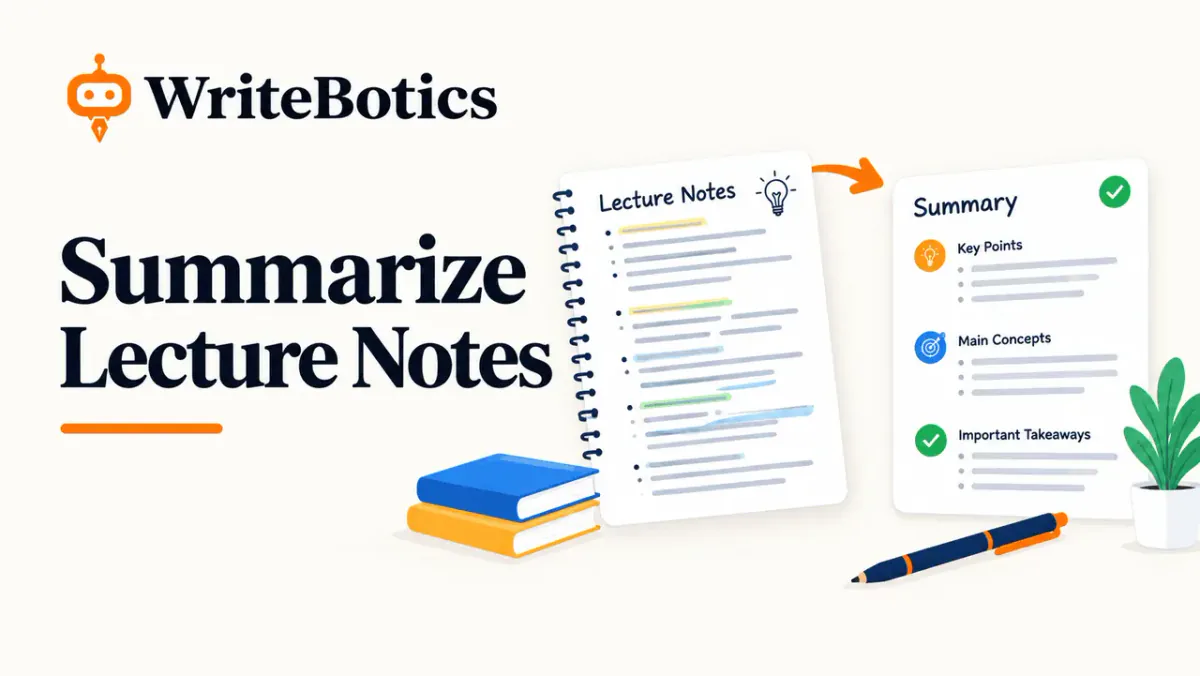
Summarizing lecture notes is one of the most practical ways to prepare for exams, understand difficult concepts, and review what you learned in class. The goal is not to rewrite every sentence or make your notes as short as possible. It is to identify the essential ideas, organize them clearly, and turn them into material you can understand and recall later.
To Summarize Lecture Notes effectively, start by cleaning up your raw notes, identify the main concepts, group related information by topic, and rewrite the key points in concise language. Then add questions, examples, and explanations that help you test your understanding. Finally, check your summary against the original notes to make sure you have not missed an important detail.
Whether you take notes on a laptop, use a notebook, or work from a lecture transcript, this step-by-step method can help you build a useful revision resource without losing the meaning of the lesson.
Why Summarizing Lecture Notes Matters
Lecture notes often contain more information than you need to review in a single sitting. They may include repeated explanations, examples, side comments, definitions, and details that make sense during class but become difficult to navigate later.
A well-written summary gives you a clearer view of the lesson. Instead of searching through several pages to find one definition, you can review the main ideas in a structured format.
Summarizing can also help you notice gaps in your understanding. If you cannot explain a concept in your own words, you may need to revisit that part of the lecture or textbook.
A useful lecture summary should:
Preserve the central ideas and important definitions.
Remove repetition and unnecessary wording.
Keep essential examples, evidence, and exceptions.
Organize information in a logical order.
Make the material easier to review and recall.
Remember that a summary is a study aid, not a replacement for learning the material. Some subjects require detailed explanations, worked solutions, or careful attention to the original lecture.
How to Summarize Lecture Notes in 6 Steps
1. Clean Up Your Raw Notes
Before summarizing, make your original notes readable. Rushed lecture notes often contain abbreviations, incomplete sentences, inconsistent headings, and ideas recorded out of order.
Start by reviewing the notes from beginning to end. Correct obvious spelling mistakes, expand abbreviations you might forget, and separate unrelated points. Add headings where the lecturer moves to a new subject.
For example, a rough set of notes might look like this:
Photosynthesis — plants make food. Chlorophyll in chloroplasts. Light energy used. CO2 + water → glucose + oxygen. Light reactions and Calvin cycle. Light reactions make ATP/NADPH. Calvin cycle fixes carbon.
These notes contain useful information, but the relationships between the concepts could be clearer.
A cleaned-up version might be:
Photosynthesis: The process by which plants use light energy to produce sugars.
Location: Chloroplasts, which contain chlorophyll.
Inputs: Carbon dioxide, water, and light energy.
Outputs: Sugars and oxygen.
Main stages: Light-dependent reactions and the Calvin cycle.
Key connection: Light-dependent reactions supply ATP and NADPH used in the Calvin cycle.
You have not summarized the material fully yet. You have simply made the information easier to understand and organize.
Tip: If a sentence in your notes is incomplete, do not guess what the lecturer meant. Check the relevant textbook, slides, or recording if available.
2. Identify the Main Concepts
Once your notes are readable, identify the ideas that carry the lesson's meaning.
Ask yourself three questions:
What was the main topic of this lecture?
Which concepts would I need to explain to someone else?
Which definitions, processes, formulas, or distinctions are essential?
Look for repeated terms, section headings, definitions, cause-and-effect relationships, and ideas the lecturer emphasized.
You can mark your notes with simple labels:
M: Main idea
D: Definition
E: Example
F: Formula or fact to remember
?: Something I need to clarify
For instance, in a lecture about supply and demand, the main concepts might include demand, supply, equilibrium price, shortages, and surpluses. A brief story about a particular store may be an example rather than a separate concept.
Do not remove every example or supporting detail. Keep the ones that make an abstract idea easier to understand, demonstrate a process, or explain an important exception.
The goal is to distinguish essential information from information that merely adds length.
3. Group Related Information by Topic
A summary becomes easier to review when related ideas appear together.
If your notes follow the lecture minute by minute, they may jump between definitions, examples, questions, and explanations. Rearrange them into topic-based sections while preserving the relationships between ideas.
For example, notes from a biology lecture could be organized like this:
| Topic
|
Information to include
| | --- | --- | |
Photosynthesis
|
Purpose and overall process
| |
Chloroplasts
|
Location and role of chlorophyll
| |
Light-dependent reactions
|
Light energy, ATP, and NADPH
| |
Calvin cycle
|
Carbon fixation and sugar production
| |
Key relationship
|
How the two stages work together
|
Choose a structure that fits the subject.
Chronological topics: Use a timeline for history or events.
Processes: Use numbered steps for biological or technical procedures.
Comparisons: Use a table for similar concepts that differ in important ways.
Hierarchies: Use headings and subheadings for subjects with broad categories.
Cause and effect: Use arrows or a simple flowchart to show relationships.
Grouping information also helps reveal missing connections. If a concept does not fit anywhere, ask whether it belongs in another section or needs further explanation.
4. Write a Concise Summary in Your Own Words
Now turn your organized notes into a shorter explanation.
Write one or two sentences for each major concept. Combine related points, remove repeated information, and use direct language. Avoid copying entire passages from a textbook or slide when a clear explanation in your own words will do.
A helpful structure for a topic summary is:
Main idea: What is the concept?
Explanation: How does it work, or why does it matter?
Supporting detail: What essential fact, formula, or example clarifies it?
For example, instead of keeping several disconnected notes about photosynthesis, you could write:
Photosynthesis is the process by which plants convert light energy into chemical energy stored in sugars. It takes place in chloroplasts and involves light-dependent reactions, which produce ATP and NADPH, and the Calvin cycle, which uses these molecules to support carbon fixation.
This paragraph is concise, but it preserves the connection between the two stages.
Avoid making your summary so short that it becomes a collection of vague keywords. A few extra words are worthwhile when they preserve the meaning.
If you are unsure how to condense a lengthy explanation, the WriteBotics Text Summarizer can help you create a shorter starting version of text you provide. Review the result against your lecture notes, correct any missing or inaccurate details, and make sure the final summary reflects your understanding.
5. Add Questions, Examples, and Memory Cues
A summary is more useful when it helps you retrieve information, not just recognize it while reading.
After each topic, create two or three questions that you can answer without looking at your notes.
For the photosynthesis example, questions might include:
What is the main purpose of photosynthesis?
What do the light-dependent reactions produce?
How does the Calvin cycle use the products of the light-dependent reactions?
Try answering each question from memory before checking the summary.
You can also include:
A simple example: A plant receives light, takes in carbon dioxide, and absorbs water. Through photosynthesis, it produces sugars and releases oxygen.
A memory cue: Light-dependent reactions supply energy-related molecules; the Calvin cycle uses them in carbon fixation.
A confusing distinction: ATP provides usable energy for cellular processes, while NADPH carries high-energy electrons. They are related but are not interchangeable.
Use examples that clarify the concept rather than adding unnecessary detail. For subjects involving mathematics, programming, or science, include a representative worked problem when the method matters as much as the final answer.
If you use flashcards, put a question on one side and a concise answer on the other. Keep each card focused on one concept.
6. Check Your Summary Against the Original
Before relying on your summary, compare it with the original lecture notes, slides, or assigned reading.
A summary can be clear and concise while still being wrong. You may accidentally reverse a relationship, omit an exception, simplify a definition too far, or leave out a step in a process.
Check the following:
Are the main concepts included?
Are definitions and technical terms accurate?
Are formulas, units, names, and dates correct?
Have I preserved important conditions and exceptions?
Does the summary reflect what the lecturer actually explained?
Can I explain each point without relying on copied wording?
For complicated subjects, revisit the original material whenever a short summary leaves you uncertain.
You can also use a guide to summarizing a long article to practice identifying central arguments and removing unnecessary details. The same core principles apply to lecture notes, although lectures may require more attention to diagrams, spoken explanations, and worked examples.
Sample Lecture Notes Transformation
Consider a hypothetical introductory economics lecture about supply and demand.
Original Raw Notes
demand = how much buyers willing/able to buy at different prices. Usually price ↑ demand quantity ↓. Supply = sellers willing to sell at different prices. Price ↑ quantity supplied ↑ usually. equilibrium where supply=demand. Price below equilibrium shortage. above = surplus. other factors shift curves e.g. income, costs, preferences.
Step 1: Identify the Main Concepts
The important ideas are demand, supply, equilibrium, shortages, surpluses, and factors that shift the curves.
Step 2: Group the Information
Separate the notes into definitions, price relationships, equilibrium, and curve shifts.
Step 3: Write the Summary
Supply and demand: Demand describes how much buyers are willing and able to purchase at different prices, while supply describes how much sellers are willing to offer. Other things being equal, a higher price generally reduces quantity demanded and increases quantity supplied.
Market equilibrium: Equilibrium occurs where the quantity demanded equals the quantity supplied. A price below equilibrium creates a shortage, while a price above equilibrium creates a surplus, assuming other conditions remain unchanged.
Shifts: Changes in factors such as consumer income, preferences, or production costs can shift supply or demand curves.
Step 4: Add Review Questions
How do supply and demand differ?
What happens when the market price is below equilibrium?
Give one example of a factor that can shift a supply or demand curve.
This transformation preserves the core concepts while removing repetition and making the relationships easier to review. Notice that the summary retains the qualification “other things being equal,” which prevents the price relationships from being treated as universal rules without context.
Common Mistakes to Avoid When Summarizing Lecture Notes
Even a well-organized set of notes can become less useful if you make these mistakes.
Copying Everything Word for Word
Copying the lecture into a new document creates more material to review without requiring you to decide what matters. Read, understand, and then explain the main ideas in your own words.
Making the Summary Too Short
A page of isolated keywords may look efficient, but it can be difficult to understand later. Keep enough context to explain relationships, processes, and important distinctions.
Removing Important Examples
Some examples demonstrate how a formula works or why a theory matters. Retain at least one useful example when it supports understanding.
Summarizing Without Checking Accuracy
Do not assume that a shorter version is automatically correct. Verify important details against the original notes, especially in technical subjects.
Treating the Summary as a Substitute for Study
Reading a summary repeatedly can create a sense of familiarity without confirming that you can recall the material. Close your notes, answer questions, and explain concepts from memory.
For additional guidance on using digital tools responsibly, read AI Writing Tools for Students. Use summarization to support your learning, and follow your instructor's rules when AI tools are involved in coursework.
Lecture Notes Summary Checklist
Use this checklist whenever you finish summarizing a lecture.
Revision readiness
0 of 8 complete
I corrected unclear abbreviations and organized my raw notes.
I identified the main concepts and essential definitions.
I grouped related ideas under clear headings.
I explained the key points in concise, original wording.
I retained important formulas, examples, and exceptions.
I added questions to test my understanding.
I checked facts and relationships against the original notes.
I can explain the main ideas without looking at the summary.
Reset checklist
FAQs About Summarizing Lecture Notes
How long should a lecture summary be?
There is no fixed length. A short, straightforward lecture may need only a few paragraphs, while a complex lecture may require several pages. Include enough information to explain the main concepts accurately, and adjust the length to the subject and your revision needs.
Should I summarize lecture notes by hand or on a computer?
Both methods can work. Handwritten summaries may suit diagrams, equations, and quick annotations, while digital notes are convenient for editing, searching, and reorganizing information. Choose the format that helps you understand and review the material consistently.
Is it better to summarize notes during or after a lecture?
You can mark key ideas during the lecture, but writing a complete summary afterward gives you time to review the full lesson and identify how the concepts connect. If possible, clean up your notes soon after class while the explanations are still familiar.
Can AI summarize lecture notes?
Yes. A text summarizer can condense text that you provide into a shorter overview. However, it may omit context, misunderstand technical terms, or overlook details that matter for an exam. Check the generated summary against your original notes and course materials before using it to study.
How do I summarize lecture notes without missing important information?
Identify the learning objectives, main concepts, definitions, and relationships. Keep essential examples, formulas, and exceptions. Then compare your summary with the original notes and test whether you can explain each major concept accurately.
How often should I review my summarized notes?
Review them regularly rather than waiting until the day before an exam. A practical routine is to revisit the summary soon after the lecture, test yourself again in a later study session, and return to difficult topics as needed. Adjust the schedule to your course and assessment dates.
Make Your Next Revision Session More Focused
Good lecture summaries make it easier to find important ideas, recognize connections, and identify what you still need to learn. Start with clear notes, organize concepts by topic, write concise explanations, and add questions that test your understanding.
If you have a long set of lecture notes or a text-heavy reading, try the WriteBotics Text Summarizer to create a starting summary. Review the output carefully, correct any missing details, and turn the key points into questions you can answer from memory.
The most useful summary is not necessarily the shortest one. It is the one that helps you understand the lesson and confidently explain what you have learned.