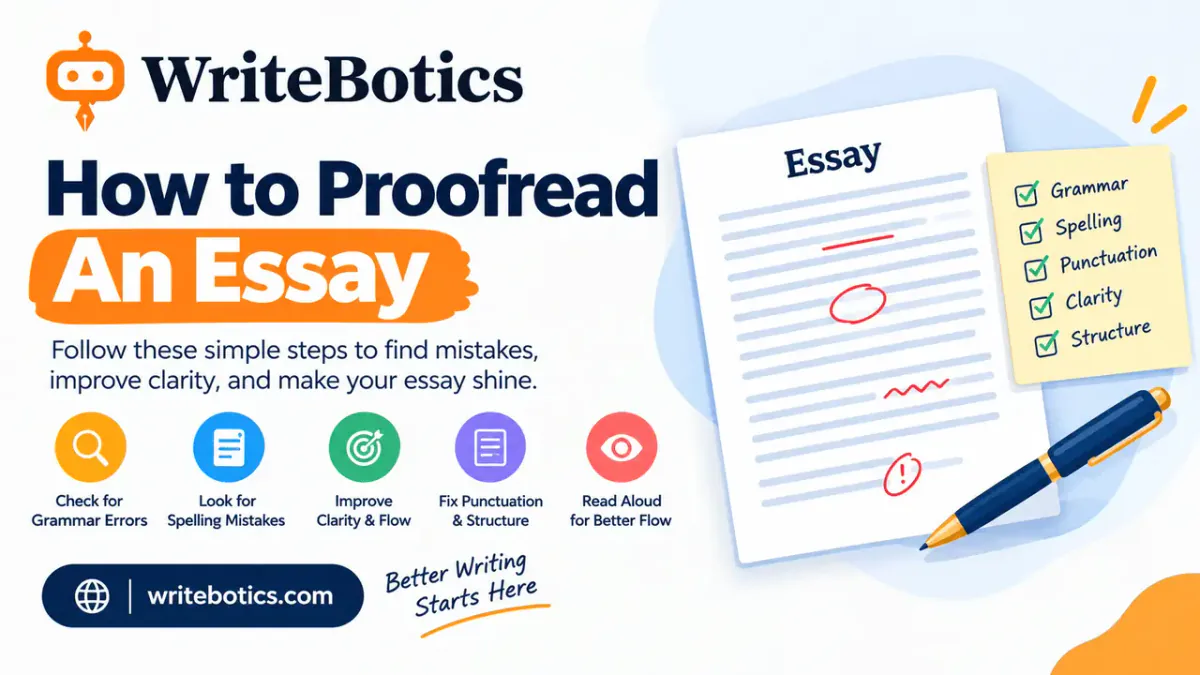
Knowing how to proofread an essay means doing more than looking for spelling mistakes. A strong final check examines your essay in layers: first the overall structure, then individual paragraphs, sentences, grammar, punctuation, citations, and finally the small errors that are easy to miss when you read too quickly.
The most effective approach is to separate editing from proofreading. Editing improves your ideas, organization, clarity, and argument. Proofreading comes afterward and focuses on correctness and consistency.
Use the following step-by-step process before submitting an essay so you can review your work systematically instead of hoping that a quick reread catches everything.
1. Finish Editing Before You Start Proofreading
One of the biggest proofreading mistakes is trying to correct grammar while you are still changing the content.
If you discover that an entire paragraph needs to move, a thesis needs to change, or an argument needs more evidence, sentence-level corrections may have to be redone.
Think of the process as two separate passes:
| Editing | Proofreading |
|---|---|
| Improves ideas and arguments | Finds surface-level errors |
| Checks organization | Checks grammar and punctuation |
| Removes repetition | Checks spelling and capitalization |
| Improves clarity and flow | Checks formatting and consistency |
| Strengthens evidence and explanations | Checks citations and references |
For example, suppose your essay says:
The policy was successful because it helped many people and was also beneficial in several different ways.
During editing, you might decide that the sentence is too vague and explain exactly which outcomes demonstrate success.
During proofreading, you might notice a missing comma, incorrect spelling, or inconsistent capitalization.
Edit first. Proofread second.
That simple separation makes the final review more efficient.
2. Check the Essay Structure
Before examining individual sentences, look at the essay as a whole.
Start by checking whether the introduction establishes the topic and gives the reader a clear sense of your main argument. Your thesis should match what the body of the essay actually discusses.
Then review the body paragraphs.
Ask:
- Does each paragraph support the thesis?
- Is the main idea of each paragraph clear?
- Does the evidence relate to the paragraph's point?
- Have you explained your evidence rather than simply presenting it?
- Do the paragraphs appear in a logical order?
- Does the conclusion bring the discussion together?
A useful test is to read only the first sentence of every body paragraph. If those sentences create a logical outline of your argument, the structure is probably easy to follow. If one paragraph suddenly introduces an unrelated idea, that is a sign to edit before proofreading.
Check the introduction and conclusion together
Your introduction promises what the essay will discuss. Your conclusion should reflect that discussion without introducing a completely new argument.
For example, if your introduction says the essay will examine three effects of remote learning, the conclusion should address those effects rather than suddenly discussing an unrelated issue.
At this stage, do not worry about whether every comma is correct. You are checking the document's architecture.
3. Proofread One Paragraph at a Time
Once the structure is sound, move through the essay paragraph by paragraph.
A useful paragraph-level checklist is:
- Identify the paragraph's main point.
- Check whether every sentence contributes to that point.
- Look for unnecessary repetition.
- Check transitions between ideas.
- Confirm that examples and evidence are explained.
- Check that the paragraph ends naturally or leads into the next one.
Consider this example:
Social media can influence how students communicate. Students use social media every day. Social media is common among young people. This means that social media is an important part of modern communication.
The paragraph repeats essentially the same idea several times.
A tighter version could be:
Social media has become an important part of how students communicate. Because many students use these platforms regularly, they can influence how young people exchange information, express opinions, and maintain relationships.
The second version has a clearer progression: claim, reason, and implications.
When proofreading, also watch for paragraphs that are too long. A paragraph containing several unrelated ideas may actually need to be divided during editing.
4. Check Grammar, Spelling, and Punctuation
Now move to sentence-level proofreading.
Read each sentence slowly and check the basic mechanics.
Subject-verb agreement
Make sure the subject and verb agree.
Incorrect:
The results of the study shows a significant difference.
Correct:
The results of the study show a significant difference.
The subject is results, not study, so the plural verb is required.
Verb tense
Check that your tense is consistent unless there is a clear reason to change it.
For example, if you are describing a historical event, avoid switching randomly between past and present tense.
Incorrect:
The researchers conducted the experiment and discover that the results were unexpected.
Correct:
The researchers conducted the experiment and discovered that the results were unexpected.
Sentence fragments
Make sure formal essay sentences express complete thoughts.
Incorrect:
Because the evidence was incomplete.
Correct:
The researchers repeated the experiment because the evidence was incomplete.
Sentence fragments are particularly easy to miss when they begin with words such as because, although, when, if, while, or after.
Run-on sentences and comma splices
Look for sentences containing multiple complete thoughts that have not been connected correctly.
Incorrect:
The evidence was convincing, the researchers changed their conclusion.
Possible corrections include:
The evidence was convincing, so the researchers changed their conclusion.
Or:
The evidence was convincing. The researchers changed their conclusion.
Punctuation
Check commas, apostrophes, quotation marks, colons, semicolons, and periods.
Do not add commas simply because you pause while reading. Instead, check what grammatical role the punctuation is serving.
Also search for inconsistent punctuation around quotations and citations. Academic styles can have specific rules, so follow the citation style required by your instructor or institution.
A grammar checker can provide another pass for spelling, grammar, punctuation, and sentence clarity, but review suggestions yourself before accepting them.
5. Check Word Choice and Clarity
Proofreading is not only about finding technically incorrect sentences. You should also watch for wording that makes your meaning unclear.
Look for:
- vague words such as “things,” “stuff,” or “a lot”
- unnecessary repetition
- overly long sentences
- words used incorrectly
- inconsistent terminology
- informal expressions in a formal essay
- unnecessary filler
For example:
There are a lot of things that show that the experiment was basically pretty successful.
A clearer version might be:
Several results indicate that the experiment was successful.
The goal is not to make every sentence complicated. Clear academic writing is often direct and specific.
If you are changing wording, make sure you do not accidentally change the original meaning or make a claim stronger than your evidence supports.
6. Check Your Citations and Sources
Citations deserve their own proofreading pass because a grammatically perfect essay can still have citation problems.
Compare your in-text citations with your reference or works-cited list.
Check:
- Is every required source cited?
- Does every in-text citation correspond to the correct source?
- Are author names spelled consistently?
- Are publication details accurate?
- Are quotations clearly identified?
- Have you cited ideas that came from other sources?
- Are citations formatted according to the required style?
- Are page numbers or other details included when required by your style guide?
Remember that changing the wording of another person's idea does not automatically remove the need for attribution. A paraphrase still needs a citation when the underlying idea or information comes from a source.
If you have paraphrased source material, compare your version with the original to make sure you have preserved the meaning and credited the source appropriately.
You can also review a draft with a plagiarism checker as an additional review step. Treat any matching text as something to investigate rather than automatically assuming that every match represents academic misconduct. Common phrases, quotations, titles, and properly cited material can produce matches too.
7. Use the Read-Aloud Method
One of the simplest ways to catch errors is to read the essay aloud.
When you silently read familiar writing, your brain can fill in missing words or overlook awkward sentences because you already know what you intended to say.
Reading aloud slows the process down.
Listen for:
- sentences that are difficult to say
- repeated words
- missing words
- awkward transitions
- overly long sentences
- unclear references such as “this” or “they”
- punctuation that changes the rhythm unexpectedly
For example:
The researcher explains the results in the discussion which provides several important observations that support the original hypothesis.
Reading this aloud may reveal that the sentence is carrying too many ideas at once.
A clearer version might be:
The researcher explains the results in the discussion. The findings provide several observations that support the original hypothesis.
The read-aloud method is especially useful for finding problems that automated checks may not fully explain, such as awkward flow or unclear phrasing.
8. Do a Final Visual Check
After you have checked the content and sentences, inspect the essay visually.
Look for:
- inconsistent headings
- unusual spacing
- missing page numbers when required
- inconsistent font formatting
- incorrect indentation
- extra spaces
- quotation formatting problems
- stray punctuation
- accidental duplicate words
- broken references
- inconsistent capitalization
If your assignment has specific formatting requirements, compare the finished document with those instructions one item at a time.
Do not assume that formatting is correct simply because the text itself looks finished.
Your Final Essay Proofreading Checklist
Before submitting your essay, use this final checklist:
Structure
- The introduction clearly presents the topic and thesis.
- Every body paragraph supports the main argument.
- Ideas appear in a logical order.
- Evidence is explained rather than simply inserted.
- The conclusion reflects the essay's main discussion.
Paragraphs and sentences
- Every paragraph has a clear purpose.
- Repetition has been removed.
- Transitions make sense.
- Sentences are complete.
- There are no obvious run-ons or comma splices.
- Wording is clear and appropriate for the assignment.
Grammar and punctuation
- Subject-verb agreement is correct.
- Verb tense is consistent.
- Spelling has been checked.
- Commas and other punctuation have been reviewed.
- Apostrophes and quotation marks are correct.
- Capitalization is consistent.
Sources and citations
- Required sources are cited.
- In-text citations match the reference list.
- Quotations are clearly identified.
- Paraphrased ideas are properly attributed.
- Citation formatting follows the required style.
Final review
- I have read the essay aloud.
- I have completed a final visual formatting check.
- I have reviewed any grammar or plagiarism-checking suggestions manually.
- The final version still represents my own ideas and intended meaning.
- The essay follows my instructor's academic and AI-use requirements.
FAQs About Proofreading an Essay
What is the difference between editing and proofreading an essay?
Editing focuses on the quality of the writing and ideas: structure, argument, clarity, organization, evidence, and flow. Proofreading is the final checking stage, where you look for grammar, spelling, punctuation, formatting, and other small errors.
How many times should I proofread an essay?
There is no universal number. Instead of repeatedly reading the same way, use different passes for different problems. For example, check structure first, then paragraphs and sentences, then grammar and citations, and finally read the essay aloud.
Should I proofread an essay immediately after writing it?
It is often useful to take a short break before the final proofreading pass. Even a change in activity can make it easier to notice problems that were invisible while you were drafting.
Should I use a grammar checker when proofreading?
A grammar checker can provide an additional review of spelling, grammar, punctuation, and sentence clarity. However, automated suggestions should be reviewed rather than accepted automatically. You remain responsible for deciding whether a suggested change preserves your intended meaning.
Does paraphrasing mean I do not need a citation?
No. If the underlying idea or information came from another source, changing the wording does not eliminate the need for appropriate attribution. Always follow the citation requirements for your assignment.
Should I use a plagiarism checker before submitting an essay?
It can be useful as an additional review step, particularly for checking whether passages may closely match existing material. However, matching text does not automatically mean plagiarism. Review the context, quotations, citations, and source material before deciding whether a change is necessary.
Final Thoughts
Learning how to proofread an essay is mainly about using a reliable process. Do not try to catch every problem at once.
First, finish your editing. Then check the structure, review each paragraph, examine grammar and punctuation, verify citations, read the essay aloud, and complete one final visual check.
For an additional grammar review, use the WriteBotics Grammar Checker after you have made your own edits. If you are concerned about source overlap, you can also review the draft with the WriteBotics Plagiarism Checker. And if you need to rewrite source material in your own words, review the guide on [how to paraphrase an essay correctly]https://writebotics.com/blog/how-to-rewrite-an-email-professionally while keeping the required citations.
The final goal is not to make an essay sound artificially perfect. It is to make sure your ideas are clear, your sources are properly handled, and the finished document accurately represents your own work.