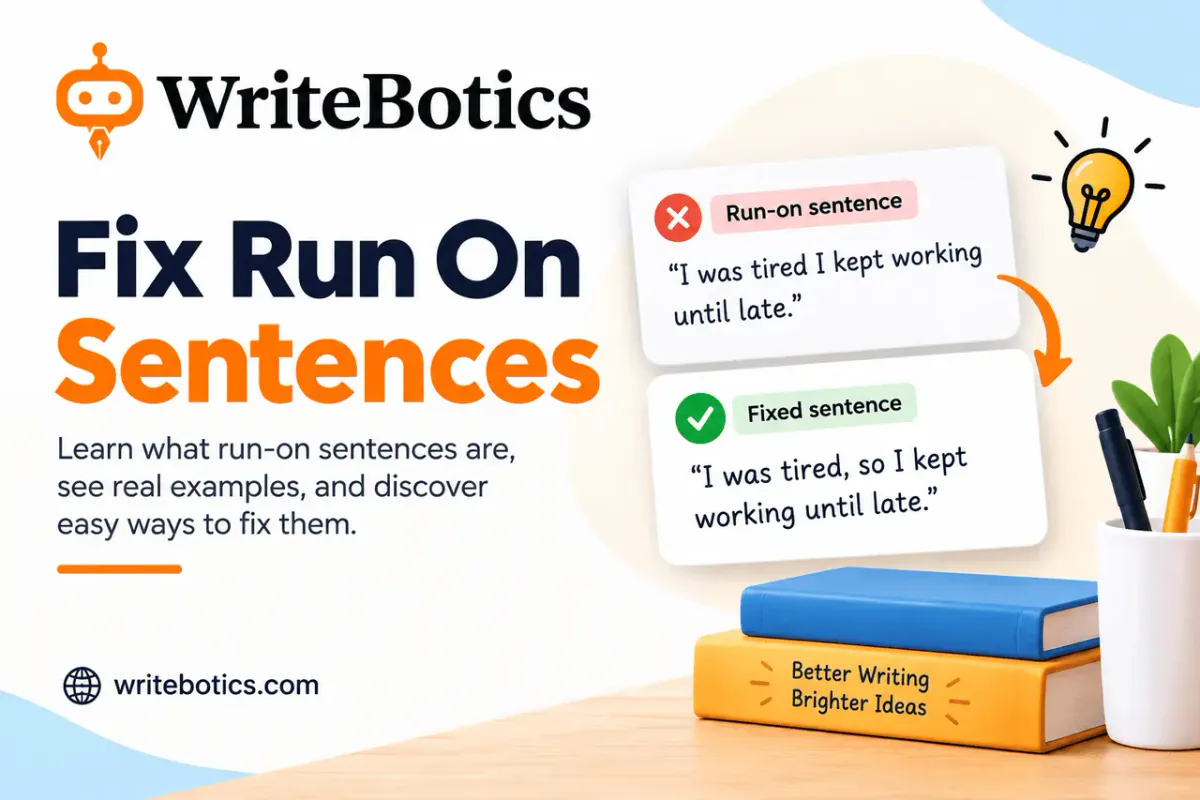
A run-on sentence happens when two or more independent clauses are incorrectly joined without the punctuation or connecting words they need. To fix a run-on sentence, separate the clauses with a period, join them with a semicolon, or connect them with a coordinating conjunction. In some cases, rewriting the sentence creates the clearest result.
Run-on sentences are common in emails, essays, blog posts, reports, and everyday writing. They are easy to create because several related thoughts can feel like one natural sentence. The problem is not always sentence length. A short sentence can be a run-on, while a long sentence can be completely correct.
The key is learning to recognize independent clauses and checking how they are connected.
What Is a Run-On Sentence?
A run-on sentence occurs when two or more independent clauses are joined incorrectly.
An independent clause contains a subject and a verb and expresses a complete thought. It can stand on its own as a sentence.
For example:
The meeting ended.
This is an independent clause because it is a complete thought.
So is:
Everyone left the room.
If you combine them without the right punctuation, you get a run-on:
Incorrect: The meeting ended everyone left the room.
The two complete thoughts need a proper boundary.
A run-on sentence can also contain a comma splice, which is a specific type of sentence-boundary error:
Incorrect: The meeting ended, everyone left the room.
A comma alone is not enough to join two independent clauses in standard edited English.
Two common types of run-on sentences
There are two common forms to watch for:
| Type | Example | Problem |
|---|---|---|
| Fused sentence | The meeting ended everyone left. | No punctuation separates the independent clauses. |
| Comma splice | The meeting ended, everyone left. | A comma incorrectly joins the independent clauses. |
Both need correction, but the best fix depends on the relationship between the ideas.
Run-On Sentence vs. Long Sentence
A long sentence is not automatically a run-on sentence.
This distinction is important because writers sometimes try to fix every long sentence by cutting it in half. That is unnecessary if the sentence is grammatically correct and easy to follow.
For example:
After the meeting ended, the project manager reviewed the notes, answered several questions from the team, and sent a summary to the client.
This sentence is relatively long, but it is not a run-on. It has one independent clause: the project manager reviewed the notes, answered questions, and sent a summary. The opening phrase is dependent on the main clause.
Compare it with:
The meeting ended the project manager reviewed the notes and everyone left.
Here, multiple independent clauses have been pushed together without proper boundaries.
Use this quick test
When a sentence feels too long, stop at each major clause and ask:
- Does this part have its own subject and verb?
- Could it stand alone as a complete sentence?
- If yes, how is it connected to the next complete thought?
If two complete thoughts are sitting next to each other without appropriate punctuation or a conjunction, you probably have a run-on sentence.
Run-On Sentence Examples
Here are some common examples of fused sentences and their corrected versions.
Example 1: Fused sentence
Incorrect: The store was closing we hurried to the checkout.
Two independent clauses are joined with nothing.
Correct: The store was closing. We hurried to the checkout.
Example 2: Comma splice
Incorrect: The weather changed suddenly, we canceled the picnic.
The comma cannot properly join the two independent clauses.
Correct: The weather changed suddenly, so we canceled the picnic.
Example 3: Missing sentence boundary
Incorrect: Maya finished her report she sent it to her manager.
Correct: Maya finished her report. She sent it to her manager.
Example 4: Too many ideas
Incorrect: I opened the document I checked the figures I corrected two errors then I sent it to the client.
This sentence contains several complete thoughts that need clearer boundaries.
Correct: I opened the document and checked the figures. I corrected two errors, then sent the revised version to the client.
The goal is not simply to make sentences shorter. It is to make the relationships between ideas clear.
How to Fix Run-On Sentences
There are several reliable ways to fix a run-on sentence. Choose the method that best communicates the relationship between the ideas.
1. Use a period
A period is usually the simplest fix.
Before:
The deadline is tomorrow we need to finish the report tonight.
After:
The deadline is tomorrow. We need to finish the report tonight.
Use a period when the two ideas are separate enough to deserve their own sentences.
This is often the best choice when a run-on feels crowded. You do not need to force closely related ideas into one sentence simply because they originally appeared together.
2. Use a semicolon
A semicolon can join two closely related independent clauses.
Before:
The deadline is tomorrow we need to finish the report tonight.
After:
The deadline is tomorrow; we need to finish the report tonight.
Both sides of the semicolon must be capable of standing alone as complete sentences.
A semicolon works especially well when the relationship between the two thoughts is obvious:
The office was nearly empty; most employees had already gone home.
The semicolon keeps the ideas connected while still providing a strong sentence boundary.
3. Add a coordinating conjunction
A coordinating conjunction can connect two independent clauses when the meaning calls for it.
The familiar coordinating conjunctions are for, and, nor, but, or, yet, and so.
Before:
I wanted to join the call I had another appointment.
After:
I wanted to join the call, but I had another appointment.
The conjunction tells the reader how the two ideas relate.
Some common relationships include:
| Conjunction | Common relationship | Example |
|---|---|---|
| and | Addition | The draft is finished, and the team is reviewing it. |
| but | Contrast | I wanted to continue, but the meeting had ended. |
| or | Alternative | We can revise the page, or we can replace it. |
| so | Result | The deadline moved, so we changed the schedule. |
| yet | Unexpected contrast | The task was difficult, yet the team completed it. |
Use the conjunction that accurately expresses the intended meaning rather than choosing one simply because it fixes the punctuation.
4. Rewrite the sentence
Sometimes the cleanest solution is to restructure the sentence entirely.
Before:
The website was difficult to navigate users left before finding the information they needed.
After:
Because the website was difficult to navigate, users left before finding the information they needed.
Or:
Users left before finding the information they needed because the website was difficult to navigate.
This approach is useful when one idea explains, causes, qualifies, or depends on another.
It can also make your writing more concise instead of simply adding punctuation.
Ten Run-On Sentence Practice Examples
Try correcting each sentence before looking at the answers.
1.
The train was delayed we arrived twenty minutes late.
Answer:
The train was delayed. We arrived twenty minutes late.
2.
I finished the presentation I sent it to the team.
Answer:
I finished the presentation, and I sent it to the team.
3.
The instructions were unclear several people made the same mistake.
Answer:
The instructions were unclear; several people made the same mistake.
4.
We wanted to eat outside it started raining.
Answer:
We wanted to eat outside, but it started raining.
5.
The client approved the draft we can begin production.
Answer:
The client approved the draft, so we can begin production.
6.
She reviewed the contract she noticed a missing clause.
Answer:
She reviewed the contract. She noticed a missing clause.
7.
The road was closed we took another route.
Answer:
Because the road was closed, we took another route.
8.
I could call the customer I could send an email instead.
Answer:
I could call the customer, or I could send an email instead.
9.
The report looked complete one section still needed an update.
Answer:
The report looked complete, but one section still needed an update.
10.
The team had limited time they focused on the most important tasks.
Answer:
The team had limited time, so they focused on the most important tasks.
There is often more than one correct way to fix a run-on sentence. What matters is that the final version has clear sentence boundaries and preserves the intended meaning.
How to Choose the Right Fix
When you are unsure which correction to use, focus on the relationship between the ideas.
| If the ideas are... | Try... |
|---|---|
| Mostly separate | A period |
| Closely related | A semicolon |
| Connected by addition, contrast, choice, or result | A coordinating conjunction |
| Cause-and-effect or explanation | A dependent clause or rewritten structure |
For example:
The store closed we went home.
A period works:
The store closed. We went home.
A semicolon works:
The store closed; we went home.
A conjunction can make the relationship explicit:
The store closed, so we went home.
Or you can restructure it:
Because the store closed, we went home.
All four versions are grammatical, but they create slightly different relationships between the ideas.
Proofreading Checklist for Run-On Sentences
A final proofreading pass can help you catch sentence-boundary problems before you publish or submit your writing.
Use this checklist:
- Look for sentences containing multiple complete thoughts.
- Check whether two independent clauses are sitting next to each other without punctuation.
- Watch for a comma followed by another complete sentence.
- Confirm that every semicolon connects two independent clauses.
- Check whether a coordinating conjunction accurately expresses the relationship between clauses.
- Split a crowded sentence when separate sentences would be clearer.
- Read the sentence aloud and listen for an awkward or missing boundary.
- Make sure your edit has not changed the original meaning.
- Check surrounding sentences so the revised sentence still flows naturally.
- Do a final spelling, punctuation, and grammar review.
If you want a second pass after making your own edits, you can use the WriteBotics Grammar Checker to review spelling, grammar, punctuation, and sentence clarity. WriteBotics recommends treating automated suggestions as a review aid rather than accepting every change automatically.
Run-On Sentences and Clearer Writing
Fixing run-on sentences is not only about following punctuation rules. It is also about helping readers understand where one thought ends and another begins.
A sentence can be grammatically correct and still be difficult to read if it contains too many ideas. When that happens, look beyond punctuation.
Ask:
What is the main point of this sentence?
If the answer contains several separate ideas, consider splitting the sentence or restructuring it.
For broader editing, the WriteBotics Writing Improver uses a three-pass approach: clarity first, grammar second, and tone third. That can be useful when a sentence is technically correct but still feels overloaded or unclear.
If you have a rough draft that needs more substantial restructuring, a WriteBotics Content Rewriter can help you create an alternative version to compare with your original. Always review the result yourself to make sure the meaning and important details remain accurate.
FAQs About Run-On Sentences
What is a run-on sentence?
A run-on sentence occurs when two or more independent clauses are joined incorrectly. The clauses may have no punctuation between them, or they may be connected with punctuation that is not sufficient.
How do you fix a run-on sentence?
You can usually fix a run-on sentence by separating the clauses with a period, joining them with a semicolon, adding an appropriate coordinating conjunction, or restructuring the sentence.
Is every long sentence a run-on?
No. A long sentence can be grammatically correct if its clauses and phrases are properly connected. Sentence length alone does not determine whether a sentence is a run-on.
What is a fused sentence?
A fused sentence is a type of run-on sentence in which two independent clauses are placed together without appropriate punctuation or a connecting word.
For example:
The meeting ended everyone left.
The two complete thoughts need a proper boundary.
Is a comma splice the same as a run-on sentence?
A comma splice is a specific type of sentence-boundary error. It occurs when two independent clauses are joined with only a comma.
For example:
The meeting ended, everyone left.
A fused sentence has no appropriate punctuation between the clauses:
The meeting ended everyone left.
Both are commonly discussed as run-on sentence problems.
Can a semicolon fix a run-on sentence?
Yes, when the run-on contains two closely related independent clauses.
For example:
The meeting ended; everyone left.
Both sides can stand alone, so the semicolon provides an appropriate connection.
Can I use a comma to fix a run-on sentence?
A comma by itself generally cannot join two independent clauses in standard edited English. If you want to use a comma, pair it with an appropriate coordinating conjunction when both sides are independent clauses.
For example:
The meeting ended, and everyone left.
What is the easiest way to fix a run-on sentence?
If you are unsure, try a period first:
The report is finished. The team can review it now.
A period creates a clear boundary and is often the simplest correction. If the ideas are closely related, a semicolon or conjunction may create better flow.
How can I avoid run-on sentences?
During proofreading, look for sentences that contain two or more complete thoughts. Check how those thoughts are connected. If there is no punctuation, or only a comma between them, revise the sentence.
Reading your writing aloud can also help you notice places where a sentence needs a clearer break.
Final Takeaway
Knowing how to fix run-on sentences comes down to one basic skill: recognizing where complete thoughts begin and end.
When two independent clauses are joined incorrectly, you can usually fix the problem with a period, semicolon, coordinating conjunction, or a clearer sentence structure. The best choice depends on how the ideas relate.
Do not confuse a long sentence with a run-on sentence. Focus on sentence structure, not word count. Then proofread for missing boundaries, comma splices, and crowded ideas.
For a final grammar and sentence-clarity review, try the WriteBotics Grammar Checker, then read the edited version yourself before publishing or submitting it.