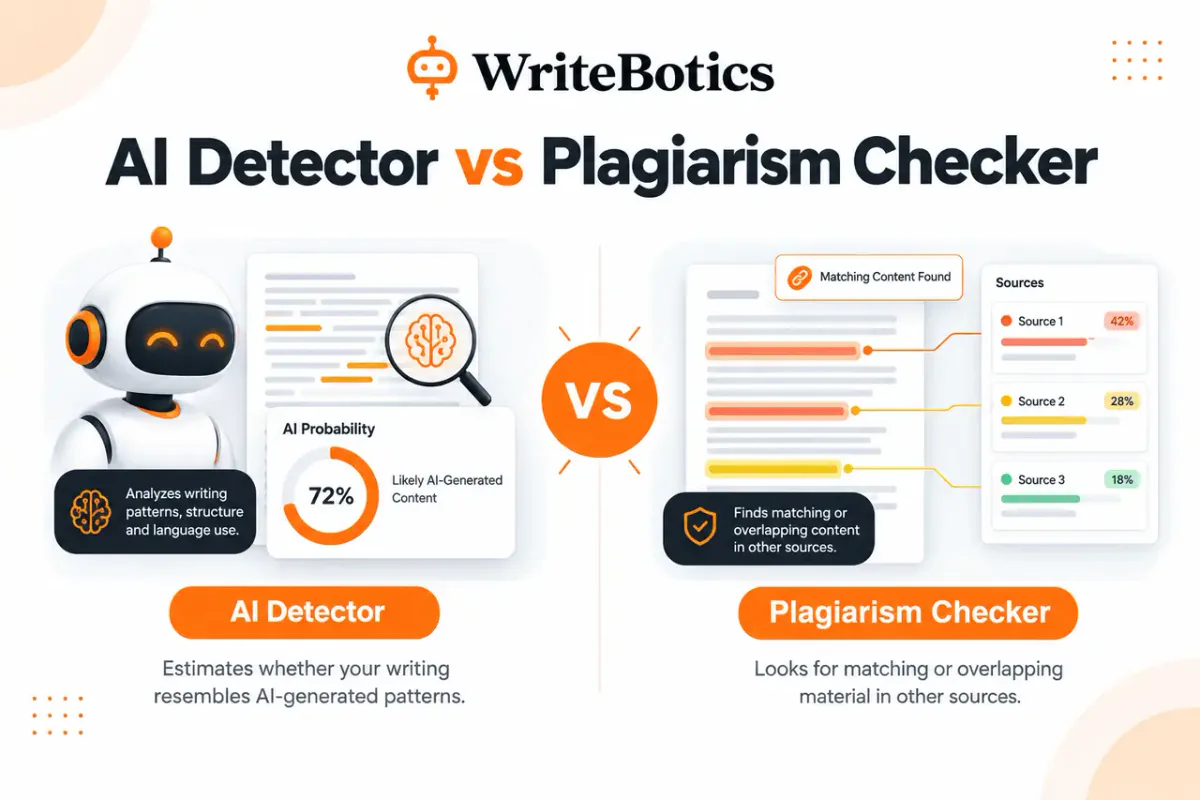
A plagiarism checker can help an SEO writer find exact or similar wording that deserves a closer look. Its most useful role is not to issue a pass-or-fail certificate; it is to direct the writer to passages that may need a citation, quotation marks, a clearer paraphrase, or original analysis.
How plagiarism checking generally works
A full commercial checker usually divides submitted text into phrases and compares them with sources available to that provider. The coverage may include public web pages, licensed publications, or private submission repositories, depending on the service. A similarity report is only as broad as that particular index.
WriteBotics works differently. Its plagiarism checker uses limited browser-side comparison logic and common-phrase signals. It does not crawl the live web or search private academic databases. The result can highlight wording to review, but it cannot certify that a document is original.
Five practical benefits for SEO writers
1. Catch accidental phrase reuse
Writers often absorb wording while researching several sources. A similarity check can draw attention to a phrase that stayed too close to the source, giving the writer a chance to quote, cite, or explain the idea independently.
2. Improve source discipline
A flagged passage prompts useful questions: Who first made this claim? Is the source authoritative? Does the page need a direct citation? This review improves trust even when the wording itself is not problematic.
3. Protect a distinct editorial voice
Repeated templates and generic phrases can make a site sound interchangeable with competitors. Reviewing them encourages examples, first-hand observations, original data, and explanations tailored to the intended reader.
4. Support client and team quality checks
A documented review step gives editors a consistent way to discuss suspicious overlap. It should be combined with source notes and revision history, not used as the only evidence in a consequential decision.
5. Reveal over-reliance on one source
Even a properly cited draft can be too dependent on a single article. Similarity review can prompt broader research and more useful synthesis.
Similarity is not the same as plagiarism
Plagiarism is an ethical or policy judgment involving attribution and context. Similarity is a text comparison. A report may flag product names, quotations, legal language, references, or ordinary phrases that are entirely legitimate. It may also miss copied ideas expressed in different words.
Search engines likewise do not apply a simple site-wide “duplicate content penalty” to every repeated phrase. For SEO, focus on whether a page adds substantial original value and serves a clear search intent. Boilerplate and copied pages can still be ignored, clustered, or outranked because they offer little unique value.
A better originality workflow
- Record sources while researching instead of reconstructing them later.
- Draft from your notes and understanding, not with a source paragraph open beside you.
- Put exact borrowed wording in quotation marks and cite it.
- Run a similarity review and inspect every meaningful match in context.
- Verify that paraphrases preserve the source meaning and still include attribution where the idea requires it.
- Add original examples, experience, comparisons, or data that improve the answer.
- Have a human editor review the final page.
The Purdue Online Writing Lab provides practical guidance on avoiding plagiarism and documenting sources.
How to interpret a score
Do not optimize toward a universal “safe” percentage. A low score can miss unattributed ideas; a high score may mostly reflect quotations and references. Open the matched passages, check the alleged sources, and decide what each instance needs.
Also review the service's privacy terms before submitting confidential, unpublished, client, or student material. Different providers store and process text differently.
Frequently asked questions
Can WriteBotics scan the entire internet?
No. The current tool does not query a live web index or private database. It offers a limited browser-based phrase review.
Does a zero similarity score prove originality?
No. It only means that the tool did not find a match within its method and coverage. It does not prove authorship, proper attribution, or factual accuracy.
Will unique wording guarantee better rankings?
No. Rankings depend on relevance, usefulness, quality, links, technical accessibility, competition, and many other signals. Original wording helps only when the page also delivers distinct value.
Should I paraphrase every flagged sentence?
No. A quotation may be the most honest choice, and common language may not need changing. Review the source and context before editing.
Can a plagiarism checker replace an editor?
No. An editor must assess attribution, evidence, meaning, and whether the page genuinely helps its audience.