APA 7th edition in-text citations help readers identify the sources behind the information, ideas, and quotations in an academic paper. Whether you are writing a research paper, university assignment, dissertation, or literature review, understanding APA's author-date citation system is essential for giving credit to original authors and avoiding plagiarism.
The good news is that APA in-text citations follow a consistent structure. Once you understand the difference between parenthetical and narrative citations, along with the rules for citing one author, multiple authors, and organizations, you can apply the format confidently throughout your writing.
This guide explains how APA 7 in-text citations work, provides practical examples, and covers common situations that students and researchers encounter.
What Is an APA 7th Edition In-Text Citation?
An APA 7th edition in-text citation is a short reference included within the body of an academic paper to identify the source of borrowed information. It typically contains the author's surname and the year of publication.
APA uses an author-date citation system, meaning readers can identify a source through the author's name and publication year before locating its complete details in the reference list.
For example:
- Parenthetical citation: (Smith, 2022)
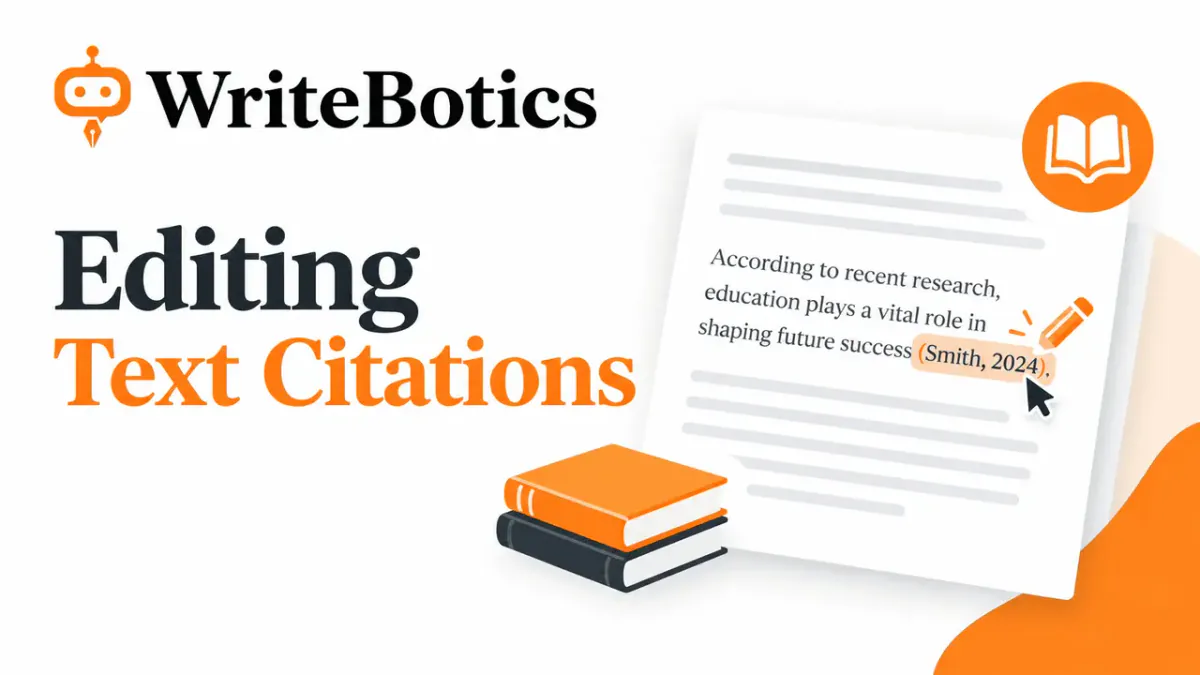
- Narrative citation: Smith (2022) explains that effective academic writing requires careful organization.
Both examples acknowledge the same source, but they incorporate the author's name differently.
In-text citations are necessary when you:
- Directly quote another author's words.
- Paraphrase information from a published source.
- Summarize research findings or academic arguments.
- Refer to another person's theories, ideas, or interpretations.
- Include statistics or information obtained from another source.
Every source cited in the text should generally have a corresponding entry in the reference list, with specific exceptions such as personal communications.
According to the official APA Style citation guidelines, appropriate citations help readers understand how existing research supports and informs your work.
Parenthetical vs. Narrative Citations in APA 7
APA 7 provides two main ways to incorporate citations into academic writing: parenthetical and narrative citations.
Both follow the author-date system, but the placement of the author's name and publication year differs.
1. Parenthetical Citations
A parenthetical citation places the author's surname and publication year inside parentheses. It usually appears at the end of the sentence containing the borrowed information.
Example:
Academic writing becomes more effective when ideas are supported by reliable evidence (Smith, 2022).
In this example:
- Smith is the author's surname.
- 2022 is the publication year.
- Both details appear inside parentheses.
Parenthetical citations are useful when you want to emphasize the information rather than the person who produced it.
2. Narrative Citations
A narrative citation incorporates the author's surname into the sentence, followed immediately by the publication year in parentheses.
Example:
Smith (2022) explains that academic writing becomes more effective when ideas are supported by reliable evidence.
Here, the author's name becomes part of the sentence, while the year appears in parentheses.
Narrative citations are particularly useful when discussing a researcher's findings, comparing different authors, or emphasizing the contribution of a particular study.
Parenthetical vs. Narrative: Key Differences
| Feature | Parenthetical | Narrative |
|---|---|---|
| Author's name | Inside parentheses | Within the sentence |
| Publication year | Inside parentheses | After author's name |
| Example | (Smith, 2022) | Smith (2022) |
| Main emphasis | Information or idea | Author or researcher |
Both formats are correct under APA 7. Choose the one that makes your writing clearer and more natural.
APA 7 In-Text Citation Rules for Different Numbers of Authors
One of the most important parts of APA 7 citation formatting is knowing how many author names to include. The rules change depending on whether a source has one author, two authors, three or more authors, or an organization as its author.
1. Citing a Source With One Author
When a source has one author, include the author's surname and publication year in both parenthetical and narrative citations.
Examples:
- Parenthetical: (Johnson, 2021)
- Narrative: Johnson (2021) found that regular reading improves academic vocabulary.
You only need to include the surname and year. Do not add the author's first name or initials to a standard in-text citation.
2. Citing a Source With Two Authors
For sources with two authors, include both authors' surnames every time you cite the source.
The punctuation depends on the citation format:
- Use an ampersand (&) in parenthetical citations.
- Use the word "and" in narrative citations.
Examples:
- Parenthetical: (Johnson & Williams, 2021)
- Narrative: Johnson and Williams (2021) examined the relationship between reading habits and academic performance.
A common mistake is using an ampersand in a narrative citation. Remember that APA 7 requires "and" when the authors' names appear naturally within the sentence.
3. Citing a Source With Three or More Authors
When a source has three or more authors, APA 7 generally requires you to include only the first author's surname, followed by et al., and the publication year.
This rule applies from the first citation.
Examples:
- Parenthetical: (Johnson et al., 2021)
- Narrative: Johnson et al. (2021) investigated the effectiveness of different learning strategies.
The abbreviation et al. means "and others." It should not be italicized, and the period belongs after "al."
Do not list every author's surname in an ordinary in-text citation when the source has three or more authors.
Quick Reference: Multiple-Author Citations
| Number of authors | Parenthetical | Narrative |
|---|---|---|
| One | (Smith, 2022) | Smith (2022) |
| Two | (Smith & Jones, 2022) | Smith and Jones (2022) |
| Three or more | (Smith et al., 2022) | Smith et al. (2022) |
These examples follow the APA 7 author-count rules and can be used as a quick reference when preparing academic assignments.
How to Cite Multiple Sources in One APA 7 Citation
Sometimes, a single statement is supported by research from several authors. Instead of creating separate citations after every sentence, you can include multiple sources within the same set of parentheses.
APA 7 generally requires multiple works in one parenthetical citation to appear in alphabetical order by the first author's surname. Separate each source with a semicolon.
Example:
Several studies have explored the relationship between academic motivation and student performance (Brown, 2020; Johnson, 2021; Williams, 2023).
When citing multiple works by the same author, arrange them chronologically, starting with the earliest publication.
Example:
Previous research has examined this topic across several years (Brown, 2019, 2021, 2023).
If the same author has multiple works published in the same year, use lowercase letters after the year to distinguish them.
Example:
(Brown, 2022a, 2022b)
These letters must also correspond to the labels used in the reference list.
How to Cite Organizations and Group Authors
Some academic publications are written by organizations, government agencies, research institutions, or professional associations rather than individual authors.
In these cases, use the organization's name as the author.
For example, a publication from the World Health Organization can be cited using the organization's full name.
First parenthetical citation:
(World Health Organization [WHO], 2023)
Subsequent parenthetical citations:
(WHO, 2023)
For narrative citations, the format is slightly different.
First narrative citation:
The World Health Organization (WHO, 2023) reported relevant findings.
Subsequent narrative citation:
WHO (2023) provided additional information.
If an organization does not have a commonly used abbreviation, you can continue using its full name in subsequent citations.
The main purpose of this rule is to introduce an abbreviation clearly before using it throughout your paper.
How to Cite Sources With No Author or No Publication Date
Not every source provides complete publication information. Websites, reports, and other online materials may have no clearly identified individual author or publication date.
APA 7 provides specific rules for handling these situations.
Citing a Source With No Author
If a source does not identify an author, use the title in the author position.
For an article, webpage, or chapter, place the shortened title inside double quotation marks. Italicize the title of a standalone work, such as a book or report.
Example:
("Academic Writing Strategies," 2022)
For a standalone report:
(Academic Writing Handbook, 2022)
Use a shortened but recognizable version of the title when the full title is lengthy.
Citing a Source With No Publication Date
If the publication date cannot be established, use the abbreviation n.d., meaning "no date."
Example:
- Parenthetical: (Smith, n.d.)
- Narrative: Smith (n.d.) discusses several approaches to academic writing.
Do not invent a publication year simply because a webpage looks recently updated. Use the date information available from a reliable source.
How to Cite Direct Quotations in APA 7
When you copy another author's exact words, you must provide a direct quotation citation. Unlike a standard paraphrase, a direct quotation requires a locator, such as a page number, whenever available.
The basic format includes:
- Author's surname
- Publication year
- Page number
Short Direct Quotations
For quotations containing fewer than 40 words, incorporate the quoted material into your paragraph using double quotation marks.
Parenthetical example:
Academic writing requires careful attention to evidence because "clear communication supports effective learning" (Smith, 2022, p. 15).
Narrative example:
Smith (2022) explained that "clear communication supports effective learning" (p. 15).
Notice that the page number follows the year in the narrative format and appears alongside the author and year in the parenthetical format.
Long Direct Quotations
For quotations containing 40 words or more, APA 7 requires a block quotation.
A block quotation:
- Starts on a new line.
- Is indented 0.5 inches from the left margin.
- Does not use quotation marks.
- Maintains double spacing.
- Includes an appropriate citation after the quotation's final punctuation.
Example:
Smith (2022) described the importance of effective academic communication:
Academic communication requires writers to present their ideas
clearly, organize supporting evidence, and acknowledge the
contributions of other researchers. These practices help readers
understand the development of an argument. (p. 15)
For online sources without page numbers, use an appropriate alternative locator, such as a paragraph number, section heading, or timestamp for audiovisual material.
For example:
- (Smith, 2022, para. 4)
- (Smith, 2022, "Research Methods" section, para. 2)
You should never invent page numbers or other location details.
How to Cite Paraphrased Information in APA 7
Paraphrasing means expressing another author's ideas in your own words while preserving the original meaning.
APA 7 requires an author and publication year for paraphrased material.
Original idea:
Students who regularly practice academic writing may develop stronger communication and critical-thinking skills.
Paraphrased example:
Regular writing practice can help students improve their ability to communicate ideas and evaluate information (Johnson, 2021).
A page number is not generally required for a paraphrase. However, APA encourages writers to include a page or paragraph number when it would help readers locate a specific passage in a lengthy source.
Remember that changing a few words from the original sentence is not sufficient paraphrasing. You must genuinely express the idea using your own sentence structure and language while still acknowledging the original author.
Common APA 7 In-Text Citation Mistakes to Avoid
Even experienced academic writers sometimes make citation errors. Understanding the most common mistakes can help you maintain consistency and improve the accuracy of your academic work.
| Common mistake | Incorrect example | Correct example |
|---|---|---|
| Using & in narrative citations | Smith & Jones (2022) | Smith and Jones (2022) |
| Listing all three authors | (Smith, Jones, Brown, 2022) | (Smith et al., 2022) |
| Omitting the publication year | (Smith) | (Smith, 2022) |
| Missing page number in a direct quote | (Smith, 2022) | (Smith, 2022, p. 15) |
| Using n.d. incorrectly | (Smith, no date) | (Smith, n.d.) |
| Missing a reference-list entry | Citing an unlisted source | Include the corresponding reference entry |
Other mistakes worth avoiding include:
- Placing punctuation incorrectly around quotations and citations.
- Using inconsistent author names throughout a paper.
- Forgetting to introduce an organization's abbreviation.
- Treating paraphrased information as original research.
- Using outdated APA 6 formatting rules.
- Citing sources in the text without checking their corresponding reference entries.
A helpful practice is to review every in-text citation alongside the reference list before submitting your assignment.
APA 7 In-Text Citation Quick Reference
Use this table to identify the correct citation format for common academic writing situations.
| Situation | APA 7 format |
|---|---|
| One author | (Smith, 2022) |
| Two authors | (Smith & Jones, 2022) |
| Three or more authors | (Smith et al., 2022) |
| Narrative citation | Smith (2022) |
| Direct quotation | (Smith, 2022, p. 15) |
| No publication date | (Smith, n.d.) |
| No individual author | ("Article Title," 2022) |
| Multiple sources | (Brown, 2020; Smith, 2022) |
| Same author, same year | (Smith, 2022a, 2022b) |
| Organization with abbreviation | (World Health Organization [WHO], 2023) |
| Subsequent organizational citation | (WHO, 2023) |
This quick reference covers frequently used citation patterns, but more specialized situations may require additional guidance.
Frequently Asked Questions About APA 7 In-Text Citations
1. What is the basic format of an APA 7 in-text citation?
The basic APA 7 in-text citation format is the author's surname followed by the publication year.
For example, a parenthetical citation looks like (Smith, 2022), while a narrative citation looks like Smith (2022).
2. What is the difference between parenthetical and narrative citations?
Parenthetical citations place the author's name and publication year inside parentheses. Narrative citations incorporate the author's name into the sentence, with the year appearing immediately after the name in parentheses.
Both formats communicate the same source information.
3. How do you cite three or more authors in APA 7?
Use the first author's surname followed by et al. and the publication year.
For example:
- Parenthetical: (Johnson et al., 2023)
- Narrative: Johnson et al. (2023)
This format applies from the first citation.
4. Do APA 7 in-text citations always need page numbers?
No. Page numbers are required for direct quotations when available, but they are generally optional for paraphrased information.
For sources without page numbers, you can use alternative locators, such as paragraph numbers or section headings, when appropriate.
5. How do you cite two authors in APA 7?
Include both authors' surnames in every citation.
Use an ampersand in parenthetical citations and the word "and" in narrative citations.
Examples:
- (Brown & Wilson, 2022)
- Brown and Wilson (2022)
6. How do you cite a website in APA 7 in-text citations?
Use the author or organization responsible for the webpage and its publication year.
For example:
- Parenthetical: (World Health Organization, 2023)
- Narrative: World Health Organization (2023)
If no author is identified, use the webpage title in the author position.
7. What does et al. mean in APA citations?
Et al. is a Latin abbreviation meaning "and others." APA 7 uses it for works with three or more authors to keep in-text citations concise.
It is not italicized, and the period appears after "al."
8. Should every in-text citation appear in the reference list?
Generally, yes. Each source cited in the text should have a corresponding reference-list entry.
However, personal communications are an important exception because they are cited in the text but not included in the reference list.
Final Thoughts
Understanding APA 7th edition in-text citation rules makes academic writing more accurate, professional, and easier to follow. The author-date system provides a consistent way to acknowledge research while helping readers locate the original sources.
Remember the essential rules: use the author's surname and publication year, distinguish between parenthetical and narrative citations, apply the correct multiple-author format, and include page numbers for direct quotations when available.
Before submitting your work, check that your citations follow APA 7 guidelines and match your reference list. You can also use the WriteBotics Grammar Checker to review spelling, punctuation, and sentence clarity as part of your final proofreading process.
For authoritative guidance on more complex citation situations, consult the American Psychological Association's official in-text citation guidelines.
Following these practices will help you produce well-supported academic writing while giving appropriate credit to the researchers whose work contributes to your ideas.