
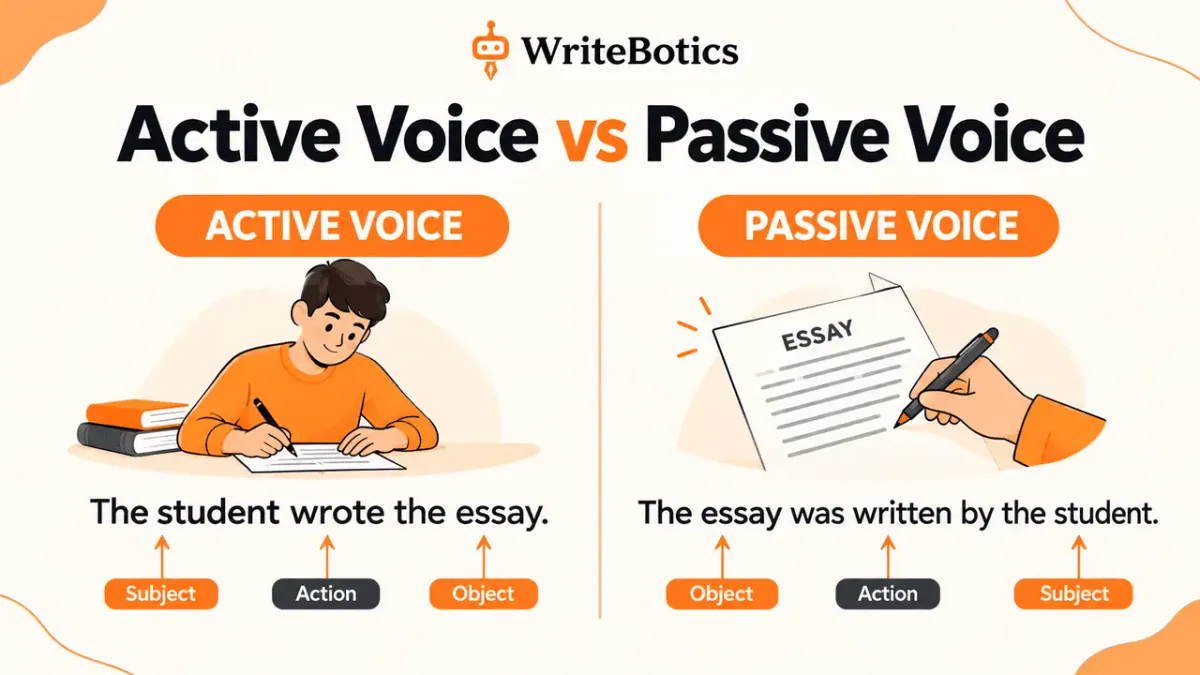
Active and passive voice are both useful in research writing. The key is knowing when each form communicates your findings more clearly, accurately, and appropriately. Although many writing guides recommend active voice for directness, passive voice remains valuable when the action, process, or result matters more than the person performing it.
For researchers, students, and academics, choosing between active and passive voice is not about following a strict rule. It is about making scientific and academic writing precise, readable, and consistent with the conventions of your field.
In this guide, you will learn the difference between active and passive voice, review examples from research writing, and discover when each style is most effective.
What Is Active Voice?
Active voice is a sentence structure in which the subject performs the action. It usually makes the sentence direct and clearly identifies who or what is responsible for the action.
Example:
- Active: The researchers analyzed the survey responses.
- Subject: The researchers
- Action: Analyzed
- Object: The survey responses
Active voice is common in research writing because it helps readers understand what the researcher did, what the study found, and how the conclusions were reached.
Active Voice Examples in Academic Writing
- The research team collected data from 250 participants.
- We compared the results of the two experiments.
- The findings indicate a significant relationship between sleep and memory.
- The authors propose a new framework for evaluating risk.
- The analysis revealed three recurring themes.
These sentences identify the person, group, or evidence responsible for the action or conclusion.
What Is Passive Voice?
Passive voice is a sentence structure in which the subject receives the action rather than performing it. The person or thing carrying out the action may be included in a phrase beginning with “by,” or it may be omitted when it is unknown or unimportant.
Example:
- Passive: The survey responses were analyzed by the researchers.
- Subject: The survey responses
- Action: Were analyzed
- Agent: The researchers
Passive voice is often used in research writing when the procedure, material, result, or object of study deserves more attention than the person who performed the action.
Passive Voice Examples in Academic Writing
- The samples were stored at room temperature.
- Participants were recruited through university mailing lists.
- The data were analyzed using statistical software.
- The questionnaire was distributed online.
- A significant difference was observed between the two groups.
These sentences emphasize the procedure or research subject rather than the researcher.
Active Voice vs. Passive Voice: Key Differences
| Feature | Active voice | Passive voice |
|---|---|---|
| Sentence focus | The person or thing performing the action | The person or thing receiving the action |
| Typical structure | Subject + verb + object | Object + form of “be” + past participle |
| Clarity | Often more direct | Can be useful, but may hide the agent |
| Best use | Explaining decisions, analysis, and conclusions | Emphasizing methods, materials, and results |
| Example | The team measured blood pressure. | Blood pressure was measured. |
Neither voice is automatically better. The best choice depends on what information the sentence needs to emphasize.
When to Use Active Voice in Research Writing
Active voice is especially useful when identifying responsibility, explaining decisions, presenting an argument, or describing what the evidence suggests.
1. When Explaining Research Decisions
Active voice helps clarify who made a methodological choice.
Less direct: The participants were excluded because they did not meet the eligibility criteria.
More direct: We excluded participants who did not meet the eligibility criteria.
Both sentences are grammatically correct. The active version is useful when the authors need to explain their decisions explicitly.
2. When Presenting Findings and Interpretations
Active voice can make claims easier to follow.
Passive: A positive association was found between exercise and sleep quality.
Active: The analysis showed a positive association between exercise and sleep quality.
The second sentence identifies the analysis as the source of the result. However, researchers should avoid implying causation when the study only establishes an association.
3. When Building an Argument
Active voice can help authors communicate their reasoning and conclusions directly.
Passive: It is suggested by the results that the intervention may improve retention.
Active: The results suggest that the intervention may improve retention.
The active version is shorter and more direct without changing the level of certainty.
4. When Reducing Wordiness
Active voice can help eliminate unnecessary phrases.
Wordy: It was determined by the research team that the second model performed better.
Concise: The research team determined that the second model performed better.
The improved sentence is easier to read and identifies the decision-maker.
When Passive Voice Is Useful in Scientific Writing
Passive voice should not be avoided automatically. In many research contexts, it serves a clear purpose by emphasizing procedures, materials, or findings.
1. When the Procedure Matters More Than the Researcher
Methods sections often describe standardized procedures that readers need to understand and reproduce.
Example: The specimens were heated to 80°C for 20 minutes.
The important information is what happened to the specimens, not necessarily who heated them.
2. When the Agent Is Unknown or Irrelevant
Sometimes the person performing an action is not known or does not affect the scientific meaning.
Example: The chemical compound was detected in all three samples.
Naming the person who detected the compound would add little value unless the identity of the analyst matters to the study.
3. When Maintaining Focus on Materials or Results
Passive voice can keep the research subject at the center of a paragraph.
Example: The collected tissue samples were preserved for subsequent analysis.
The sentence maintains focus on the samples and their treatment.
4. When Following Disciplinary Conventions
Some disciplines and journals traditionally use passive voice more frequently in methods descriptions. Other fields prefer active constructions, including “we measured” or “we interviewed.”
Always consider the target journal's author guidelines, disciplinary conventions, and the need for clear communication. Do not assume that every scientific paper must use passive voice or that every journal prohibits it.
Active vs. Passive Voice Examples in Research Writing
The following examples show how voice changes emphasis without necessarily changing the core meaning.
| Passive voice | Active voice | When the active version helps |
|---|---|---|
| The data were analyzed using R. | We analyzed the data using R. | When identifying the researchers' actions is useful |
| The interviews were conducted by two trained researchers. | Two trained researchers conducted the interviews. | When the interviewers' role matters |
| The samples were stored at −20°C. | We stored the samples at −20°C. | When the methods need to specify who performed the step |
| A significant difference was observed between the groups. | The analysis revealed a significant difference between the groups. | When explaining how the result emerged |
| The questionnaire was distributed online. | We distributed the questionnaire online. | When describing the research team's procedure |
Choose the version that best fits the paragraph. Do not change a sentence to active voice if doing so makes the agent unclear, adds unnecessary first-person wording, or shifts the intended emphasis.
How to Change Passive Voice to Active Voice
Converting passive sentences into active ones is straightforward when the person or thing performing the action is known.
Step 1: Find the Action
Identify the verb phrase, often a form of “be” followed by a past participle.
Example: The results were reviewed by the supervisor.
The action is “were reviewed.”
Step 2: Identify the Agent
Look for who performed the action. In the example, the agent is “the supervisor.”
If the agent is missing, check the surrounding context before adding one. Do not invent a person or group simply to force an active sentence.
Step 3: Make the Agent the Subject
Move the agent to the beginning of the sentence.
Passive: The results were reviewed by the supervisor.
Active: The supervisor reviewed the results.
Step 4: Check Meaning and Emphasis
Make sure the new sentence preserves the original meaning and tense. Decide whether naming the agent improves the writing.
For example, “The samples were stored at −20°C” may be preferable in a methods section if the storage condition matters more than who carried it out.
Common Mistakes to Avoid
Treating Passive Voice as Grammatically Incorrect
Passive voice is a legitimate grammatical construction. It is appropriate when it supports the purpose of the sentence.
Better approach: Choose voice based on clarity, emphasis, and disciplinary expectations rather than a blanket rule.
Hiding Responsibility Unnecessarily
Passive voice can make it unclear who made a decision or performed an action.
Vague: Errors were made during data entry.
Clearer, when accurate: The research team made errors during data entry.
Use the active version when responsibility is relevant and the evidence supports identifying the agent.
Using Active Voice That Sounds Awkward
Not every passive sentence needs to be converted.
Natural passive: The samples were stored at −20°C.
Potentially unnecessary active version: We stored the samples at −20°C.
Both are correct. The passive version may be more suitable if the methods section focuses on procedures rather than the researchers.
Confusing Passive Voice With Past Tense
Voice and tense are different grammatical features. Active and passive constructions can both refer to past, present, or future actions.
- Active, past: The team collected the samples.
- Passive, past: The samples were collected.
- Active, present: The model predicts the outcome.
- Passive, present: The outcome is predicted by the model.
Choose tense according to the timing and purpose of the statement, then choose voice according to the emphasis you want.
How to Improve Voice and Style in a Research Paper
Use these practical checks when editing a manuscript:
- Identify the purpose of each sentence. Decide whether it explains a decision, describes a procedure, or presents a result.
- Prefer direct wording when it improves clarity. Active voice often makes responsibility and reasoning easier to follow.
- Keep passive voice when it serves the sentence. Methods, materials, and observed outcomes may deserve the focus.
- Avoid unnecessary wordiness. Replace phrases such as “it was found that” with more direct wording when appropriate.
- Maintain consistency. Follow your target journal's guidelines and use a voice that fits the section and discipline.
- Preserve scientific accuracy. Do not change an association into a causal claim or introduce an agent that the study does not establish.
For another editing pass, use the WriteBotics Grammar Checker to review grammar and sentence construction, then check every suggested change to ensure it preserves your intended scientific meaning.
Frequently Asked Questions About Active and Passive Voice
1. Should research papers use active or passive voice?
Research papers can use both active and passive voice. Active voice is often effective for explaining research decisions, describing analysis, and presenting arguments. Passive voice can be useful when the procedure, material, or result deserves more emphasis than the person performing the action. Follow the target journal's guidelines.
2. Is passive voice acceptable in scientific writing?
Yes. Passive voice is widely used in scientific writing, especially in methods descriptions and when the agent is unknown or unimportant. It should be used purposefully rather than as a default for every sentence.
3. Why do researchers use passive voice in the methods section?
Researchers may use passive voice to emphasize procedures and materials, such as “The samples were stored at −20°C.” This keeps attention on the experimental conditions. However, active constructions such as “We stored the samples at −20°C” can also be appropriate when the journal's style and context support them.
4. When should I use active voice in academic writing?
Use active voice when it makes the sentence more direct, identifies who performed an action, or clearly presents an analysis or conclusion. For example, “We interviewed 30 participants” is direct and identifies the researchers' action.
5. Does passive voice make academic writing more formal?
Not necessarily. Formal academic writing depends on precision, evidence, suitable tone, and clear organization—not on passive voice alone. Active voice can be just as formal and is often easier to read.
6. How can I identify passive voice?
Look for a form of the verb “be” or sometimes “get” followed by a past participle, as in “was measured” or “were collected.” Then ask whether the grammatical subject receives the action. This pattern is a useful clue, although not every “be” verb followed by a participle is passive.
7. Is it wrong to use “we” in a research paper?
No. Many academic journals accept or encourage “we” when authors describe their methods, decisions, or interpretations. Check the publication's style guidance and use first person when it improves clarity.
8. How can I reduce passive voice in my research paper?
Review sentences to identify where passive voice obscures responsibility or makes the writing unnecessarily wordy. Convert those sentences to active voice when the agent is known and relevant. Keep passive constructions that appropriately emphasize methods, materials, or results.
9. Can passive voice change the meaning of a sentence?
It can change emphasis and sometimes make responsibility less clear, even when the basic event remains the same. For example, “The team excluded the participants” identifies the team, while “The participants were excluded” focuses on the participants and leaves the agent unstated.
10. What is the best way to check voice and grammar in academic writing?
Combine careful proofreading with your institution's or journal's style guidance. A grammar tool can help flag awkward or unclear sentences, but review each suggestion manually to preserve technical accuracy, appropriate caution, and the intended meaning of your research.
Final Thoughts
Active voice and passive voice both have a place in research writing. Active voice often improves directness and makes responsibility clear, while passive voice can emphasize procedures, materials, and results when the agent is less important.
Rather than banning passive voice, choose the construction that communicates your meaning most accurately. Review each sentence for clarity, emphasis, and scientific precision, and follow the conventions of your discipline and target journal.
The goal is not to make every sentence active or passive. It is to make your research easy to understand, accurate, and professional.