The most common citation mistakes are forgetting to cite borrowed ideas, citing paraphrases incorrectly, mixing citation styles, mismatching in-text citations with the reference list, and adding inaccurate or incomplete source information. Other frequent problems include missing page numbers when a style requires them, citing a source you did not actually read, and attributing a claim to a source that does not support it.
The easiest way to avoid these errors is to identify the citation style required for your assignment or publication, record source details while researching, cite information as you write, and verify each citation against the original source before submitting your work. APA, MLA, Chicago, and other systems have different rules, so there is no single citation format that is universally correct.
This guide explains 12 common citation mistakes, shows how to fix them, and gives you a practical checklist for checking citations before you submit an essay, research paper, article, or report.
Key Takeaways
- Cite borrowed ideas and information, not just direct quotations.
- A paraphrase still needs a citation when the idea comes from another source.
- Follow the citation style required by your instructor, institution, journal, or publisher.
- Make sure in-text citations, notes, and reference-list entries point to the correct sources.
- Never invent page numbers, publication details, or other missing information.
- Verify important claims against the original source rather than relying only on another writer's interpretation.
- A plagiarism checker can help identify potentially matching text, but citation accuracy still requires human review.
What Are Common Citation Mistakes?
Common citation mistakes are errors in giving credit to sources or documenting them accurately and consistently. They can involve missing citations, incorrect formatting, incomplete references, inaccurate attribution, or failure to follow the rules of the required citation style.
A citation can look professionally formatted and still be wrong. For example, you might correctly format an author's name and publication year but cite that source for a claim the author never actually made.
That is why citation checking has two parts: formatting accuracy and source accuracy.
Why Do Citations Matter?
Citations help readers identify where information, evidence, quotations, and borrowed ideas came from. They also allow readers to locate the underlying source and distinguish your contribution from material you obtained elsewhere.
Citation systems also create consistency. APA, MLA, and Chicago, for example, use different approaches to documenting sources. Chicago itself has both notes-and-bibliography and author-date systems, while MLA uses a Works Cited system connected to in-text references.
The goal is therefore not to make every paper use the same format. The goal is to use the correct system consistently for your context.
What Are the 12 Most Common Citation Mistakes?
1. Forgetting to Cite a Borrowed Idea
A citation is not required only when you copy someone's exact words. If you use a source's original idea, argument, finding, interpretation, or other information that requires attribution, you generally need to cite it.
Example:
Students who study with spaced practice may retain information differently from students who rely on one long study session.
If this statement is based on a particular source, the source needs to be acknowledged according to the required style.
How to fix it: Add citations while drafting instead of waiting until the entire paper is finished.
A useful habit is to mark borrowed information immediately with a temporary citation such as [SOURCE], then replace it with the correct citation before editing the final draft.
2. Assuming Paraphrasing Means You Don't Need a Citation
Paraphrasing changes the wording, but it does not change ownership of the underlying idea.
Weak approach:
Original: Researchers found that regular revision can improve long-term retention. Paraphrase: Researchers discovered that frequent review can increase long-term retention.
The wording has changed, but the underlying claim still came from the source.
Better approach: Write the idea in your own structure and cite the source.
WriteBotics' guidance on paraphrasing similarly emphasizes that changing a few words is not enough; the source still needs attribution when its idea is being used.
3. Using the Wrong Citation Style
APA, MLA, Chicago, and other systems differ in how they handle authors, dates, page numbers, titles, notes, and reference entries.
A format that is correct in one style can be incorrect in another.
| Citation issue | Why it varies |
|---|---|
| Author names | Different styles use different ordering and abbreviations |
| Publication date | Its position and treatment can differ |
| Page numbers | Requirements vary by style and source |
| Notes | Some systems rely heavily on footnotes or endnotes |
| Reference entries | Titles, dates, publishers, and URLs follow different patterns |
How to fix it: Find out which style your assignment, institution, journal, or publisher requires before formatting your references.
Do not choose APA simply because it is familiar, or MLA because it looks shorter. Use the system your context requires.
4. Mixing Citation Styles
A paper can contain individually recognizable citations but still be inconsistent overall.
For example, you might use an author-date citation in one paragraph and a footnote-based system in another without a deliberate reason.
Chicago officially supports both notes-and-bibliography and author-date systems, but they are distinct systems and should not be mixed casually.
How to fix it:
- Identify your required citation style.
- Choose the appropriate version of that style where multiple systems exist.
- Apply its rules consistently.
- Review the entire document after the writing is complete.
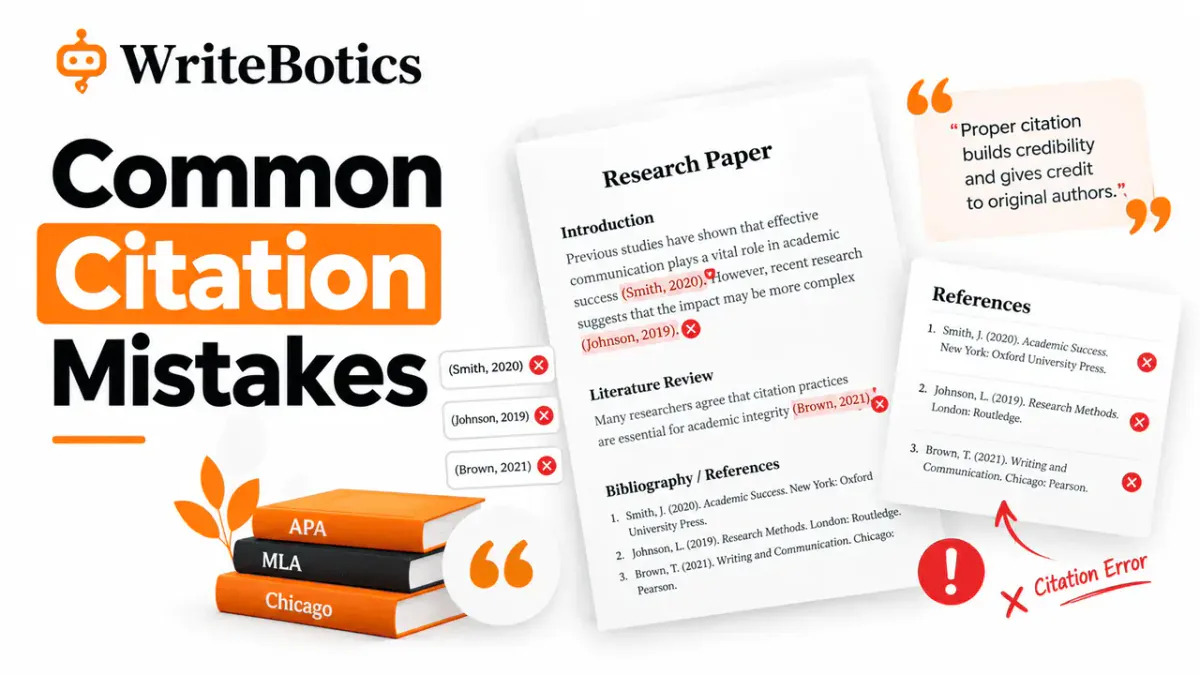
5. Mismatching In-Text Citations and References
One of the easiest citation errors to spot is a mismatch between the citation in your text and the source at the end.
Example:
In text: (Garcia, 2025)
But your reference list contains:
Garcia, M. (2024). Research Writing Basics.
The different years may indicate that you cited the wrong source or entered the wrong publication date.
MLA similarly expects in-text references to connect readers to the corresponding Works Cited entry.
How to fix it: Search your document for every author name and compare it with the corresponding reference entry.
Check:
- Author name
- Publication year where applicable
- Source title
- Page or other locator
- DOI or URL where required
- Matching source identity
6. Adding or Omitting Page Numbers Incorrectly
Page numbers are one of the most misunderstood parts of citation.
The correct treatment depends on the citation style, source, and whether you are quoting or paraphrasing. MLA, for example, uses a location marker when relevant, such as a page number for a paginated source. If a source has no page numbers or another usable part number, MLA says not to invent one.
Example of a source with pages:
(Garcia 42)
Example of a source without stable page numbers:
Don't turn the browser's printed page count into a fake source page number.
How to fix it: Check the rules for your specific citation style and source type. If the source does not provide the required locator, use an alternative permitted by the style or omit the locator when the style instructs you to do so.
7. Citing a Secondary Source as If You Read the Original
Suppose an article discusses a study you have not read. You then cite the original study as though you personally consulted it.
That can misrepresent your research process and may cause you to repeat an interpretation that the secondary author made rather than what the original researcher actually concluded.
Better workflow:
- Find the original source.
- Read it if you can access it.
- Verify the claim directly.
- Cite the original when appropriate.
- If you cannot access it, use your required style's secondary-source format.
The important distinction is simple: cite what you actually consulted, and make a secondary-source relationship clear when the style requires it.
8. Citing a Source That Does Not Support Your Claim
A citation does not automatically make a statement accurate.
Imagine writing:
The study found that online learning always improves student performance (Lee, 2025).
You open the study and discover that it examined a small sample and reported a limited association rather than an "always" effect.
The citation exists, but the sentence still misrepresents the evidence.
How to fix it: Compare your wording with the source.
Ask:
- Does the source actually make this claim?
- Did I preserve the author's qualification?
- Am I confusing correlation with causation?
- Did I turn a limited finding into a universal statement?
- Did I quote the conclusion accurately?
This source-verification step is often more important than punctuation.
9. Treating a Search Result or Snippet as the Source
Search engines are useful for finding sources, but a search-result snippet is not necessarily the underlying evidence.
For example, you might see a statistic in a search result and copy it into your essay without opening the original report.
The snippet could be incomplete, outdated, or stripped of the context that changes the meaning.
How to fix it: Open the original article, report, book, study, government publication, or other source. Verify the information there and cite the actual source.
For important claims, trace the information as close to the primary source as reasonably possible.
10. Copying a Quotation Without Checking the Original
A quotation can be wrong even when you copied it from a reputable-looking webpage.
The quotation may have been shortened, transcribed incorrectly, taken from an excerpt, or presented without the surrounding context.
How to fix it:
- Locate the original source.
- Compare the wording character by character when accuracy matters.
- Confirm who actually said or wrote it.
- Check the surrounding context.
- Confirm the location marker required by your citation style.
- Use quotation marks only around the exact borrowed wording.
This is especially important when a quotation is being repeated across multiple websites.
11. Creating Incomplete or Inaccurate Reference Entries
A reference entry should give readers enough information to identify and locate the source according to the requirements of your citation style.
A vague entry such as:
Smith, article about education, 2025.
does not give the reader enough useful information.
Depending on the source and style, you may need information such as the author, title, publication date, publisher or journal, volume and issue, pages, DOI, URL, or another identifier.
Chicago's current citation guidance, for example, provides different formats for books, journal articles, websites, and other source types.
How to fix it: Build each reference from the source itself rather than from memory.
If information is genuinely unavailable, check your style guide for how to handle the missing element. Never invent bibliographic details just to make the entry look complete.
12. Assuming a Citation Makes a Claim Automatically Credible
This is a subtle but important mistake.
A sentence can contain a citation and still be misleading if the source is outdated, irrelevant, misunderstood, or being used beyond what it actually supports.
For example:
"Research proves that students learn best when they study with music."
A citation at the end does not automatically justify the word "proves."
How to fix it: Make your wording match the strength of the evidence.
Instead of automatically using words such as:
- proves
- always
- never
- everyone
- guarantees
- causes
check whether the source actually supports that level of certainty.
Good citation practice is therefore partly about accurate attribution and careful language, not just formatting.
How Do You Check In-Text Citations Against a Reference List?
The fastest method is a two-direction check.
Check 1: Text to References
Start with every citation in your paper.
For each one, ask:
Can I find the corresponding full source information at the end?
Check the author, date, title, and other identifying details.
Check 2: References to Text
Now start with the reference list.
For every entry, ask:
Did I actually cite or otherwise use this source in the document?
The exact treatment of uncited sources depends on the citation system and assignment. For example, Chicago distinguishes a reference list used with author-date citations from a bibliography used with its notes-and-bibliography system.
This two-way check catches errors that a simple spelling or grammar review will miss.
How Should You Handle Sources Without Page Numbers?
Do not invent page numbers.
If a digital source has no stable pagination, use the locator method permitted by your citation style. Depending on the style and source, this may involve a section heading, paragraph number, chapter, timestamp, or another identifiable location.
MLA specifically notes that when a source has no page numbers or other part number, writers should not manufacture one by counting unnumbered paragraphs.
Chicago also provides examples for electronic books where fixed page numbers are unavailable, including the use of chapter or section information in appropriate situations.
The safest rule is: check the style guide instead of guessing.
What Is the Best Way to Avoid Citation Mistakes?
Use a citation workflow rather than treating citations as final formatting.
Step 1: Identify the required style
Confirm whether you need APA, MLA, Chicago, or another system.
Step 2: Capture source details immediately
Record the author, title, date, publication information, DOI or URL, and relevant page or location information while researching.
Step 3: Mark borrowed information
As you draft, distinguish your ideas from quotations, paraphrases, summaries, statistics, and other sourced information.
Step 4: Cite as you write
Don't leave 20 uncited source-based paragraphs for the final five minutes.
Step 5: Verify the source
Open the original source and confirm that it supports your wording.
Step 6: Run a consistency check
Compare in-text citations or notes against the reference list or Works Cited section.
Step 7: Perform a final originality review
A plagiarism checker can help you identify text that deserves closer review, especially when you may have accidentally retained wording from a source. WriteBotics also recommends reviewing individual matches rather than treating a similarity result as automatic proof of plagiarism.
You can use the WriteBotics Plagiarism Checker as one part of that review.
Citation Mistakes vs. Plagiarism: Are They the Same?
No. A citation mistake is an error in attribution or documentation; plagiarism is the improper presentation of another person's words, ideas, or work as one's own.
The two can overlap, but they are not identical.
For example, an incorrectly formatted reference may be a citation error without meaning that the writer intentionally presented someone else's work as their own. Conversely, copying substantial material without attribution can be a much more serious originality problem.
If you're unsure how close your paraphrase is to the source, compare your draft with the original and review the guidance in How to Paraphrase an Essay Correctly and Avoid Plagiarism.
Citation Verification Checklist
Before submitting your paper, use this checklist:
| Check | Question |
|---|---|
| Attribution | Did I credit borrowed ideas as well as direct quotations? |
| Style | Am I using the required citation system? |
| Consistency | Have I applied the same system throughout? |
| Source match | Does every citation point to the correct source? |
| References | Are required sources documented fully? |
| Page numbers | Did I use page or location markers where the style requires them? |
| Accuracy | Does each source actually support my claim? |
| Quotations | Did I verify quoted wording against the original? |
| Paraphrases | Did I substantially express the idea in my own words while retaining attribution? |
| Secondary sources | Did I clearly distinguish sources I read from sources mentioned by other authors? |
| Missing data | Did I avoid inventing bibliographic information? |
| Final review | Did I check both the document and the reference list? |
For additional context, you can also review WriteBotics' guide to paraphrasing, summarizing, and quoting.
FAQs About Common Citation Mistakes
What is the most common citation mistake?
Forgetting to cite a borrowed idea is one of the most basic citation errors. Writers sometimes remember to cite direct quotations but forget that paraphrased ideas and source-derived information can also require attribution.
Do paraphrased sentences need citations?
Yes, when the underlying idea or information comes from another source and requires attribution. Rewriting the sentence in your own words does not turn the source's idea into your own.
Do all citations need page numbers?
No. Page-number requirements depend on the citation style, source type, and whether you are quoting or paraphrasing. If a source has no page numbers, follow the relevant style's rules rather than inventing a locator.
What should I do if a website has no page numbers?
Do not create page numbers yourself. Check whether your citation style permits another locator, such as a heading, paragraph number, chapter, timestamp, or another identifiable location.
Can I cite a source that I found in another article?
Yes, but you should not imply that you read the original source when you only encountered it through another work. If possible, locate the original and verify the information. Otherwise, follow your required style's rules for secondary sources.
Is APA better than MLA or Chicago?
No citation style is universally best. APA, MLA, Chicago, and other systems serve different academic and publishing contexts. Use the style required by your instructor, institution, journal, publisher, or organization. Chicago itself provides both notes-and-bibliography and author-date systems.
Can a plagiarism checker fix citation mistakes?
Not by itself. A plagiarism checker may help identify potentially matching wording, but it cannot replace checking whether a source is correctly attributed, whether a citation follows the required style, or whether the source actually supports your claim.
Can AI create incorrect citations?
Yes. AI-generated text can contain inaccurate, incomplete, or unverifiable citations. Treat AI-generated references as drafts that require verification against the original sources rather than assuming they are correct.
Final Takeaway
The best way to prevent *common citation mistakes is to make source verification part of your writing process, not an afterthought.
Choose the required citation style first. Record source details as you research, cite borrowed ideas as you draft, verify quotations and claims against the original source, and check your in-text citations against your reference list before submission.
Most importantly, remember that citation quality is more than punctuation. A useful citation should help the reader identify the source, accurately represent what that source says, and make your research trail easy to follow.