Content creation has reached a fork in the road. On one side sits the traditional approach: human writers, researchers, and editors working through drafts, revisions, and fact-checks. On the other sits a growing ecosystem of AI text generators, capable of producing drafts in seconds and improving them with a few clicks. Neither path is inherently superior — each carries distinct strengths, costs, and risks. Understanding those trade-offs matters more than ever as tools for ai text analytics and ai generated text analysis become standard parts of the content workflow.
This article breaks down how AI-driven content creation compares to traditional methods across quality, speed, cost, and long-term brand value, and where tools like an Ai Content Improver fit into a balanced strategy.
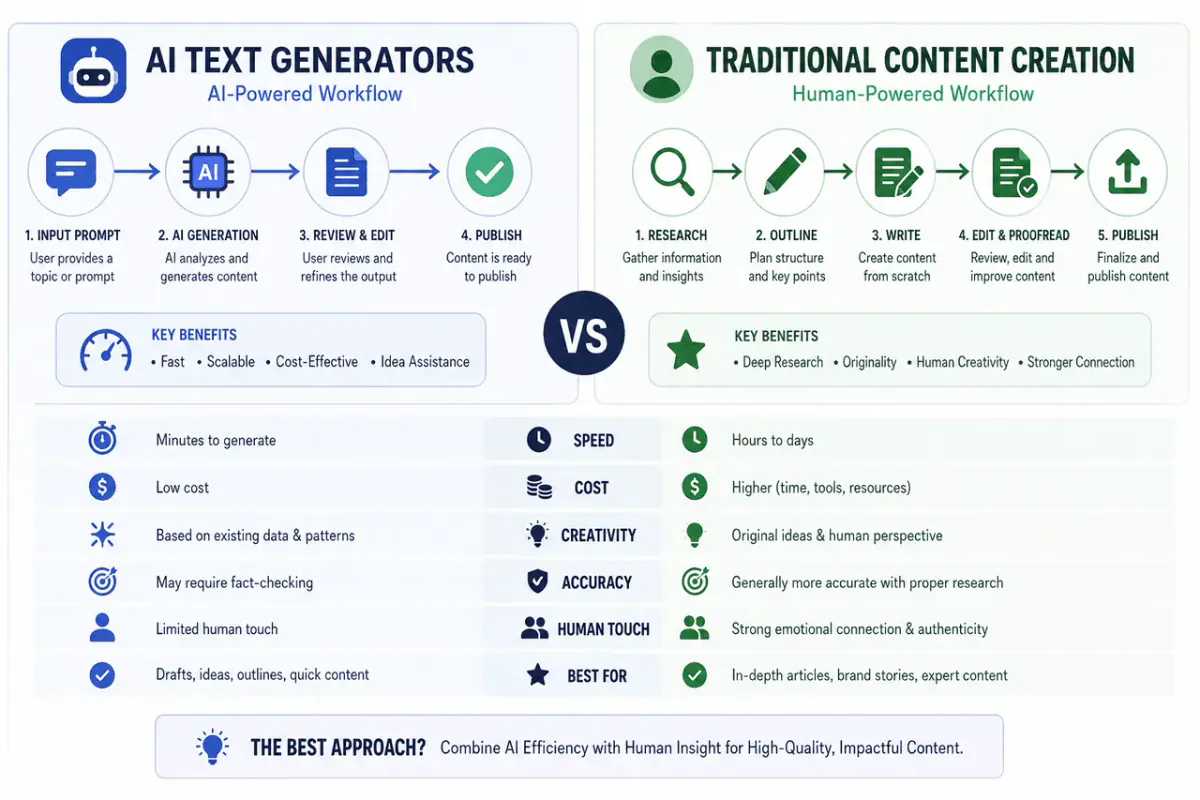
What "AI Text Generators" Actually Means Today
Modern AI text generators are large language models trained on enormous datasets of text, capable of producing coherent, contextually relevant writing on almost any topic. They range from general-purpose assistants to specialized platforms built for marketing copy, technical documentation, or SEO-optimized blog content.
What sets today's tools apart from earlier generations of "spinning" software is depth of understanding. Rather than shuffling synonyms, current models can maintain tone, structure arguments, and adapt to a brand's voice when given sufficient guidance. That said, they still require human oversight to verify facts, ensure originality, and align output with strategic goals.
What "Traditional Content Creation" Means
Traditional content creation refers to the human-led process: research, outlining, drafting, editing, and publishing, typically involving writers, subject-matter experts, and editors. This method has historically been the gold standard for authoritative, brand-aligned, and emotionally resonant content — but it comes with higher time and labor costs.
Head-to-Head Comparison
1. Speed and Output Volume
AI text generators win decisively on raw speed. A well-prompted tool can produce a 1,500-word draft in under a minute, compared to hours or days for a human writer working through research and revisions. For businesses that need to scale content production — product descriptions, social captions, or high-volume blog calendars — this speed advantage is often the deciding factor.
Traditional creation, however, still leads when a single piece requires deep original research, exclusive interviews, or nuanced investigative work that no dataset can substitute for.
2. Quality and Nuance
This is where the comparison gets more balanced. AI-generated drafts tend to be grammatically sound and structurally logical, but they can lack a distinct voice, deep subject expertise, or genuine storytelling nuance unless carefully guided. Traditional writers bring lived experience, original insight, and emotional intelligence that's difficult for a model to replicate from scratch.
This is precisely why ai generated text analysis has become a critical step in modern workflows. By running AI output through structured evaluation — checking for factual accuracy, tone consistency, redundancy, and readability — teams can catch weaknesses before publishing rather than after.
3. Cost Efficiency
AI tools dramatically reduce the cost-per-word of content production. Subscription-based platforms cost a fraction of a full-time writer's salary or a freelancer's per-word rate, making them attractive for startups and lean marketing teams.
Traditional content creation carries higher upfront costs but often delivers stronger long-term ROI for cornerstone content — pillar pages, brand storytelling, and thought-leadership pieces — where authenticity directly influences trust and conversions.
4. SEO and Discoverability
Search engines have grown more sophisticated at evaluating content quality regardless of its origin, prioritizing helpfulness, originality, and expertise over how a piece was produced. This is where ai text analytics platforms add real value: they assess keyword density, readability scores, semantic relevance, and competitive gaps at a scale no human editor could manage manually.
Traditional writers, paired with SEO specialists, can achieve similarly strong results — but the process is slower and more resource-intensive.
5. Consistency and Scalability
AI generators maintain consistent tone and formatting across thousands of pieces, which is invaluable for large content operations like product catalogs or knowledge bases. Human teams, while capable of consistency, are more prone to variation across multiple writers and over time — though this variation can also be a strength when brand voice benefits from diverse creative input.
6. Originality and Risk of Sameness
Because AI models draw from patterns in existing data, there's a real risk of generic-sounding output when multiple brands use similar tools with similar prompts. Traditional content, rooted in individual perspective and original research, tends to differentiate more naturally. This is a key reason many companies use AI as a starting point rather than a final product — running drafts through an ai content improver to inject specificity, brand voice, and unique data points before publishing.
The Hybrid Model: Where Most Businesses Are Headed
Rather than treating this as an either/or decision, most successful content strategies now blend both approaches:
- AI generates the first draft — saving hours of blank-page time and providing a structural foundation.
- Human editors refine tone, accuracy, and originality — adding expertise, examples, and brand personality.
- AI text analytics tools evaluate performance — measuring readability, keyword optimization, and engagement potential before and after publishing.
- An ai content improver polishes language — tightening sentences, correcting awkward phrasing, and enhancing clarity without erasing the human editor's voice.
- Ai generated text analysis audits final output — flagging plagiarism risk, factual inconsistencies, or AI-detection concerns before content goes live.
This hybrid approach captures the speed and scalability of AI while preserving the authenticity and strategic judgment that traditional content creation offers.
Choosing the Right Approach for Your Content Goals
The right balance depends on the type of content and its purpose:
- High-volume, low-complexity content (product descriptions, FAQs, meta descriptions): AI-first approach with light human review.
- Cornerstone and brand-defining content (case studies, thought leadership, investigative pieces): Human-first approach, with AI tools used for editing support and analytics.
- SEO-driven blog content: Hybrid approach — AI draft, human refinement, and analytics-driven optimization.
Businesses that treat AI as a collaborator rather than a replacement tend to see the strongest outcomes: faster production timelines without sacrificing the trust and quality that keeps readers coming back.
Final Thoughts
AI text generators and traditional content creation aren't really competitors — they're complementary tools serving different strengths. AI offers speed, scale, and data-driven optimization through ai text analytics, while human writers bring originality, expertise, and emotional resonance that algorithms can't fully replicate. The smartest content strategies use ai generated text analysis to catch weaknesses early and an ai content improver to refine language, combining both worlds into a workflow that's faster, smarter, and still authentically human where it counts.
Frequently Asked Questions
1. Can AI text generators completely replace human writers?
Not entirely. AI excels at speed and volume but often lacks the nuanced judgment, original research, and emotional depth that skilled human writers provide, especially for high-stakes or brand-defining content.
2. What is an ai content improver, and how is it different from a text generator?
An ai content improver refines existing text — improving clarity, tone, grammar, and flow — rather than generating content from scratch. It's typically used as an editing layer after a draft (human- or AI-written) already exists.
3. How does ai text analytics help with content strategy?
Ai text analytics tools evaluate large volumes of content for readability, keyword performance, sentiment, and structural quality, helping teams identify what's working and where to improve at a scale manual review can't match.
4. Is AI-generated content bad for SEO?
Not inherently. Search engines evaluate content based on quality, helpfulness, and originality rather than how it was produced. Poorly edited or generic AI content can underperform, but well-refined AI-assisted content can rank just as well as traditionally written content.
5. What role does ai generated text analysis play in avoiding plagiarism or inaccuracies?
Ai generated text analysis tools scan AI output for factual errors, unoriginal phrasing, and potential plagiarism risks, giving editors a critical checkpoint before publishing.
6. Is a hybrid approach more expensive than using AI alone?
It typically costs more than a pure AI workflow but significantly less than fully traditional content creation, while often delivering higher quality and stronger long-term engagement than either method alone.
7. Which industries benefit most from AI text generators?
E-commerce, SaaS, and media companies with high content volume needs (product descriptions, help articles, social content) tend to benefit most, while industries requiring deep expertise — like legal, medical, or financial advisory content — should lean more heavily on human-led creation with AI support for editing and analytics.